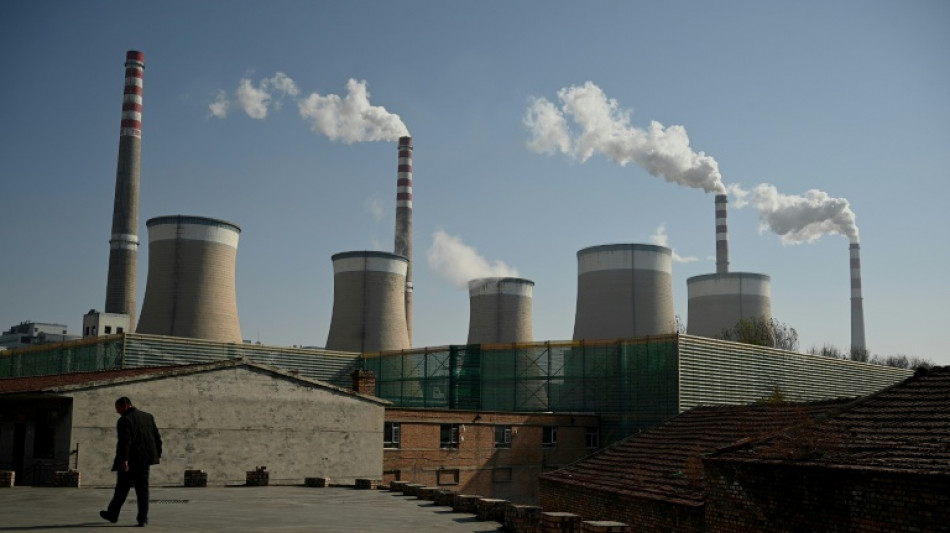
In China, climate litigation starts with the state / Photo: Noel Celis - AFP/File

 Ed Sheeran set to return to stage after Palestinian controversy

 Toulouse edge Vannes, Lyon beat Pau to take Top 14 summit

 Germans arrested for Louvre stunt in Mona Lisa hall

 Saudi-led coalition says Houthis fired ballistic missile at Riyadh

 France's debt climbs to highest since 1978: ministry

 McIlroy two shots off the lead at Wentworth after eagle on 18
 Martinez brace saves Inter in Serie A top-two clash with Roma

 Rosenior abused but guides Paris FC past old club Strasbourg

 Seven-try Lyon beat Pau, climb to Top 14 summit

 Brighton defeat a 'big lesson' against complacency for Arsenal, says Arteta

 Thousands protest inaction over climate crisis in Switzerland

 Carapaz out of cycling world championships

 'Fragile' Tottenham beaten by Aston Villa despite late rally

 Mourinho hails Real Madrid grit before Atletico derby clash

 Martin wins Austrian MotoGP sprint after Acosta crash

 Japan edge Fiji to win Pacific Nations Cup

 Black smoke, flames rising near Riyadh airport: residents to AFP

 UK actor Naomi Watts honoured at Spain film festival

 Japan emperor declares Asian Games open after turbulent build-up

 Asian Games open with unity message after troubled build-up

 Denmark hails 'binding' Greenland deal with Trump

 We don't want Games host Japan losing money, says Asian Olympic official

 Ed Sheeran returns to stage after Palestinian controversy

 Asian Games to open in Japan after troubled build-up

 Drone owners rush to offload devices ahead of Beijing ban

With thousands of dedicated courts and more than a million recent cases, environmental and climate litigation is booming in China, but it often looks different to the trend seen elsewhere.
Instead of a movement led by activists and NGOs, in China climate litigation is dominated by state prosecutors seeking to enforce existing regulations, rather than encourage government climate ambition.
Globally, domestic and international courts have become a new arena in the fight to pressure governments on climate.
Perhaps their most high-profile win came in July at the International Court of Justice, where countries were told they had a legal duty to tackle climate change.
In China though, cases tend to focus on regulatory enforcement and NGOs and activists are largely shut out.
"Courts in China use climate change provisions scattered across various laws and regulations to implement climate policy, rather than bring about policy changes," said Zhu Mingzhe, a legal scholar at the University of Glasgow.
Though many cases "are conducive to climate change mitigation... they don't deal with climate change directly".
China is the world's biggest greenhouse gas emitter, and will determine the planet's climate change trajectory.
Ahead of the COP30 climate talks next month, President Xi Jinping outlined China's first-ever emission targets, pledging to reduce greenhouse gases by 7-10 percent within a decade.
- 'The law grows teeth' -
Those figures fall short of what experts say is needed, but there is little chance they will be challenged in court.
Instead, "the courts and prosecutors make sure the law grows teeth", Boya Jiang, a climate lawyer at ClientEarth in Beijing, told AFP.
A decade ago, local authorities might have escaped sanction for skirting environmental obligations if they achieved economic growth.
Now, "they will be brought to court and there will be severe punishments", said Jiang.
"Companies also have to really consider environmental impacts."
Between 2019 and 2023, courts resolved more than a million cases, according to Chinese state media, up almost 20 percent from the previous five-year period.
China probably has the most comprehensive and "systematically established mechanism" for environmental justice, said Jiang.
And support for bringing cases is widespread, with the central government empowering prosecutors and public opinion in favour, said Lu Xu, a legal scholar at Lancaster University.
"If there is anything that is 'politically correct' for all audiences in China, this is it," he told AFP.
In 2020, for example, prosecutors in Huzhou, eastern China, won a public interest case against a company that had used Freon, a banned ozone-depleting substance and potent greenhouse gas. It was ordered to pay compensation.
Lawsuits on such substances are officially designated "climate change cases", making it the "first public interest litigation on climate change initiated by prosecutors", according to ClientEarth.
And last year, a court concluded that a power generation company's failure to meet carbon trading obligations violated China's climate mitigation goals and people's environmental rights.
- NGOs largely sidelined -
More than 95 percent of potential cases are settled before reaching court though, with the mere threat of litigation an effective enforcement mechanism.
NGOs meanwhile are only bit players, who cannot sue the government or officials.
They can however challenge private and state-owned firms, and in 2017 one of China's oldest environmental NGOs, Friends of Nature, accused state-owned companies of unnecessarily curtailing wind and solar power in favour of more polluting output.
One case was settled in 2023, with the state grid promising to invest in increasing renewable energy on the grid. The second is yet to conclude.
One environmental lawyer serving at an NGO concedes state prosecutors wield more power, but said other actors still play an important role.
Prosecutors will sometimes "consider some local economic interests and pressures, so they don't want to sue", the lawyer, who wished to remain anonymous due to the potential risk to their organisation, told AFP.
NGOs "may be more detached, so we can bring the case".
China's new Ecological and Environmental Code, expected to come into force in 2026, and climate law in the works for nearly a decade, could open the way for broader ambition cases, said Jiang, though it might not pass for up to five more years.
A.O.Scott--AT