Next in Putin's sights? Estonia town stuck between two worlds / Photo: STR - AFP

 Tech jitters lead stocks lower, oil surges then slides
 Wild West Wing? Turmoil revives memories of Trump 1.0

 Tap water no longer drinkable near South Africa capital
 Arsenal coach Arteta always a leader, says former teammate Gnabry

 Investors pledge 230 billion euros at German summit: Merz
 Emery adamant injuries 'no excuse' for Aston Villa
 UN demands aid access to besieged Yemen city Taiz
 Faletau still in Tandy's plans despite being left out of Wales squad

 Stock markets retreat as oil rises again

 Those who profited from fund scandal 'identified': Turkish minister
 At half a century, Senegal's Orchestra Baobab bets on new generation

 O'Connor, Sivakov join Seixas at Decathlon CMA CGM
 Faletau left out of Wales squad for Nations Championship
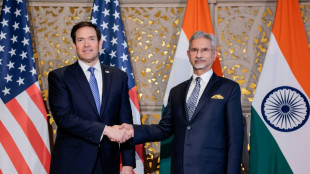 Rubio says India diversifying oil, trade deal 'very close'
 Agrograde Introduces AI Optical Sorter for Arecanut Processing

 CNN Global Perspectives to Make Middle East Debut in Doha

 Doha Debates Examines Who Should Set the Moral Rules for AI
 Qatar Amir and Singapore Prime Minister Expand Bilateral Cooperation

 Cali Biodiversity Fund Struggles After Raising Only $7,085

 Yan Diomande Finds Form Before Real Madrid Faces Former Club Leipzig
 Asian Technology Shares Slide as Investors Reassess AI Boom
 Marco Rubio Travels to India as Trade Talks Reach Difficult Stage

 Brokerages See Eternal Extending Food Delivery and Quick-Commerce Gains
 Gold Remains Under Pressure as Energy Inflation Clouds Rate Outlook
 Richard Riehle, Prolific Film and Television Actor, Dies at 78

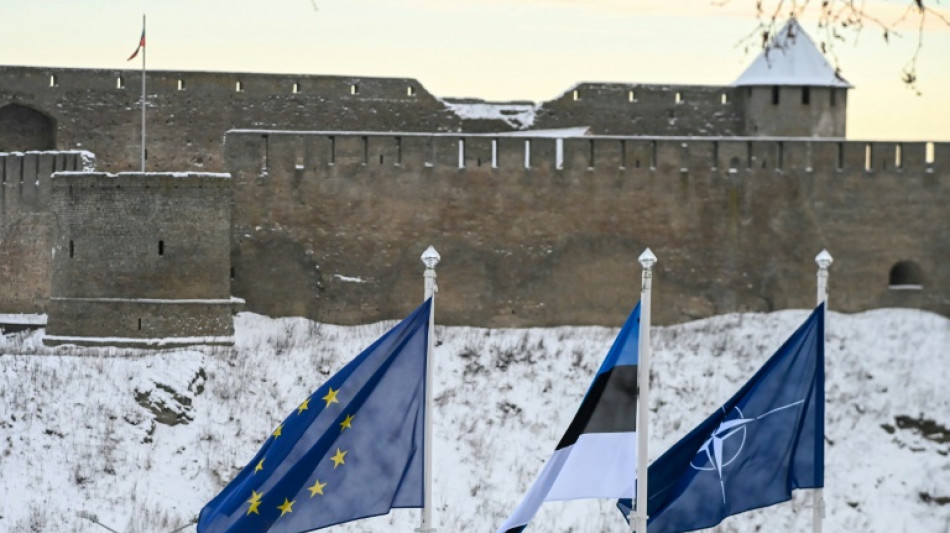
Two medieval fortresses face each other across the Narva River separating Estonia from Russia on Europe's eastern edge.
Once a symbol of cooperation, the "Friendship Bridge" connecting the two snow-covered banks has been reinforced with rows of razor wire and "dragon's teeth" anti-tank obstacles on the Estonian side.
"The name is kind of ironic," Eerik Purgel, the regional border chief, told AFP in the Russian-speaking town of Narva.
Some fear the border town of over 50,0000 people -- a mixture of Estonians, Russians and people left stateless after the fall of the Soviet Union -- could be Vladimir Putin's next target.
On the Estonian side of the bridge, the NATO flag flutters in the wind beside those of Estonia and the European Union.
People in cars used to queue up to cross the Narva River to go shopping and see relatives in Russia. But today the crossing is closed to traffic and travellers pull their luggage across on foot.
"Maybe there should not be a bridge at all," said Purgel.
As Moscow's war against Ukraine approaches its fourth anniversary, the mood in Narva is gloomy.
"Here at the edge of Europe the war feels different," said mayor Katri Raik. "We see Russia across the border every day.
"We're all thinking about what comes next," she added inside a freshly renovated 17th-century town hall, surrounded by drab Soviet-era buildings.
- 'Most difficult period' -
Since the Russian invasion of Ukraine in 2022, Estonia -- along with the fellow Baltic nations of Latvia and Lithuania -- has reinforced its defences.
Estonia's army is tiny. The defence ministry says a force of just under 44,000 people can be deployed to defend the country if necessary, alongside around 2,000 troops from allied NATO countries in the country.
The Estonian authorities have also sought to enhance national security with other measures. They have stripped Russians and stateless residents of the right to vote in local elections, and are switching to teaching in Estonian in dozens of schools.
Those reforms have hit Russian-speaking Narva hard.
The changes, combined with high unemployment, soaring energy bills, a collapse in ties with Russia and fear of conflict, have heightened tensions in the border town.
"This is the most difficult period in our history in about 40 years," said Mihhail Stalnuhhin, chairman of the town council, denouncing policies targeting Russian speakers.
"It's compounded by the constant talk of war, war, war, war, war. People are going through a very difficult moral, economic and social situation."
- Russian passports -
In Narva, around half of all residents are Estonian, a third hold Russian citizenship, and roughly 7,000 people are stateless.
Strategically located, the town has in past centuries been ruled by the Danes, Germans, Russians, Swedes, and Estonians.
Much of the historic baroque Old Town was destroyed during World War II, and under Soviet rule Narva became predominantly Russian-speaking.
Thirty-five years after Estonia won independence, Narva is still struggling with its sense of identity.
Vladimir Aret, a 32-year-old hotel manager and member of the town council, said many in Narva felt caught between two worlds.
"I am European, but we sometimes joke that we do not understand what our homeland is," he said.
While many -- including Aret -- call themselves Estonian patriots, some praise Putin.
Some people in Narva speak only Russian. They watch Russian television and are nostalgic for the Soviet past.
- 'Russophobic madness' -
Russia regularly rails against the Estonian government.
Russia's foreign ministry slammed "Estonia's growing Russophobic madness" and the authorities' "neo-Nazi" policies in a report released in December.
The ministry, in its report on the rights of Russians abroad, also said that the large number of stateless people in Estonia was a major problem.
Some back the Moscow view.
"We, Russian speakers, are being discriminated against," a woman in her mid-50s said in Narva on condition of anonymity for fear of reprisal.
Olga Kolesnikova, a stateless 64-year-old, disagreed.
"I don't feel disadvantaged," said the retired baker, adding that three of her four children were Estonian citizens.
Aleksandr Gruljov, a 59-year-old construction worker, said he was even considering giving up Russian citizenship.
"Nobody is oppressing anyone here," he added.
- 'Perfect gateway' -
But German political scientist Carlo Masala said depriving Russian citizens in Estonia of the right to vote in local elections was "a perfect gateway for Russian propaganda".
As in Donbas in eastern Ukraine, "Russia can argue that the rights of its minorities living abroad are under threat, providing a reason to protect them, if necessary by military means," he told AFP.
In his best-selling book "If Russia Wins: A Scenario", he imagines Russian troops capturing Narva in 2028 in order to launch a broader attack on the Baltic States and trigger a possible collapse of NATO.
Under such a scenario, Russians troops would conquer Narva within hours, aided by "parts of the local civil population," who would be supplied with small arms and machine guns ahead of the assault.
Masala told AFP several other cities with sizable Russian communities including Kirkenes in Norway and Daugavpils in Latvia could also be vulnerable to a possible Russian attack.
Russia's invasion of Ukraine has cast the political sympathies of Estonia's Russian-speaking population into the spotlight.
"Will they support the state in the event of war, possibly against Russia?" asked a 2023 study of the country's Russian-speaking minority.
According to its findings, 65 percent of Estonia's Russian speakers said they were "rather or definitely patriots of Estonia," whereas 28 percent said that they were "rather or definitely not."
- 'We are ready' -
Jelisei Solovjov knows where his loyalties lie.
The 18-year-old fatigue-clad member of the Kaitseliit, a voluntary national defence organisation, already knows how to dig trenches and shoot.
"We are ready to defend our country, we are not afraid," he said.
Masala, the analyst, said that Narva today resembled a "fortress."
"This would make military action much more difficult than it would have been a few years ago."
Estonian border chiefs dismiss the idea that Narva is particularly vulnerable to a Moscow assault.
Egert Belitsev, the head of the country's border service, said Berlin also had a large Russian population.
With such a pretext, "you can also invade Berlin," he said.
Back at the Narva border crossing, Purgel was defiant.
"It's our town, we will protect it with our lives," he said.
W.Nelson--AT