As Estonia schools phase out Russian, many families struggle / Photo: STR - AFP

 Martin wins Austrian MotoGP sprint after Acosta crash

 Japan edge Fiji to win Pacific Nations Cup

 Black smoke, flames rising near Riyadh airport: residents to AFP

 UK actor Naomi Watts honoured at Spain film festival
 Japan emperor declares Asian Games open after turbulent build-up

 Asian Games open with unity message after troubled build-up
 Denmark hails 'binding' Greenland deal with Trump

 We don't want Games host Japan losing money, says Asian Olympic official
 Ed Sheeran returns to stage after Palestinian controversy

 Asian Games to open in Japan after troubled build-up
 Drone owners rush to offload devices ahead of Beijing ban

 Trump's beef policies irk Texas ranchers, testing their loyalty

 Kennedy Center: future unclear for iconic Washington arts hub

 Trump claims 'infinite' Greenland security deal with Denmark

 Helicopters battle wildfire threatening Ecuador's capital

 Brentford batter Chelsea to undo Alonso's promising start
 Kane hits Bundesliga century as Bayern rout Union
 Trump says CNN, MS NOW, Politico banned from White House
 Hushing and hedging: US companies retreat on climate

 Springboks to face Fiji before 2027 Rugby World Cup
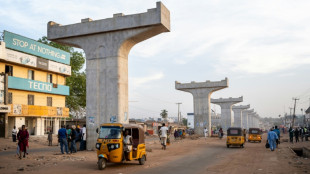 Nigeria miners struggled to breathe in cell before 37 died: survivors

 McIlroy on the charge at PGA Championship as Reed withdraws

 McIlroy on the charge at PGA Championship

 Crisis-wracked Volkswagen warns of 10-bn-euro hit to profits

 Costa Rica's Grynspan tops third informal poll for UN chief: diplomat

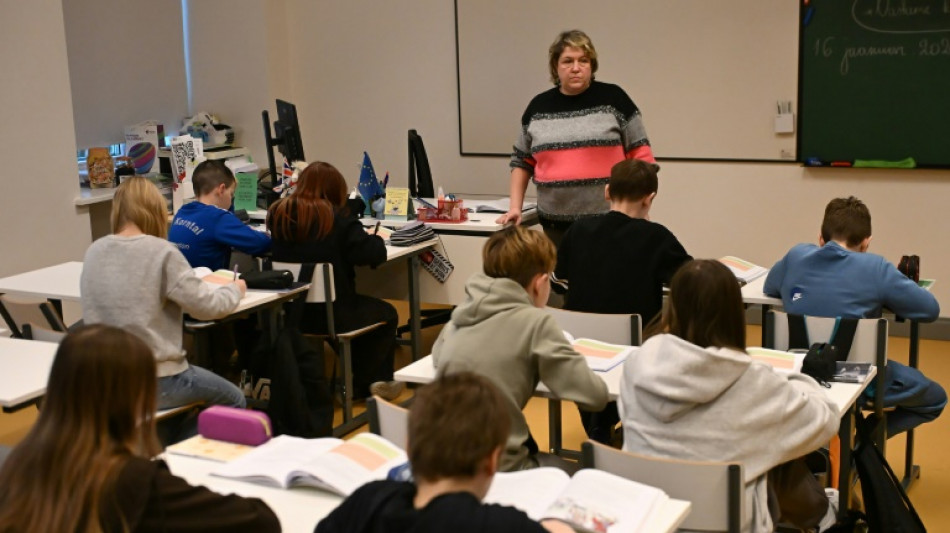
When Estonian mother Jelizaveta Ponomarjova's elder daughter started fourth grade in September, she did not understand what her teacher was saying.
For the first three years of primary school, 10-year-old Tasja had been taught in Russian.
Then, in the fourth grade, classes began in Estonian, which has a reputation for being one of the world's most difficult languages.
"Mum, I don't understand anything," Tasja would say. "Our teacher speaks only Estonian."
The first two weeks were especially tough, the 30-year-old mother of two told AFP in Estonia's Russian-speaking town of Narva.
Parents in a school group chat complained of similar experiences, with some children coming home in tears and almost refusing to go back to school, Ponomarjova added.
In 2024, Estonia began phasing out Russian as a language of instruction in dozens of schools, a legacy of decades of Soviet rule.
Under the long-mooted reform adopted in 2022, after Vladimir Putin invaded Ukraine, the transition to Estonian began in kindergartens and first and fourth grades.
Neighbouring Latvia has launched a similar reform.
Moscow accuses both countries of discriminating against Russian speakers.
- 'Gradual process' -
Estonian authorities say the reform is aimed at better integrating Russian-speaking children and fostering social cohesion.
"This is the final step in a long and gradual process that was set in motion after Estonia regained its independence," the education ministry told AFP. "Language-based segregation causes division in society."
But some politicians say the language transition has been poorly thought out. As a result, many pupils and their parents are struggling, especially in Narva.
Arina Manzikova, a mother of four, says teachers have been supportive but she still worries about her seven-year-old daughter Anja's future.
The 43-year-old knows Estonian and helps her daughter with her studies, but the first grader confuses Russian and Estonian letters.
"She doesn't understand what she's reading," said Manzikova. "I'm very concerned that her knowledge and education level will be very low."
She said people who live in Estonia should speak Estonian.
"But I think that some basic knowledge, such as mathematics, should be taught in one's native language."
- 'Lost generation' -
Ponomarjova said that while things have improved for her daughter, problems remain.
"My daughter doesn't understand maths -- just because it's being taught in Estonian," she said.
She believes Tasja is not very gifted with languages. It took her several years, she says, to learn to say "mulle meeldib" -- "I like" in Estonian.
Her daughter's eyes light up when she speaks of Russia and how children are taught in Russian there.
"She says she would really like to go there," Ponomarjova said.
Lawmaker Aleksei Jevgrafov said his Centre Party voted against the reform.
"Residents of Estonia must know the state language, it's a given," Jevgrafov, who represents Narva in the Estonian parliament, told AFP.
But he argued that the transition was launched in haste, pointing to a shortage of teachers, as well as teaching guides and materials.
"The government was not interested in whether schools were ready, if teachers were ready, if children were ready," said the former mayor of Narva.
"I would agree with many experts who say children who have been caught up in the grinding wheels of this reform risk becoming a lost generation," he said.
But Anna Zubova, who heads one of the schools in Narva, is optimistic.
Russian-born Zubova did not speak a word of Estonian when she herself graduated from school decades ago but is now fluent. She expects children to gradually adapt.
"Of course there are difficulties," she said. "Step by step, year by year, things will become easier."
- 'Horrible' -
To help families, the school administration has eliminated homework in Estonian for a number of subjects including history.
"I'm very happy that this transition is happening," Zubova said.
Zubova's deputy in charge of the transition, Kairi Jurgens, praised parents for helping their children and learning the language together with them.
"They are trying," she said.
Mihhail Stalnuhhin, the tough-talking head of the Narva city council, argues that the language reform should not have happened at all.
Stalnuhhin headed a parliamentary commission on the development of the Estonian language between 2019 and 2023.
He accused the authorities of choosing "the easier path".
The government, he said, should have allowed Russian speakers to study in their native language. And the teaching of Estonian should have been improved to give such children a better chance in life, he added.
Stalnuhhin said he had heard complaints from many distressed parents, adding that some hired tutors to help their children.
"They're desperate, it's horrible," he told AFP.
He worries Russian-speaking children will not be able to compete with Estonian peers in the job market and become "social outcasts".
- 'Need time' -
Helna Karu, in charge of the language transition at the education ministry, acknowledged "challenges" but said the transition "is working".
"With a reform of this scale, it is not realistic to plan every activity in full detail in advance," she added in written comments.
"Both children and parents need time before the results become fully visible."
But some parents are not convinced.
Irina Rozkova, a mother of three, said vulnerable children like her autistic son Alexander were hit the hardest.
The teenager is now in seventh grade and does not speak Estonian. "Even 'tere' (hello) and 'head aega' (goodbye) didn't stick," she said.
She fears that even vocational training might be out of reach for him now.
"I dread to think what comes next," she added.
A.Williams--AT