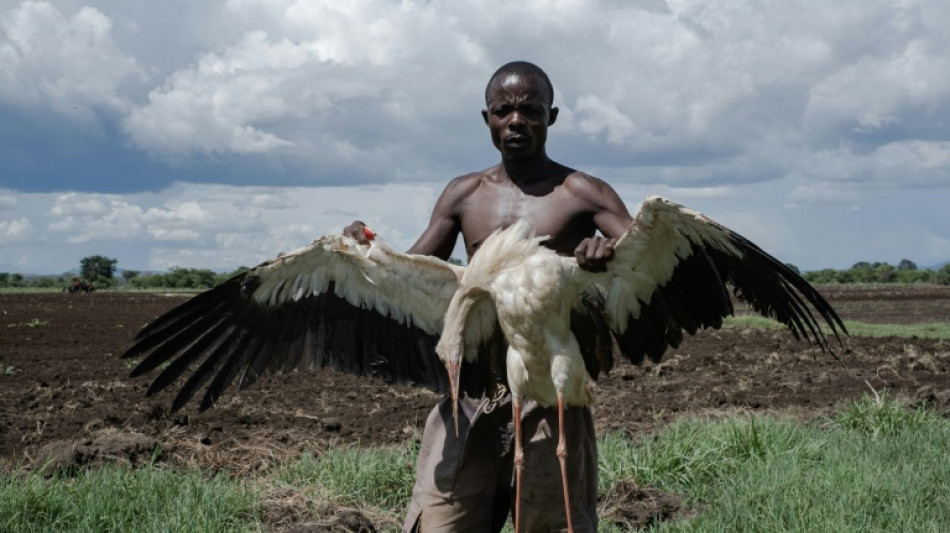
Ugandans kill migrating storks in desperation for food / Photo: Badru Katumba - AFP

 Drones hit Moscow as Russians go to the polls

 New England boss Fleming says 'wrong' to ask Stokes to end retirement

 Germans vote in elections threatening fresh blow to Merz

 US fears rapid escalation in Mideast after Houthis attack Riyadh

 Japan triathlete Hojo wins first gold of Asian Games

 IOC president impressed by 'beautiful' Asian Games wooden huts

 First Asian Games gold goes to Japan as China's 13-year-old Yu lights up pool

 Data centre command hub keeps AI up and running

 Pope Leo in France: the issues on the table

 Packing for a pope: behind the scenes on foreign trips

 Republicans find transgender issues a powerful political weapon in midterm campaigning

 German state elections threaten new shock waves for Merz

 Chile's Bachelet quits race to be next UN chief

 Raphinha treble fires perfect Barca to win at Sevilla

 Thiam makes winning heptathlon return at Decastar meet

 Czechs beat USA to qualify for Davis Cup finals

 Dortmund sink Stuttgart to climb to Bundesliga summit

 Trump says will not tolerate attempts to slow AI growth

 'It has to stop': runners protest women's murders in S.Africa district

 Fire erupts near Riyadh airport as Houthis claim strikes

 Cuba works to restore power after another blackout

 England thrash Sri Lanka again to return to top of T20 rankings

 Arsenal thrashed by Brighton, sorry Spurs lose again

 South Korea, Austria qualify for Davis Cup finals

 Seare shocks Ingebrigtsen to win world 5km gold

Desperate Ugandans are using poison to kill thousands of migrating white storks and other protected birds because they have so few sources of food.
In Ayoreri, a village on the Kenyan border, Sam Chekwoi, 42, said unpredictable rains and droughts have made it increasingly hard to feed his two wives and 11 children.
"I used to farm but the sun would destroy my food crops. That is when I decided to start catching those birds to provide food for my children and myself," he said.
He showed AFP how locals hunt their prey.
First they catch a mouse and kill it, then pour a mixture of alcohol and rat poison into its mouth and leave it in the field for a bird to spot.
The birds swoop down and quickly feel the impact of the poison. They try to fly away but cannot get very far and the villagers chase them down to finish the kill.
"When the birds eat the trap, they get weak, we catch them, kill them, and then eat them," said Chekwoi.
He estimates he has eaten upwards of 300 storks since moving to the area in 2016.
"If there was an alternative, I would do it," said Chekwoi.
The activity risks heavy fines but locals feel they have no choice.
- 'Only source of protein' -
Joel Cherop, 45, a farmer and conservationist, grew up in the area and is trying to discourage the practice.
He estimates that some 3,000 white storks have been eaten by villagers since the start of the year when the migrating season began.
Cherop described the birds as the "only source of protein" for many in the area. They can sell a stork for around 2,000 shillings or less than a dollar, he said.
He has monitored the birds over the years and knows from tagging that some came from Poland, Czech Republic and Hungary.
Although the nomadic communities in the region have degraded the land by cutting down too many trees for charcoal, Cherop empathises with their difficulties, especially the worsening droughts.
"There is no doubt that crop failure tops the agenda in this community for the last 10 years," he told AFP.
It feels particularly unfair, he said, to think that climate change is the result of industrial practices elsewhere in the world -- "the Americas, the Russias and the Chinas who are emitting billions of (tonnes of) carbon."
Cherop has started planting thousands of fruit trees around his farm in a bid to regenerate the land and is employing as many locals as he can with his limited means.
He says the local villagers are simply trying to survive.
"These are hungry young people who have no food, so they found an alternative in the migratory birds," he said.
A.Williams--AT



