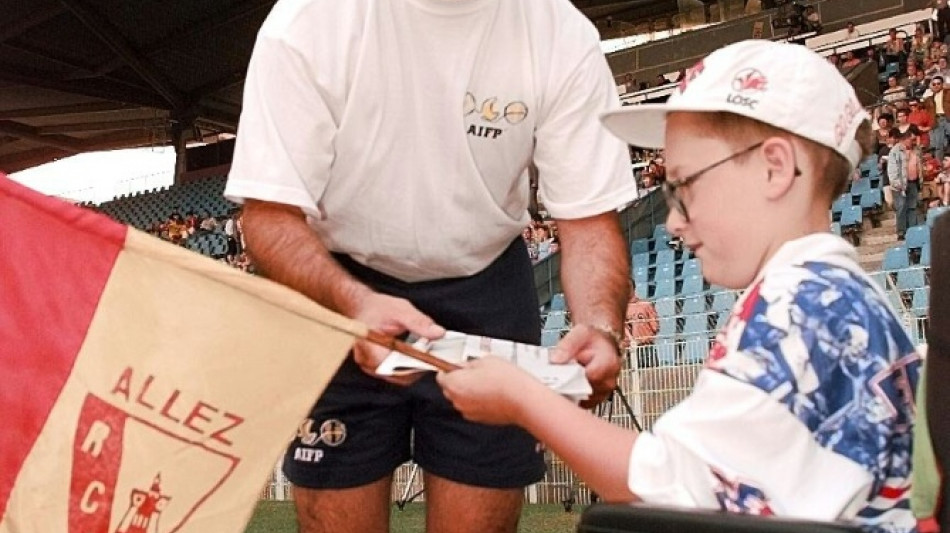
Decades after Bosman, football's transfer war rages on / Photo: PHILIPPE HUGUEN - AFP

 Pope visits San Marino, before addressing Italian political gathering

 Trump tariffs heap up as Canada tries to curb US reliance

 Australia lose three wickets after skittling Bangladesh for 64

 Bangladesh all out for 64 in 2nd Test after Starc masterclass

 Odyssey effect: stars sell Greece to a new wave of US tourists

 South Korea to send first container ship through Arctic route

 Starc takes 5-11 to leave Bangladesh reeling in 2nd Test

 Injured Rune withdraws from US Open

 Nakashima knocks out Fritz to reach Cincinnati semi-finals

 Ukraine says 'cynical' Russian strike on shopping centre killed 16
 TikTok to pay $400 mn settlement in US children's privacy case

 MLS fines Messi for striking an opponent

 Gouiri double fires Marseille past Strasbourg in Ligue 1 opener

 Mavericks buy out Thompson, now reportedly bound for Heat

 England v Pakistan first Test: Three talking points

 US, Canada push to seal trade deal as deadline nears

 One dead, three wounded after sword attack at Swedish high school

 Ukraine says 'cynical' Russian strike on shopping centre killed 15

 US Supreme Court allows White House ballroom construction for now

 Root hails emerging fast bowlers as England thrash Pakistan

 Brazil's Lula urges tariffs resolution in call with Trump
 Ukraine says 'cynical' Russian strike on shopping centre killed 14

 Heatwave-hit Europe logs over 30,000 excess summer deaths: first figures

 Give LIV Golf 'one more shot,' says DeChambeau
 Duplantis hits the high notes for athletics anthem

Thirty years after the European ruling on the case of Jean-Marc Bosman transformed football's economic landscape, the sport is still wrestling with the legal fallout.
The latest chapter is the result of a ruling by the European Court of Justice (ECJ) in 2024 in favour of former France midfielder Lassana Diarra which has spawned a potential collective suit by players' unions that could cost football authorities "billions of euros", a lawyer representing them told AFP.
Bosman changed Europe's playing field. On December 1995, the ECJ ruled in favour of the Belgian midfielder who had sued RFC Liege, the Belgian football federation and European governing body UEFA, after the club blocked his move to French side Dunkerque in 1990.
Liege said that even though Bosman's contract had run out, they wanted a transfer fee.
The decision created free agency in football -- and more. The ECJ also ruled that leagues in the European Union could not place limits on players from other EU countries.
Players and their agents quickly adapted to the new rules. Dutch internationals Edgar Davids and Michael Reiziger became the first big name free agents when they left Ajax for Inter Milan the following summer, an early signal that the ruling would accelerate the concentration of talent at Europe's biggest clubs.
The ruling came as revenues were surging in the main European leagues, particularly the English Premier League, and, perhaps not coincidentally, just before billionaire owners began buying clubs, starting with Roman Abramovich at Chelsea in 2003.
The Bosman decision has sparked a series of follow-on cases, as football wrestles over how to regulate payer contracts.
The latest action, being brought in the Dutch courts by a group called Justice for Players, against FIFA, the 28 EU national federations and the four British 'home' unions, follows the ruling in favour of Diarra, a former Chelsea, Arsenal, Real Madrid and Paris Saint-German player.
When in 2014, his club Lokomotiv Moscow attempted to cut his wages, Diarra agreed a deal with Belgian club Charleroi.
Lokomotiv demanded a fee and FIFA's transfer tribunal backed them, ordering Diarra to pay Lokomotiv 10 million euros and banning him for 15 months.
When the ECJ found in Diarra's favour, it also found, "professional football players, that had an active career in a period of more than 20 years from 2002 till 2024, and maybe still until today, have suffered damages," said Dolf Segaar, a Dutch lawyer on the board of Justice for Players.
"We have calculated that each of the players have in average suffered eight percent on their salaries," said Segaar.
For an estimated 100,000 professional players in that period "it's certainly a few billion euros," he added.
The problem is that for players who do not have a release clause, which is illegal in many European countries, "you do not know if you terminate, what exactly you will have to pay to your former club."
Segaar is trying to recruit national player unions to give his action greater credibility.
He said he hopes to go to to court "in the first quarter" of 2026.
"The process itself can take some years," he added.
Former player David Terrier leads both the French players' union, which has joined the action, and international players' body FIFPRO Europe, which has not.
"It's difficult for a lot of unions because it's directly against their federation and some unions have direct contact and agreement with their federations," Terrier told AFP.
- Rich clubs stay rich -
He said he hoped to negotiate as he had tried to do in the Diarra case.
"Lassana Diarra did not want be a Jean-Marc Bosman," said Terrier. "He said, 'I play in the national team, I play for the top clubs, and I don't want that people remember me for this case. I want the people to remember me for... what I won or lost on the pitch.'
"And FIFA never responded."
Terrier said he was mystified by FIFA's attitude -- and compared their results to those of a football club.
"If I am a lawyer for FIFA, I know that I have no chance to be qualifying as a Champions League lawyer or Club World Cup lawyer, because I have lost all the cases," he said.
Both FIFA, which responded to the Diarra judgement with "interim" rules, and European governing body UEFA refused to comment on that case, but both have released statements saying they will revise the transfer system.
Seegar, Terrier and the football bodies seem to agree on some points.
Clubs should have the right to sign their youth players to a first professional contract. Players should not be able to opt out in the first one or two years of a contract.
And clubs should receive compensation either through an agreed 'transparent' formula or through release clauses.
The system that emerges, said Seegar, "will change the economics in a certain way, but it will probably not be as disturbing as the Bosman ruling at the time was".
But, he added, "the richer clubs will remain rich. That system will not change."
T.Perez--AT