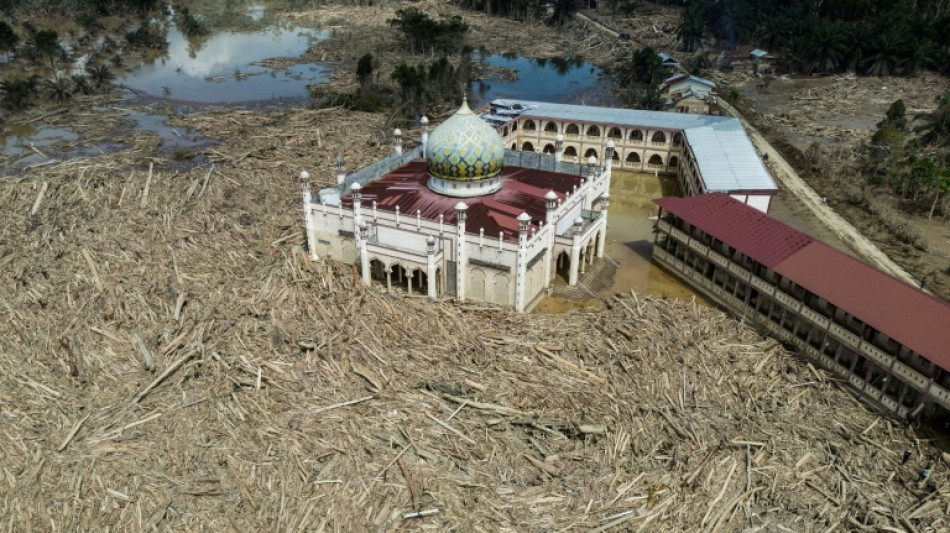
Nowhere to pray as logs choke flood-hit Indonesian mosque / Photo: Aditya Aji - AFP

 France's debt climbs to highest since 1978: ministry

 McIlroy two shots off the lead at Wentworth after eagle on 18

 Martinez brace saves Inter in Serie A top-two clash with Roma

 Rosenior abused but guides Paris FC past old club Strasbourg

 Seven-try Lyon beat Pau, climb to Top 14 summit

 Brighton defeat a 'big lesson' against complacency for Arsenal, says Arteta

 Thousands protest inaction over climate crisis in Switzerland

 Carapaz out of cycling world championships

 'Fragile' Tottenham beaten by Aston Villa despite late rally

 Mourinho hails Real Madrid grit before Atletico derby clash

 Martin wins Austrian MotoGP sprint after Acosta crash

 Japan edge Fiji to win Pacific Nations Cup

 Black smoke, flames rising near Riyadh airport: residents to AFP

 UK actor Naomi Watts honoured at Spain film festival
 Japan emperor declares Asian Games open after turbulent build-up

 Asian Games open with unity message after troubled build-up
 Denmark hails 'binding' Greenland deal with Trump

 We don't want Games host Japan losing money, says Asian Olympic official
 Ed Sheeran returns to stage after Palestinian controversy

 Asian Games to open in Japan after troubled build-up
 Drone owners rush to offload devices ahead of Beijing ban

 Trump's beef policies irk Texas ranchers, testing their loyalty

 New to The Street Broadcasts Tonight at 6:30 PM ET Across the United States, Latin America and MENA, Featuring BioVie, Acurx Pharmaceuticals, Lantern Pharma and SafeSpace Global
 Nvidia, OpenAI CEOs to attend Xi dinner at White House

 Anthropic picks Accenture for in-house AI safety evaluation
Almost two weeks on from devastating floods, Muslim worshippers in Indonesia's Sumatra who gathered at their local mosque on Friday for prayers were blocked from entering by a huge pile of thousands of uprooted trees.
The deadly torrential rains had inundated vast tracts of rainforest nearby, leaving residents of the Darul Mukhlisin mosque and Islamic boarding school to search elsewhere for places of worship that had been less damaged.
"We have no idea where all this wood came from," said Angga, 37, from the nearby village of Tanjung Karang.
Before the disaster, the mosque bustled with worshippers -- locals and students alike -- attending daily and Friday prayers.
"Now it's impossible to use. The mosque used to stand near a river," said Angga. "But the river is gone — it's turned into dead land."
Village residents told AFP the structure likely absorbed much of the impact of trees and logs carried by the torrents, preventing even greater destruction downstream.
When AFP visited the site, the mosque was still encircled by a massive heap of timber -- a mix of uprooted trees and felled logs, likely from nearby forests.
By Friday, the death toll from one of northern Sumatra’s worst recent disasters — including in Aceh, where a tsunami wreaked havoc in 2004 — had reached 995 people, with 226 still missing and almost 890,000 displaced, according to the National Disaster Mitigation Agency.
- Uncontrolled logging -
Authorities have blamed the scale of devastation partly on uncontrolled logging.
Environmentalists say widespread forest loss has worsened floods and landslides, stripping the land of tree cover that normally stabilises soil and absorbs rainfall.
Indonesia consistently ranks among the countries with the highest annual deforestation rates.
President Prabowo Subianto, visiting Aceh Tamiang district on Friday, assured victims the government was working to restore normalcy.
"We know conditions are difficult, but we will overcome them together," he said, urging residents to "stay alert and be careful."
"I apologise for any shortcomings (but) we are working hard," he said.
Addressing environmental concerns, Prabowo called for better forest protection.
"Trees must not be cut down indiscriminately," he said.
"I ask local governments to stay vigilant, to monitor and safeguard our nature as best as possible."
But frustrations were growing, with flood victims complaining about the pace of relief efforts.
Costs to rebuild after the disaster could run up to 51.82 trillion rupiah ($3.1 billion) and the Indonesian government has so far shrugged off suggestions that it call for international assistance.
Back in nearby Babo Village, Khairi Ramadhan, 37, said he planned to seek out another mosque for prayers.
"I'll find one that wasn't hit by the flood," he said. "Maybe some have already been cleaned. I don't want to dwell on sorrow anymore."
str-dsa-jhe/ceg
P.A.Mendoza--AT



