Natural pesticides gain ground in 'agri-tox' capital Brazil / Photo: Sergio Lima - AFP

 'I live in fear': 1.5 million Pakistani children sexually exploited online

 Cowboys beat Commanders, Vikings down Bears as star QBs injured

 Braves clinch division title as Red Sox reach MLB playoffs
 Bordeaux-Begles hammer Stade Francais despite Jalibert injury

 Milan and Juventus end blips with home wins

 Bridgeman wins PGA Biltmore title with sizzling 61

 Williams injured as Bears shut down by Vikings

 US warns of rapid escalation in Middle East war

 Germany's far-right AfD celebrates another state election win

 Russia vows revenge for election-day attacks as poll shows ruling party win

 Spaun late shows snatches PGA Championship win

 Conceicao strikes as Juventus beat Atalanta

 Britain, Zverev-inspired Germany, Spain complete Davis Cup finals

 Man Utd salvage Fulham draw as pressure mounts on Carrick

 Spanish civil war drama 'The Black Ball' wins at Toronto festival

 Germany's Merz shaken by far-right and far-left gains in state votes

 Macron welcomes Canada's Carney to French Atlantic territory

 Fiorentina frustrate Napoli with Serie A draw, Como upset

 Five-star Man City top Premier League after Sunderland thriller

 Ukrainian drones hit Moscow on last day of Russian elections

 Multi-Asset Trading Venue Monochrome Exchange Announces IEO of Its Native Token, $MCR

 South Korea break Japan hearts to win Asian Games basketball gold
 Acosta takes first victory at Austrian MotoGP

 PSG president Nasser al-Khelaifi under investigation in France for conflict of interest

 China swim sensation, 13, sets Games record after Japan win early

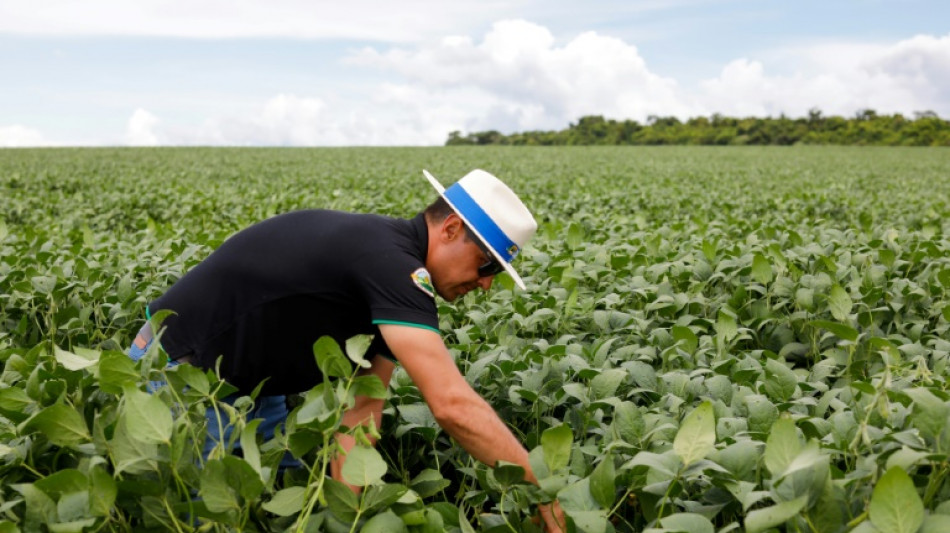
Inspecting a thriving green field, Brazilian farmer Adriano Cruvinel is beaming: Using a fraction of the chemical products he used to, he is growing even more soy, thanks to natural pesticides.
Agricultural powerhouse Brazil may be the world leader in chemical pesticide use, but Cruvinel is part of a growing trend of farmers turning to natural products known as "biopesticides."
"Our soy is doing great," says the 36-year-old agricultural engineer, giving a tour of his 1,400-hectare (nearly 3,500-acre) farm in the central-western county of Montividiu, as combine harvesters work their way across a field.
"Thanks to the microorganisms we apply to the crop, it's a lot more resistant to pests and disease."
Brazil, the world's biggest exporter of soy, corn and cotton, is also the top consumer of chemical pesticides: nearly 720,000 metric tons in 2021, or one-fifth of global sales, according to the UN's Food and Agriculture Organization.
Seeking to improve his profits, in 2016 Cruvinel started transitioning toward so-called "regenerative" agriculture.
The technique seeks to restore the soil's biodiversity, replacing chemical fertilizers and pesticides with natural alternatives.
He still uses genetically modified soy, widespread in Brazil. But near those fields he built an ultra-modern laboratory and factory.
Inside, refrigerators conserve fungi and bacteria, some harvested from forestland on his farm.
He cultivates them en masse in vats, then uses them to treat his fields.
"Here, we imitate nature on a giant scale," says Cruvinel, who has replaced 76 percent of the chemical pesticides he formerly used with natural products.
The approach is good for health and the environment, but also business: His production costs have fallen by 61 percent, while his soy yields have risen by 13 percent, he says.
- 'Long way to go' -
Natural pesticides "could revolutionize Brazilian and global agriculture," says Marcos Rodrigues de Faria, a researcher at Embrapa, Brazil's public agricultural research agency.
But "there's a long way to go," he adds.
Brazil still relies heavily on chemical pesticides, known here as "agrotoxicos," or "agri-toxic" products.
Natural products grew from four percent of total pesticide sales in Brazil in 2020 to nine percent in 2022.
Their use has expanded four times faster in Brazil than internationally, says Amalia Borsari, of CropLife Brasil, an organization representing the agricultural chemicals industry.
"There has been exponential growth," she says.
Geographer Larissa Bombardi, an expert on pesticide use in Brazil, calls the trend "interesting."
But she says it is not yet changing Brazil's dominant model of massive, land-intensive mono-crop agriculture, which leaves little room for small-scale producers or more environmentally friendly practices.
"The surface area of land under cultivation in Brazil increased by 29 percent from 2010 to 2019, while pesticide use increased by 78 percent," she says.
- 'Gift to agribusiness' -
The agribusiness sector accounts for nearly a quarter of Latin America's biggest economy, making the pesticide debate politically charged.
After a long standoff with Congress, where agribusiness interests are a powerful force, President Luiz Inacio Lula da Silva signed a bill into law in December softening regulations on agricultural chemicals.
The veteran leftist used his line-item veto to block some controversial aspects of the bill. But the final text significantly lowered the bar for regulatory approval of new pesticides, drawing scathing criticism from environmentalists.
Chemicals that can cause cancer and mutations or harm the environment are no longer automatically banned -- only those found to represent an "unacceptable risk."
Bombardi calls the law a "tragedy" and "a gift to the agribusiness and agricultural chemicals industries."
The stakes go beyond Brazil.
The country's massive use of pesticides is one of the main objections voiced by opponents of a landmark trade deal between the European Union and South American bloc Mercosur, in which Brazil is the biggest player.
D.Lopez--AT