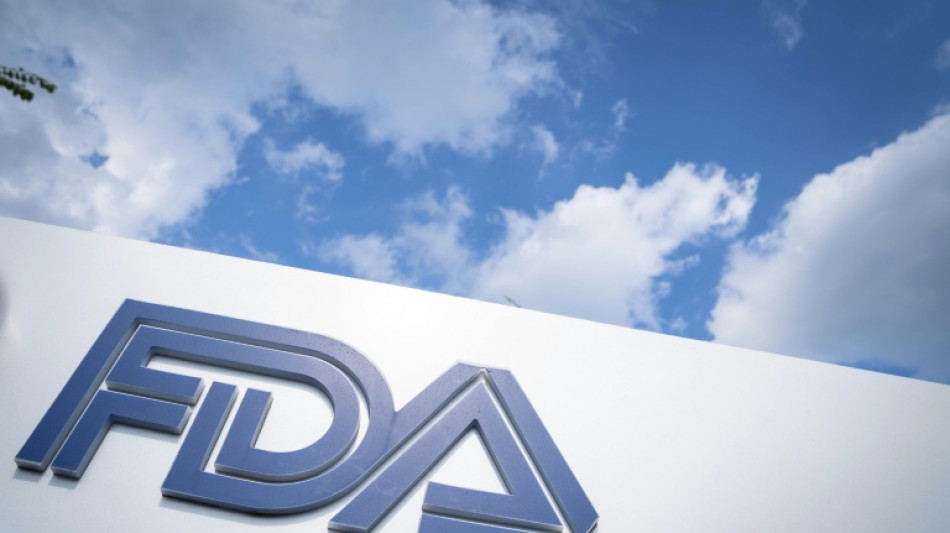
US panel says to loosen restrictions on popular peptide despite safety concerns / Photo: Sarah Silbiger - GETTY IMAGES NORTH AMERICA/AFP

 Iran proposes Hormuz plan, Trump reportedly refuses

 El Nino rewrites the menu in the world's top restaurants
 Pope to hold giant mass on Champs-Elysees

 TikTok to pay Alabama $100 mn under pre-trial settlement

 Internationals take 7-3 Presidents Cup lead after foursomes sweep

 Brazil team returns to Colombian site of doomed jet crash

 Mbappe injured as Zidane wins on France debut, Italy lose on Mancini return

 Senegal draw in Vieira debut, Nigeria survive scare as Cape Verde crash

 U2 performs surprise 50th anniversary gigs in Dublin

 Pope calls worshippers 'saints of France' after AI warning

 US court sides with Pentagon in Anthropic AI ban

 Wall Street stocks rise, greeting optimism over possible US-Iran deal

 NFL players chief raises concerns over pitch for Maracana game

 Daytime Russian attacks kill seven in Kyiv
 Spotting AI writing: how reliable are the detectors?

 French youth await pope after AI 'paradise of machines' warning

 Man City found guilty of Premier League charges, set to appeal: reports

 Embolo follows Xhaka out of Swiss squad over fake Covid documents

 Trump, Xi inspect founding documents of US democracy to close summit

 'Bottle Claus': Kipchoge's 'hero' helping runners chase Berlin marathon glory

 Olympic medallist Samba-Mayela handed provisional doping ban

 First US trial against TikTok to open Monday

 Palmer misses 'too many' England games, says Tuchel

 UN refugees chief warns conditions in W.Sahara 'deteriorating'

 Antonelli 'mad' about crash in Azerbaijan qualifying

A US review panel on Thursday recommended loosening restrictions on the much hyped peptide BPC-157, voting that specialized pharmacies be allowed to produce it despite alarm bells from medical experts over safety concerns.
The vote came as part of a two-day meeting by the panel tasked with considering whether seven total peptides should be added to the approved compounding list, which allows facilities to create custom drugs that will in turn be more accessible to the public.
Peptides are short chains of amino acids, which are the building blocks of proteins -- they occur naturally in the body, but synthetic peptides are increasingly buzzy in the wellness industry, touted by influencers and celebrities as the key to an optimized life.
Medical experts accused President Donald Trump's health chief Robert F. Kennedy Jr of packing the Food and Drug Administration advisory committee with people who have strong ties to the peptide industry, given his personal interest in the products that he has said he has used to treat injuries.
The substances under review -- including BPC-157, TB-500 and Semax -- are among those that the administration of Trump's predecessor Joe Biden restricted from compounding, notably over lack of human clinical trial data.
But that hasn't thwarted use in many cases -- substances can be purchased online from chemical suppliers "for lab use," and are widely touted on social media among influencers, celebrities and those inclined to follow "wellness" trends, like Kennedy.
The panel's 8-6 vote, with one abstention, to recommend the FDA's addition of BPC-157 to the bulks list is at odds with the expert opinions of career scientists at the agency.
Panel member Elizabeth Rebello, a pharmacist and anesthesiologist, told the committee she had voted no "because of the lack of efficacy data" and "safety concerns."
Member Brian Lee also voted no, saying: "I think this endorsement can be potentially harmful, and I cannot in good conscience vote yes."
But they were outnumbered by panelists who voted yes, with those members citing reasons including "the greater good" and "medical freedom" for their decisions.
- 'Grift' or gray market? -
The vote followed hours of presentations by FDA scientists who urged against recommending greater access to BPC-157, as well as public comment on both sides of the issue.
Peter Lurie, president of the Center for Science in the Public Interest and a former FDA official, urged against easing restrictions on the peptides.
"This action is inconsistent with the FDA's own standards for pharmacy compounding, poses dangers to consumers, and removes incentives for developing new pharmaceutical products through the standard drug approval process," he said.
He dubbed the burgeoning world of peptides as one of "pseudoscience and grift."
Telehealth companies Hims & Hers were among those urging the panel to allow compounding the peptides, arguing that further restricting them will only drive Americans further into the gray market.
Some peptides, like insulin or GLP-1, are well-studied and the risks and benefits of lab-created versions well-understood.
But the synthetic peptides touted by influencers and biohackers, which are often injectable, are not.
Such substances have not undergone the kind of large-scale trials the FDA would normally require to establish safety and efficacy.
The committee is due to consider six more peptides during the two-day meeting.
The recommendations are not binding, but the FDA historically has given them significant weight.
O.Ortiz--AT