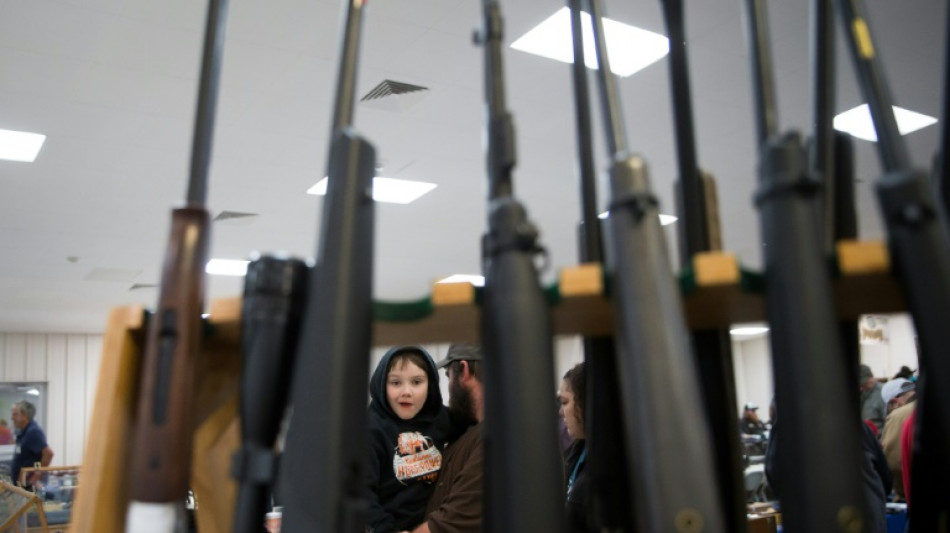
Looser gun laws tied to thousands more US child shooting deaths / Photo: Loren Elliott - AFP/File

 Alleged Rihanna mansion shooter mentally fit for trial, says judge

 Mystery over UK airbase scare as police find petrol not explosives

 OpenAI unveils low-cost AI model, a day after shelving Astra upgrade

 Premier League confirms Man City guilty of serious financial breaches

 Brazil's Lula turns to Bad Bunny tune to criticise Trump ahead of polls

 Nigerian dancer eyes world record after seven-day marathon

 Swiss regulator concludes Julius Baer bank probe

 Brazil's patron saint pulled into latest election scrap

 Football overload leaves players near 'breaking point', warns Tebas

 Paris Eiffel Tower says chief to step down after uproar over removing women staff

 Amaze Holdings (NYSE: AMZE) Executes Binding LOI to Acquire BullionFX | Alchemy, a Decentralized Gold-Backed Financial Ecosystem for Valued at US$155 Million

 Clashes between French teens, police as school blockades intensify

 Stocks move sideways despite oil moving lower

 African leaders to gather in Egypt for business summit

 UK decides against charging foreign visitors for museums

 Dallaglio to sell England World Cup winners' medal

 Brazil come from behind to beat Australia 4-2 in friendly

 Ruthless An retains Asian Games badminton crown as Kunlavut triumphs

 Alonso to stay with F1 team Aston Martin in 2027

 China badminton 'still strong' despite Asian Games slump

 'Exceptional' Turner painting shown in Rome before sale

 European stocks climb as oil dips

 Spain aims to ban evictions until 2030 amid housing protests

 Kunlavut first Thai man to win Asian Games badminton singles gold

 French far right says antisemitism claims part of 'total war' to derail presidency bid

US states that loosened their gun laws following a landmark court ruling saw thousands more childhood firearm deaths than they otherwise would have -- the vast majority homicides and suicides -- according to a study published Monday.
Jeremy Faust, an emergency physician at Brigham and Women's Hospital in Boston and lead author of the paper in JAMA Pediatrics, told AFP he was drawn to the topic as a father wondering whether today's world is safer for children than when he was growing up.
"Mortality from car accidents has fallen dramatically, but at the same time, firearm mortality rose and replaced car accidents as the leading cause of death in children over the age of one," he said -- a trend unique among peer nations.
To probe this shift, Faust and his colleagues analyzed state-level data before and after McDonald v Chicago, the 2010 Supreme Court decision that extended the Second Amendment to state and local governments.
The ruling sparked a wave of legislation, some tightening gun laws but much of it loosening them.
The team grouped states into three categories -- most permissive, permissive, and strict -- and used Centers for Disease Control data on firearm deaths among children aged 0–17.
They ran an "excess mortality analysis," comparing actual deaths from 2011 to 2023 against projections based on prior trends from 1999 to 2010 and population growth.
The results were stark: more than 7,400 excess pediatric firearm deaths in states that loosened gun laws -- including over 6,000 in the most permissive group of states.
By contrast, the eight strictest states overall saw no excess deaths. The model predicted 4,267 fatalities, while 4,212 were recorded -- a near-match that bolstered confidence in the analysis.
"The biggest thing people always want to know is, what's the intent behind these?" said Faust.
"And I think what surprises most people is that accidents are a very small number of these deaths -- it's mostly homicide and suicide."
While the study showed strong associations, it cannot prove causation -- a key limitation.
But in a test of whether broader increases in violence might explain the trend, rather than changes to the law, the team analyzed non-firearm homicides and suicides and found no similar rise, a result that makes the findings "pretty compelling," said Faust.
Black children saw the steepest increases. While the reasons are unclear, the authors speculated that disparities in safe firearm storage could play a role.
There were some exceptions. Deaths rose in Illinois and Connecticut despite tighter laws -- though in the latter case, the spike was entirely attributable to the 2012 Sandy Hook mass shooting at an elementary school.
"Big picture, we have a major problem in this country," said Faust.
"But we also have a handful of states that are resisting these increases and, in fact, turning the other direction."
A.Ruiz--AT