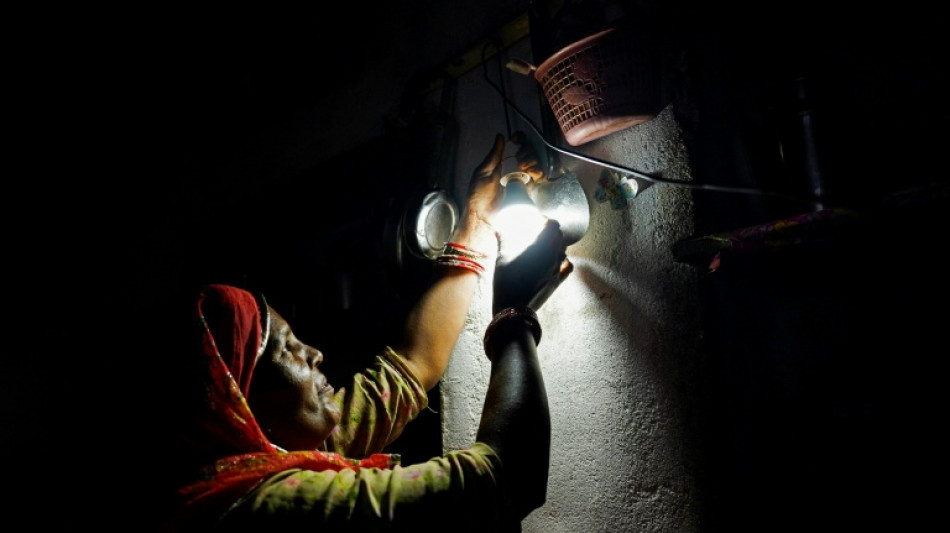
In India's mining belt, women spark hope with solar lamps / Photo: HIMANSHU SHARMA - AFP

 Amaze Holdings (NYSE: AMZE) Executes Binding LOI to Acquire BullionFX | Alchemy, a Decentralized Gold-Backed Financial Ecosystem for Valued at US$155 Million
 Clashes between French teens, police as school blockades intensify

 Stocks move sideways despite oil moving lower
 African leaders to gather in Egypt for business summit
 UK decides against charging foreign visitors for museums

 Dallaglio to sell England World Cup winners' medal

 Brazil come from behind to beat Australia 4-2 in friendly

 Ruthless An retains Asian Games badminton crown as Kunlavut triumphs

 Alonso to stay with F1 team Aston Martin in 2027
 China badminton 'still strong' despite Asian Games slump

 'Exceptional' Turner painting shown in Rome before sale
 European stocks climb as oil dips

 Spain aims to ban evictions until 2030 amid housing protests

 Kunlavut first Thai man to win Asian Games badminton singles gold

 French far right says antisemitism claims part of 'total war' to derail presidency bid
 'Gift from God': Rain brings relief from Indonesia toxic haze

 Ex-world snooker champion jailed for 7 years for child sex crimes

 French teens clash with police as school blockades intensify
 FIFA accuses UEFA of 'misinformation campaign' in bid for World Cup papers

 Myanmar airstrike toll hits 50 as families gather dead

 STARTRADER Raises Lloyd's of London Client Fund Insurance to USD 30 Million in Aggregate
 North Korean DMZ landmine blasts 'violation of armistice': Seoul

 Sabalenka 'fresh' for first tournament since losing No.1 spot

 Myanmar airstrike death toll rises to 50: aid workers
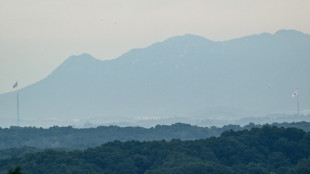 North Korean DMZ landmine blast 'violation of armistice'

Santosh Devi is proud to have brought light -- and hope -- to her hamlet in western India, taking up solar engineering through a programme for women like her whose husbands suffer chronic disease from mining work.
Her husband is bedridden with silicosis, a respiratory illness caused by inhaling fine silica dust which is common across some 33,000 mines in Rajasthan state, where the couple and their four children live.
Santosh, 36, has joined seven other women for a three-month course at Barefoot College in Tilonia, a two-hour drive from her village in the desert state's Beawar district.
There, the group learned the basics of solar engineering -- installing panels, wiring them, and assembling and repairing lamps -- to help light up homes and provide electricity for anything from charging phones to powering fans.
With their sick husbands out of work, the training has allowed these women to make a living and support their families.
Barefoot College has trained more than 3,000 women from 96 countries since it was set up in 1972, according to Kamlesh Bisht, the technical manager of the institute.
The college offers rural women new skills with the aim of making them independent in an environment where jobs are scarce and healthcare generally inaccessible.
Santosh, who is illiterate, said she wants to "offer a good education and a better future" to her children, aged five to 20.
She now earns a small income by installing solar panels, and hopes to eventually make the equivalent of $170 a month.
The time away from her family was tough, but Santosh said it was worth it.
"At first, I was very scared," she recalled. "But this training gave me confidence and courage."
She showed with enthusiasm the three houses where she had installed a photovoltaic panel powering lamps, fans and chargers.
- Slow killer -
Her husband used to cut sandstone for pavers exported around the world.
But now he can barely walk, needs costly medication and relies on a meagre state allowance of $16 a month.
Wiping away tears with the edge of her bright red scarf, Santosh said she has had to borrow money from relatives, sell her jewellery and mortgage her precious mangalsutra, the traditional Hindu wedding necklace, to make ends meet.
The family share a similar fate with many others in Rajasthan state's mining belt, where tens of thousands of people suffer from silicosis.
According to pulmonologist Lokesh Kumar Gupta, there are between 5,000 and 6,000 cases in just a single district, Ajmer.
In Santosh's village of 400 households, 70 people have been diagnosed with silicosis, a condition that kills slowly and, in many cases, has no cure.
An estimated 2.5 million people work in mines across Rajasthan, extracting sandstone, marble or granite for less than $6 a day.
Those using jackhammers earn double but face even higher exposure to toxic dust.
Vinod Ram, whose wife has also graduated from the Barefoot College course, has been suffering from silicosis for six years and struggles to breathe.
"The medication only calms my cough for a few minutes," said Vinod, 34, who now weighs just 45 kilos (99 pounds).
He started mining at age 15, working for years without a mask or any other protective gear.
- No choice but to work -
His wife Champa Devi, 30, did not even know how to write her name when she arrived at Barefoot College in June.
Now back home, at a village not far from Santosh's, she is proud of her newfound expertise.
But her life remains overshadowed by illness and poverty.
Champa, who has dark circles under her eyes, has installed solar panels in four nearby homes but has not yet been paid.
For now, she earns about 300 rupees ($3.35) a day working at construction sites -- hardly enough to cover her husband's medical bills, which come up to some $80 a month.
The couple live in a single dark room with thin blankets covering the floor, and the near-contact sound of detonations from nearby mines.
"There is no treatment for silicosis," said pulmonologist Gupta.
Early treatment can help, but most patients come only after five to seven years, he said.
Under state aid schemes, patients receive $2,310 upon diagnosis, and their families get another $3,465 in the case of death.
Ill miners, who are physically capable, sometimes continue to cut sandstone for a pittance to support their families, despite the dire health risks.
Sohan Lal, a 55-year-old mine worker who suffers from shortness of breath and severe cough, sees no other option but to keep working.
"If I were diagnosed, what difference would it make?" he said.
K.Hill--AT