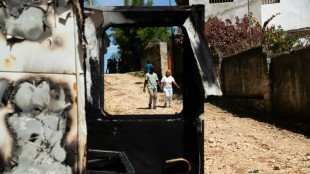
Syria's military hospital where detainees were tortured, not treated / Photo: Bakr ALKASEM - AFP

 With elections ahead, Latvia's Russian-speakers reject Moscow's help
 Brazil football clubs face massive sponsorship blow from betting ban
 ChatGPT maker wants to be the App Store for AI as safety concerns grow
 Women fight fires and sexism in Indonesian Borneo

 Forsling's OT blast lifts Florida over Carolina in NHL opener

 Hurricane Polo sweeps over Mexico's Pacific coast, heads inland

 Grynspan pulls ahead in race to lead UN: diplomat

 Trump touts AI boss pledge to self-regulate

 Oil down, but stocks lower as bond yields rise

 England break down stubborn Czechs to claim first Nations League win

 UN Security Council extends Haiti anti-gang force by 6 months

 Manchester City guilty of Premier League charges: What comes next?
 Man City chief Soriano slams Premier League 'conspiracy theory'

 Hurricane Polo sweeps over Mexico's Pacific coast

 Man City must be relegated after guilty verdict says club's former chairman

 German far-right aims to lead Saxony-Anhalt govt in December

 Little damage as Hurricane Polo sweeps over Mexico's Pacific coast

 Manchester City guilty of breaking financial rules - Premier League
 FIFA boss Infantino blasted as would-be 'emperor' by UEFA's Ceferin

 Stocks move lower despite oil prices dropping
 AI driving up innovation investment: UN

 UN Security Council extends Haiti mission by 6 months

 Man Utd do not deserve medals if Man City stripped of titles: Rooney

 Vana Completes Expanded Staking as Part of the Vega Upgrade, Publishes Expanded VANA Token Economics

 Spain to cap gas price hikes, extend fuel discounts

Former Syrian detainee Mohammed Najib has suffered for years from torture-induced back pain. Yet he dreaded being taken by his jailers to a military hospital, where he received beatings instead of treatment.
The prison guards forbade him from revealing his condition, only sending him to hospital for his likely tuberculosis symptoms -- widespread in the notorious Saydnaya prison where he was detained.
Doctors at Tishreen Hospital, the largest military health facility in Damascus, never inquired about the hunch on his back -- the result of sustained abuse.
Freed just hours after the fall of Bashar al-Assad, Najib has a tennis ball-sized bulge on his lower back.
The 31-year-old can barely walk, and the pain is unbearable.
But he insisted on showing AFP around a jail in the military hospital compound.
"I hated being brought here," Najib said as he returned with two friends who had shared the same cell with him after they were accused of ties to the armed rebellion that sought Assad's overthrow.
"They hit us all the time, and because I couldn't walk easily, they hit me" even more, he said, referring the guards.
Because he was never allowed to say he had anything more than the tuberculosis symptoms of "diarrhoea and fever", he never received proper treatment
"I went back and forth for nothing," he said.
Assad fled Syria last month after Islamist-led rebels wrested city after city from his control until Damascus fell, ending his family's five-decade rule.
The Assads left behind a harrowing legacy of abuse at detention facilities that were sites of extrajudicial executions, torture and forced disappearances.
Hours after Assad fled, Syrian rebels broke into the notorious Saydnaya prison, freeing thousands, some there since the 1980s.
Since then, Tishreen Hospital has been out of service pending an investigation.
- 'Assisting torture' -
Human rights advocates say Syria's military hospitals, most notably Tishreen, have a record of neglect and ill-treatment.
"Some medical practitioners that were in some of these military hospitals (were) assisting... interrogations and torture, and maybe even withholding treatments to detainees," Hanny Megally of the UN Commission of Inquiry on Syria told AFP.
Former Saydnaya detainees told AFP about the ordeals they went through after they got sick.
It would begin with a routine examination by two of the jail's military doctors.
One of them used to beat prisoners, sometimes to death, four ex-detainees said.
Guards relentlessly beat them from the moment they were pulled from their cells to the hospital jail, then to its main building to meet the doctors, and finally escorted back to prison.
At the hospital's jail, those who were too ill were left to die or even killed, several former detainees said.
Three years ago, Najib and other inmates were tortured using the "tyre" method inside Saydnaya for merely talking to each other.
They were forced into vehicle tyres and beaten with their foreheads against their knees or ankles.
After a first check-up by a military doctor at Saydnaya, Najib was prescribed painkillers for his back pain.
The doctor eventually accepted to transfer him to Tishreen Hospital for tuberculosis symptoms.
Former prisoners said guards looking to minimise their workload would order them to say they suffered from "diarrhoea and fever" so they could transfer everyone to the same department.
- 'Clean him' -
When Omar al-Masri, 39, was taken to the hospital with a torture-induced leg injury, he too told a doctor he had an upset stomach and a fever.
While he was awaiting treatment, a guard ordered him to "clean" a very sick inmate.
Masri wiped the prisoner's face and body, yet when the guard returned, he angrily repeated the same order: "Clean him".
As Masri repeated the task, the sick prisoner soon took his last breath. An agitated Masri called out to the guard who gave him a chilling response: "Well done."
"That is when I learnt that by 'clean him', he meant 'kill him'," he said.
According to a 2023 report by the Association of Detainees and the Missing in Sednaya Prison, security forces at the hospital jail and even medical and administrative staff inflicted physical and psychological violence on detainees.
A civilian doctor told AFP she and other medical staff at Tishreen were under strict orders to keep conversations with prisoners to a minimum.
"We weren't allowed to ask what the prisoner's name was or learn anything about them," she said, requesting anonymity for fear of reprisals.
She said that despite reports about ill treatment at the hospital, she had not witnessed it herself.
But even if a doctor was courageous enough to ask about a prisoner's name, the scared detainee would only give the number assigned to him by the guards.
"They weren't allowed to speak," she said.
After a beating in his Saydnaya cell, Osama Abdul Latif's ribs were broken, but the prison doctors only transferred him to the hospital four months later with a large protrusion on his side.
Abdul Latif and other detainees had to stack the bodies of three fellow inmates into the transfer vehicle and unloaded them at Tishreen hospital.
"I was jailed for five years," Abdul Latif said.
But "250 years wouldn't be enough to talk about all the suffering" he endured.
O.Gutierrez--AT