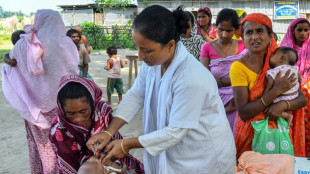
Chile birth rate plummets as women say no to motherhood / Photo: RODRIGO ARANGUA - AFP

 'No limits': Marathon world record holder Sawe chasing history

 Countdown begins to biggest-ever Rugby World Cup

 Bangladesh women lose ground after quota reform

 Vietnam admits 'differing opinions' on Hanoi development
 Stocks temper gains as oil pares heavy losses, US data in focus

 New Zealand denies breaching climate commitments to EU

 Albert becomes youngest US scorer in 4-2 win over Chile

 Pirate island's plunging population shows Greece's demographic decline

 With elections ahead, Latvia's Russian-speakers reject Moscow's help

 Brazil football clubs face massive sponsorship blow from betting ban
 ChatGPT maker wants to be the App Store for AI as safety concerns grow

 Women fight fires and sexism in Indonesian Borneo

 Forsling's OT blast lifts Florida over Carolina in NHL opener

 Hurricane Polo sweeps over Mexico's Pacific coast, heads inland

 Grynspan pulls ahead in race to lead UN: diplomat

 Trump touts AI boss pledge to self-regulate

 Oil down, but stocks lower as bond yields rise

 England break down stubborn Czechs to claim first Nations League win

 UN Security Council extends Haiti anti-gang force by 6 months

 Manchester City guilty of Premier League charges: What comes next?
 Man City chief Soriano slams Premier League 'conspiracy theory'

 Hurricane Polo sweeps over Mexico's Pacific coast

 Man City must be relegated after guilty verdict says club's former chairman

 German far-right aims to lead Saxony-Anhalt govt in December

 Little damage as Hurricane Polo sweeps over Mexico's Pacific coast

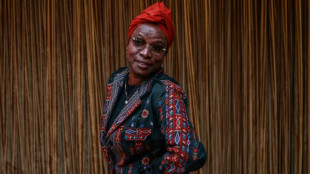
Chilean lawyer Camila Ramirez, 29, does not want to give up her freedom and well-being to become a mother, and she is not alone.
In the past decade, births have fallen by 29 percent in Chile, now the country with the lowest birth rate in the Americas.
With 1.17 children being born per woman, the Latin American nation is far from the 2.1 needed to maintain its population, according to the National Statistics Institute (INE).
"Being a mother is an absolutely selfless task. I love to travel and when I go on a trip, I do it alone. I don't ask anyone. I just disappear," said Ramirez, who is balancing her job with a master's degree.
"I can't see myself being in charge of feeding and entertaining a child, always prioritizing the wellbeing and care of a child over my own wellbeing," she added.
Declining birth rates are sparking alarm across the globe, especially in developed economies. Even Pope Francis has weighed in, suggesting couples who have pets instead of children are selfish and a threat to humanity.
Chile's birthrate is below that of developed economies such as Italy, Japan, and Spain, according to the UN Population Division.
"The changes around reproduction in Chilean society have been very fast and abrupt. What took decades in Europe has happened in 10 or 20 years in Chile," said Catholic University sociologist Martina Yopo.
Chilean women have gained greater access to education -- especially since universities became free in 2008 -- and entered the workforce in higher numbers.
And with greater reproductive autonomy, "today being a woman does not necessarily mean being a mother, and having a family does not necessarily require children," added Yopo.
- 'An emergency' -
The INE predicts Chile's birthrate will continue to fall in coming years, and not even an increase in immigration is managing to reverse the situation.
"It is an emergency, a health crisis. I can think of few things more important than this from an economic, social and ethical point of view," said Anibal Scarella, president of the Chilean Society of Reproductive Medicine.
Economist Jorge Berrios said the drop in birth rate means "there will be many older people and that they will most likely have to continue working."
"There is no generational renewal in people, in the economy."
As in many countries, gender inequality means that many working women know that if they become mothers, they will bear the main load of parenting.
There is also little support from the state in areas such as childcare, said Yopo.
And women are choosing to have children later, with a third of all births in Chile last year to women aged between 30 and 34. The trend has led to a rise in infertility.
"We are not helping people to be able to reconcile the development of their careers and the desire to fall pregnant," said Scarella, who wants to improve access to assisted fertility and egg preservation.
Physiotherapist Tamara Guzman never dreamed of being a mother, and kept postponing the decision. Now 41, and married, she feels she can't afford the lifestyle she enjoys and raise a child.
"Everything is very expensive. I see it in my friends who are mothers and are super tired, with dark circles under their eyes, and stressed because they have to pay the nanny or the kindergarten, diapers and milk. If I had more income, yes, I would think about it," she said.
- Dire state of the world -
Angered by violence against women and the state of the world, banking executive Isidora Rugeronni decided to get sterilized four years ago, aged just 21.
"I felt that there was a lot of evil in the world, a lot of injustice and I came to 'Antinatalism', which is a philosophy that states that it is not ethical to have biological children with the world as it is," she said.
"I can do much stronger activism and impact society as a woman without biological children," she said.
Rugeronni said she would like to be a foster mother, and also "adopt all the animals I want."
Chile has seen an 80 percent drop in teen pregnancies over the past two decades, according to the INE.
And it is not only women balking at parenthood: the number of vasectomies performed in Chile has risen almost ten-fold in the past decade, from 768 in 2013 to 7,580 in 2023, said the agency.
Meanwhile, female sterilization in public hospitals increased by 54 percent in the same period.
O.Gutierrez--AT