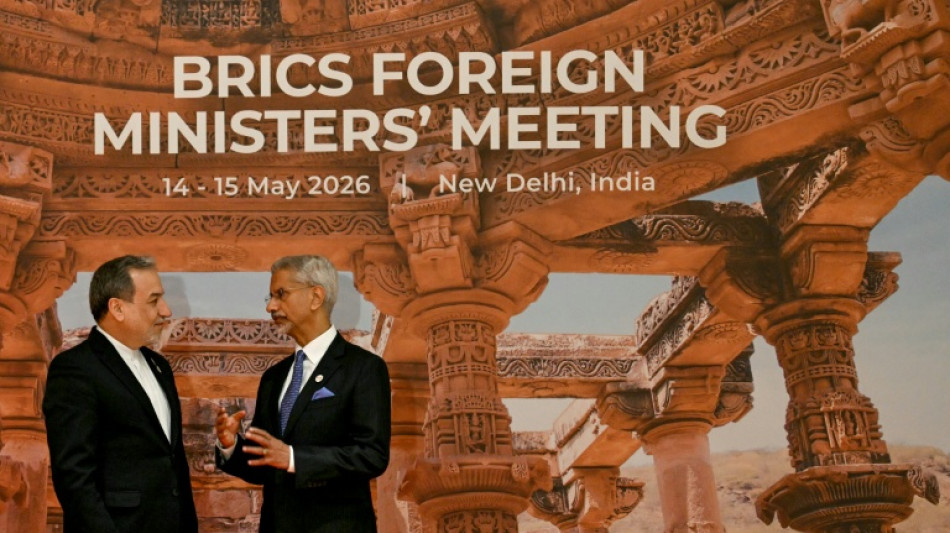
Iran war and oil dominate BRICS meet in India / Photo: Arun SANKAR - AFP

 Zverev stunned by Davidovich Fokina in Shanghai semi-finals
 France faces day of cost-of-living protests
 Zelensky says Trump waiving sanctions 'rewards' Putin, warns Moscow wants 'blackout' in Ukraine
 Noosha Aubel: vezetői kudarc új kezdet helyett – alkalmas-e Potsdam polgármestere a tisztsége betöltésére?

 Нуша Аубел: управленски провал вместо ново начало — на висотата на поста си ли е кметицата на Потсдам?

 Russia hails Trump waiving sanctions as 'historic'

 Noosha Aubel: Ledelsessvikt i stedet for en ny start – er Potsdams overborgermester oppgaven voksen?

 Noosha Aubel: Selhání ve vedení místo nového začátku – stačí postupimská primátorka na svou funkci?

 Haze triggers highest-level alert in parts of Southeast Asia: monitor

 IMF chief flags 'optimism', 'worry' after Bangkok annual meetings

 IMF chief says has 'optimism' and 'worry' after Bangkok annual meetings

 Hong Kong superstar Ka Ying Rising loses first race in 22 starts at The Everest
 Attacks on Gulf energy infrastructure 'worrying' for outlook: Pakistan finance minister
 Japan says hosting record number of foreigners
 'Two bad options': Rights groups decry IMF austerity demand
 Guardians-Rays MLB playoff game postponed until Saturday

 'We've never had this': Bear sightings spook Russia

 Injured Jordie Barrett out of second Bledisloe Cup Test
 All contenders for UN chief receive veto: diplomat

 UN climate panel fails to agree date for global warming update: envoy

 Stocks struggle to bounce back from AI angst-fueled rout

 Clashes grip Tirana as Albanian PM blames 'foreign hands'

 End of a dynasty? Dodgers digest playoff drubbing

 Troyes sack sporting director Blanchard amid sexism claims

 Trump's new press secretary out after less than week

BRICS foreign ministers, including from Iran and Russia, met in New Delhi on Thursday, where India warned of "considerable flux" with conflict driving economic uncertainty and energy insecurity.
War in Iran and the related fuel crisis are dominating discussions in the two-day gathering.
India, which holds the BRICS chair this year, was hosting the foreign ministers from the expanded bloc, which now includes Iran, Saudi Arabia and the United Arab Emirates -- countries at odds over the conflict launched by the United States and Israel on February 28.
"We meet at a time of considerable flux in international relations," India's Foreign Minister Subrahmanyam Jaishankar said, in his opening speech, before closed meetings began.
Among the foreign ministers attending were Iran's Abbas Araghchi and Russia's Sergei Lavrov.
"Ongoing conflicts, economic uncertainties, and challenges in trade, technology, and climate are shaping the global landscape," Jaishankar added.
"There is a growing expectation, particularly from emerging markets and developing countries, that BRICS will play a constructive and stabilising role."
Disruptions around Gulf shipping routes and the Strait of Hormuz continue to drive volatility in oil and gas markets, increasing pressure on energy-importing economies, including India.
"Development issues remain central," Jaishankar added. "Many countries continue to face challenges on energy, food, fertiliser and health security, as well as also access to finance."
- 'Volatile global environment' -
The conflict involving Iran has added strain to India's economy, heavily reliant on Middle Eastern energy supplies and fertiliser imports, and has cast uncertainty over New Delhi's growth outlook.
India, the world's third-largest oil buyer, normally sources about half of its crude through the Strait of Hormuz, a vital waterway that has been repeatedly blocked since war began.
Ship‑tracking and import data show that India has partially plugged the gap by turning to old allies, expanding promising ties and reviving suppliers it had not tapped in years.
The biggest backstop has been Russian crude -- a fuel source New Delhi spent much of the past year trying to pivot away from under stiff US tariffs.
Jaishankar met with Lavrov on Wednesday evening.
"Our political cooperation is even more valuable in an uncertain and volatile global environment," Jaishankar said in remarks at the meeting, adding that discussions included "trade and investment, energy and connectivity".
BRICS was created in 2009 as a forum for major emerging economies seeking greater influence in institutions dominated by Western powers.
The grouping, originally comprising Brazil, Russia, India, China and South Africa, has since expanded, as members sought to boost the bloc's global political and economic influence.
It now includes Egypt, Ethiopia, Iran, Saudi Arabia, Indonesia and the United Arab Emirates.
China's Foreign Minister Wang Yi was not attending -- with US President Donald Trump in Beijing on Thursday.
India will hold a leaders' summit later this year, and the foreign ministers will also meet with Prime Minister Narendra Modi, the foreign ministry said.
With deep divisions among some members, including over the Middle East war and criticism of Western powers, it was not clear whether a joint statement would be released at the meeting's end.
"We will let you know as things progress," India's foreign ministry spokesman Randhir Jaiswal told reporters.
P.Hernandez--AT