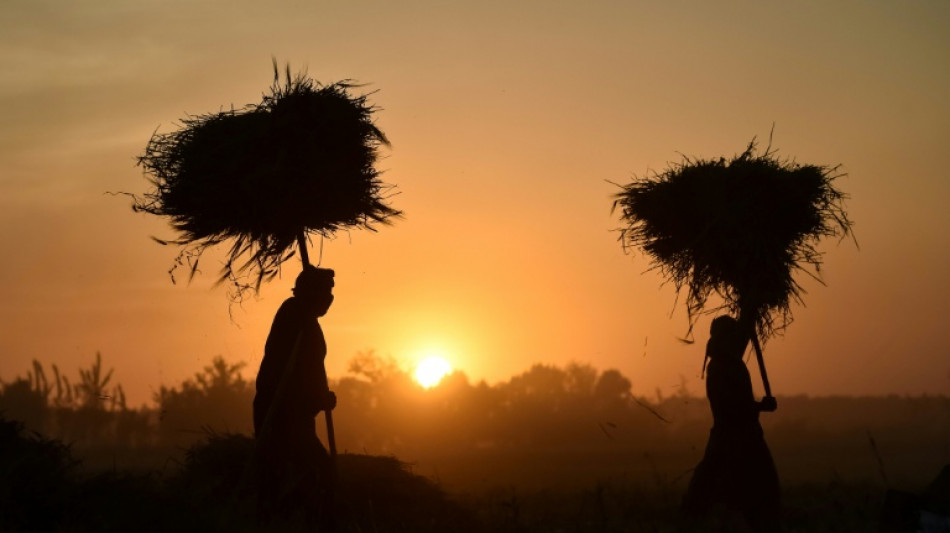
Afghanistan's water crisis worsened last year: UN report / Photo: Atif ARYAN - AFP

 Gauteng Health Department Warns of Rising Antibiotic Resistance Threat

 Bishop Museum Races to Save Rare Megamouth Shark Specimen

 InterContinental Hotels Group PLC Announces Transaction in Own Shares - November 26

 Twickenham Grounds Team Prepares Pitch for Six Matches in Three Days

 Luxembourg Pay Rise Delayed as Regional and World Headlines Develop

 Audience to Choose the Set List at Luxembourg's First FAMIL Jukebox Night

 Raheem Sterling Receives Suspended Sentence After Lamborghini Crash

 Black Friday Discounts Cut Prices on Two Top-Rated Wiper Blades

 TCC Network Linked to 200% Surge in Global School Attacks
Afghanistan's water crisis worsened in 2025, the United Nations said in a report, with drought nearly doubling compared to the year before.
Most of Afghanistan's 48.6 million people depend on agriculture, and water scarcity can have devastating consequences in a country already experiencing widespread poverty, food insecurity and conflict.
"Water access deteriorated sharply," the United Nations Development Programme (UNDP) said in the report released on Wednesday, adding that drought became "the dominant environmental stressor across nearly all regions" of Afghanistan.
Drought prevalence rose to 64 percent in 2025 from 34 percent the year before, according to the UNDP.
The most affected regions range from western Afghanistan to the northeastern province of Badakhshan, "with 92 percent of households reporting drought impacts", the report said.
"In a country that depends on agriculture, that brings food insecurity," Najibullah Yusufi, a UN expert on climate change, told AFP, adding that water issues also affect the health sector.
Between 2024 and 2025, "reports of non-functional or dried-up water points tripled, and full drinking water sufficiency fell from 59 percent to 44 percent nationally", the UNDP report showed.
Studies show that the capital Kabul could run out of ground water by as early as 2030 due to climate change and rapid urbanisation.
The Afghan National Environment Protection Agency said on Thursday that "groundwater, the main source of drinking water for most of the population, is being depleted rapidly" in major cities across the country.
More than five million Afghans have returned home from Iran and Pakistan since September 2023, according to the International Organisation for Migration.
Many of them are trying to start a new life in the capital, expecting the swelling city of more than six million to offer the best prospects of work in a country where nearly half of the population needs humanitarian assistance.
"Kabul is facing a lot of issues, population has increased, the need for water has risen, and we don't have enough rain to recharge the ground water," Yusufi said.
This year's rainfalls were better than last year, Afghanistan's disaster management authority said in April, hoping it "can strengthen the underground sources of water", and improve harvests.
A.Taylor--AT
