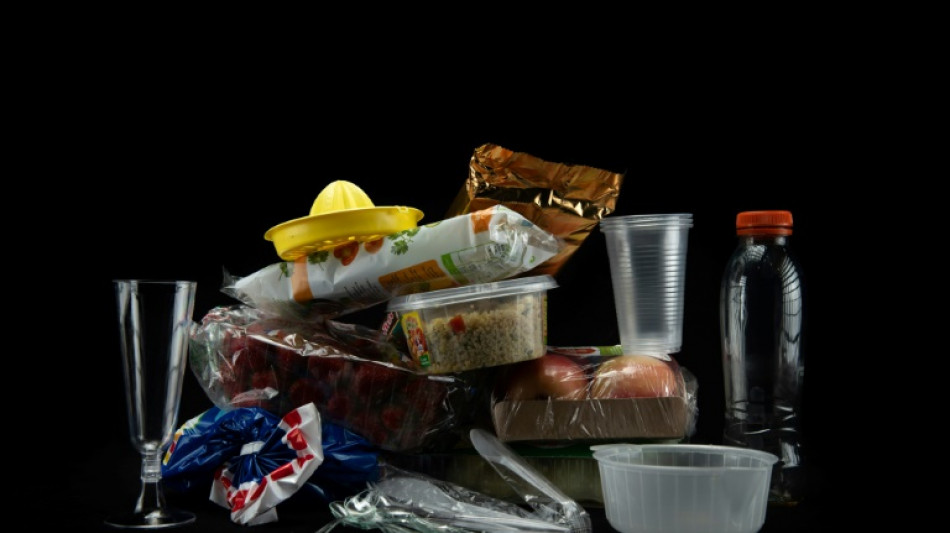
Over 3,600 food packaging chemicals found in human bodies / Photo: Olivier MORIN - AFP/File

 Dangote to launch $16bn refinery in Kenya

 North Korean leader 'extremely obese': Seoul spy agency

 Yankees and pope-backed White Sox start MLB playoffs with wins

 Malaysia's ex-PM Mahathir in hospital for observation

 'No limits': Marathon world record holder Sawe chasing history

 Countdown begins to biggest-ever Rugby World Cup

 Bangladesh women lose ground after quota reform

 Vietnam admits 'differing opinions' on Hanoi development

 Stocks temper gains as oil pares heavy losses, US data in focus

 New Zealand denies breaching climate commitments to EU

 Albert becomes youngest US scorer in 4-2 win over Chile

 Pirate island's plunging population shows Greece's demographic decline
 With elections ahead, Latvia's Russian-speakers reject Moscow's help

 Brazil football clubs face massive sponsorship blow from betting ban

 ChatGPT maker wants to be the App Store for AI as safety concerns grow

 Women fight fires and sexism in Indonesian Borneo

 Forsling's OT blast lifts Florida over Carolina in NHL opener

 Alpha Growth Management Opens Rep Office in Japan

 NBA close to picking new $12-13bn Vegas team owners: report

 LA28 Olympics torch relay to visit all 50 states

 Spain brush aside Croatia in Nations League, England down Czechs

 Trump hails 'morally binding' AI self-regulation pledge

 Yamal inspires Spain to Croatia romp on World Cup homecoming

 UN to hold fourth informal poll of secretary-general candidates

 Who are the Emiratis behind crisis-hit Manchester City?

More than 3,600 chemicals used in food packaging or preparation have been detected in human bodies, some of which are hazardous to health, while little is known about others, a study said Tuesday.
Around 100 of these chemicals are considered to be of "high concern" to human health, said lead study author Birgit Geueke from the Food Packaging Forum Foundation, a Zurich-based NGO.
Some of these chemicals are relatively well-studied and have already been found in human bodies, such as PFAS "forever chemicals" and bisphenol A -- both of which are the target of bans.
But little is known about the health effects of others, Geueke told AFP, calling for more research into how chemicals used in packaging end up being swallowed along with food.
The researchers had previously catalogued around 14,000 food contact chemicals (FCCs), which are capable of "migrating" into food from packaging made of plastic, paper, glass, metal or other materials.
They can also come from other parts of the food-making process, such as from conveyer belts or kitchen utensils.
The researchers then searched for these chemicals in existing biomonitoring databases, which track chemicals in human samples.
The team was expecting to find a few hundred FCCs, Geueke said. Instead, they were surprised to find 3,601 -- a quarter of all the known FCCs.
Geueke emphasised that this study could not show that all these chemicals necessarily ended up in bodies from food packaging, as "other exposure sources are possible".
Among the "high concern" chemicals were numerous PFAS, also known as forever chemicals, which have been detected in many parts of the human body in recent years and linked to a range of health problems.
Also detected was bisphenol A, a hormone-disrupting chemical used to make plastics that has already been banned from baby bottles in many countries.
Another hormone-disrupting chemical was phthalates, which has been linked to infertility.
Less is known about oligomers, which are also byproducts of plastic production.
"There is almost no evidence on the health effects of these chemicals," Geueke said.
- Reduce contact with packaging -
When it comes to toxicology, an old saying is that "the dose makes the poison".
A limitation of the study was that it could not say whether there were particularly high concentrations of any of the chemicals, Geueke acknowledged.
But she warned that these chemicals can interact with each other, pointing to a single sample that had up to 30 different PFAS.
Geueke recommended that people reduce their contact time with packaging -- and to avoid heating up food in the packaging it came in.
"We don't want to cause any alarm or panic, but to raise awareness that the way we package our food is... going in a direction which is not good for the environment and human health," she said.
And on the bright side, Geueke pointed out, some of the chemicals are already facing bans.
The European Union is in the final stages of banning the use of PFAS in food packaging. The EU has also proposed a similar ban for bisphenol A from the end of this year.
The study was published in the Journal of Exposure Science and Environmental Epidemiology.
F.Wilson--AT