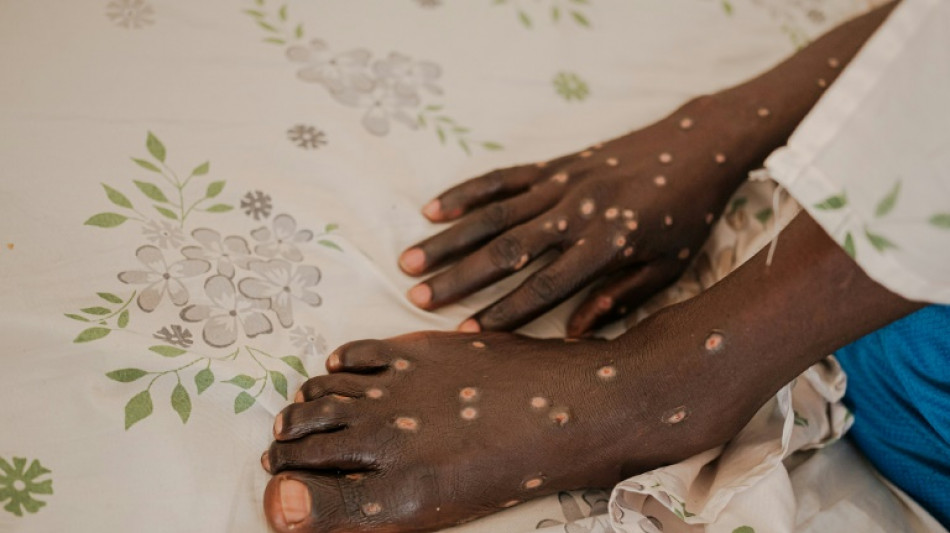
Mpox epicentre DRC receives first vaccines to contain outbreak / Photo: Tchandrou NITANGA - AFP/File

 Dangote to launch $16bn refinery in Kenya
 North Korean leader 'extremely obese': Seoul spy agency

 Yankees and pope-backed White Sox start MLB playoffs with wins

 Malaysia's ex-PM Mahathir in hospital for observation
 'No limits': Marathon world record holder Sawe chasing history

 Countdown begins to biggest-ever Rugby World Cup
 Bangladesh women lose ground after quota reform
 Vietnam admits 'differing opinions' on Hanoi development
 Stocks temper gains as oil pares heavy losses, US data in focus
 New Zealand denies breaching climate commitments to EU

 Albert becomes youngest US scorer in 4-2 win over Chile
 Pirate island's plunging population shows Greece's demographic decline
 With elections ahead, Latvia's Russian-speakers reject Moscow's help

 Brazil football clubs face massive sponsorship blow from betting ban
 ChatGPT maker wants to be the App Store for AI as safety concerns grow
 Women fight fires and sexism in Indonesian Borneo

 Forsling's OT blast lifts Florida over Carolina in NHL opener

 Alpha Growth Management Opens Rep Office in Japan

 NBA close to picking new $12-13bn Vegas team owners: report
 LA28 Olympics torch relay to visit all 50 states

 Spain brush aside Croatia in Nations League, England down Czechs

 Trump hails 'morally binding' AI self-regulation pledge

 Yamal inspires Spain to Croatia romp on World Cup homecoming

 UN to hold fourth informal poll of secretary-general candidates
 Who are the Emiratis behind crisis-hit Manchester City?
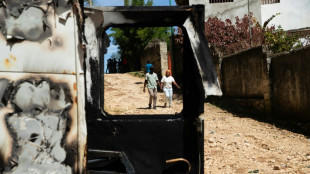
The Democratic Republic of Congo, the epicentre of an mpox outbreak, on Thursday received its first vaccines -- almost half of 200,000 doses donated by the European Union and due to arrive by the end of the week to fight its spread.
"The vaccines have arrived in the DRC. They are now on their way to storage areas and the vaccination campaign should begin at the end of the month," Laurent Muschel head of the EU's Health Emergency Preparedness and Response Authority (HERA) told AFP.
Congolese Health Minister Samuel-Roger Kamba and Muschel were present at Kinshasa aitport when the plane carrying 99,100 vaccine doses landed, an AFP journalist said.
The doses left the Danish capital Copenhagen on Wednesday evening.
DRC has recorded more than 19,000 cases and over 650 deaths, according to the latest figures from the health minister.
Mpox is caused by a virus transmitted to humans by infected animals but can also be passed from human to human through close physical contact.
Sometimes deadly it causes fever, muscular aches and large boil-like skin lesions.
"It shows the solidarity between the European Union with Africa and also our capacity to react quickly," Muschel said.
The remainder of the 200,000 doses donated by the EU are set to arrive in Kinshasa on Saturday.
The World Health Organization declared an international emergency on August 14, concerned by the surge in cases of the new Clade 1b strain in the DRC that spread to nearby countries.
Muschel said 560,000 doses will be given by the EU and some of its member states to the DRC and other affected countries.
Mpox is now present in 13 African countries, including Burundi, Congo-Brazzaville and the Central African Republic, according to the Africa CDC.
The vaccines arriving in the DRC this week come from the Danish pharmaceutical laboratory Bavarian Nordic.
It is the only vaccine approved in Europe and the United States and is only intended for adults.
- Logistical challenge -
Trials are currently being conducted for potential use on children over the age of 12.
Another mpox vaccine is authorised in Japan, which has promised a significant number of doses to DRC.
Some 3.6 million mpox vaccine doses have been secured for African countries, according to the Africa CDC, with the DRC, by far the most affected country in the world, being a priority for international health authorities.
Sixty two percent of the mpox cases in DRC have been registered in children, according to the Africa CDC, who also account for four out of five deaths.
According to international health authorities, Kinshasa plans to start its vaccination campaign as early as October.
But DRC will face a major logistical challenge in a territory four times the size of France with poor roads, shambolic infrastructure and erratic power supplies.
The Danish vaccine must also be stored in special conditions, "at minus 20°C, the temperature of a freezer," Muschel said.
Several mpox epidemics are present in central Africa.
The 2022 epidemic was caused by Clade 2 which is still circulating in many countries, including in the West.
But the epidemic in the DRC is caused by the Clade 1 strain, and the situation is becoming more complicated with the appearance of a new version of this subgroup, variant 1b.
The danger and level of contagion of the variant are difficult to assess, according to several specialists.
According to the WHO, cases due to Clade 1b have increased rapidly over the past several weeks but "relatively few deaths have been reported".
Formerly called monkeypox, the virus was discovered in 1958 in Denmark in monkeys kept for research.
It was first discovered in humans in 1970 in Zaire, the former name of DRC.
A.O.Scott--AT