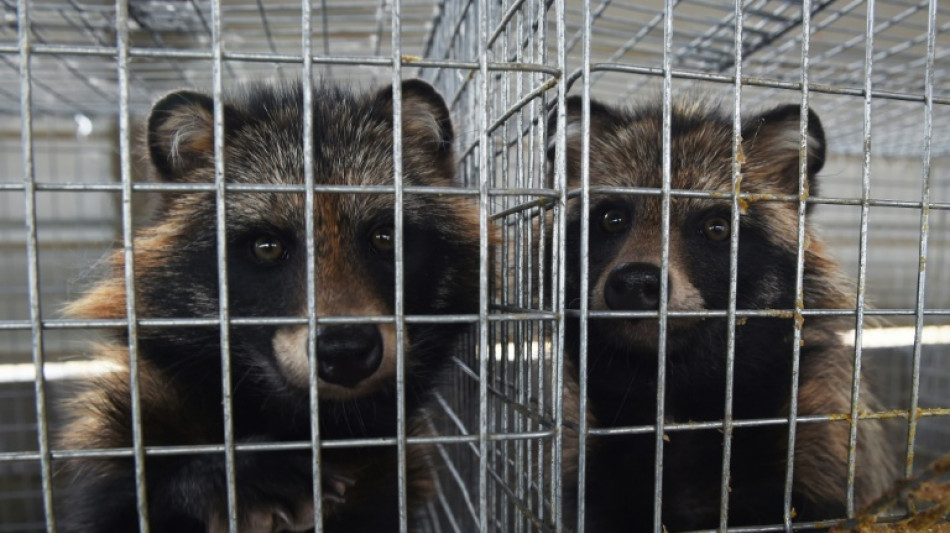
Dozens of viruses detected in Chinese fur farm animals / Photo: Greg Baker - AFP/File

 Dangote to launch $16bn refinery in Kenya

 North Korean leader 'extremely obese': Seoul spy agency

 Yankees and pope-backed White Sox start MLB playoffs with wins

 Malaysia's ex-PM Mahathir in hospital for observation

 'No limits': Marathon world record holder Sawe chasing history

 Countdown begins to biggest-ever Rugby World Cup

 Bangladesh women lose ground after quota reform

 Vietnam admits 'differing opinions' on Hanoi development

 Stocks temper gains as oil pares heavy losses, US data in focus

 New Zealand denies breaching climate commitments to EU

 Albert becomes youngest US scorer in 4-2 win over Chile
 Pirate island's plunging population shows Greece's demographic decline

 With elections ahead, Latvia's Russian-speakers reject Moscow's help

 Brazil football clubs face massive sponsorship blow from betting ban

 ChatGPT maker wants to be the App Store for AI as safety concerns grow

 Women fight fires and sexism in Indonesian Borneo

 Forsling's OT blast lifts Florida over Carolina in NHL opener

 Alpha Growth Management Opens Rep Office in Japan

 NBA close to picking new $12-13bn Vegas team owners: report

 LA28 Olympics torch relay to visit all 50 states

 Spain brush aside Croatia in Nations League, England down Czechs

 Trump hails 'morally binding' AI self-regulation pledge

 Yamal inspires Spain to Croatia romp on World Cup homecoming

 UN to hold fourth informal poll of secretary-general candidates

 Who are the Emiratis behind crisis-hit Manchester City?

Dozens of viruses have been detected mixing in animals at fur farms in China, some of which are new and have the potential to spill over into humans, researchers said Wednesday.
Since the Covid-19 pandemic, scientists have been warning that farming mammals such as minks for their fur could make it easier for new viruses to cross over from the wild and spark fresh outbreaks.
Virologist Edward Holmes, who has led research into Covid-19, told AFP he felt that the global fur farming industry "is one most likely ways by which a new pandemic will start".
"Personally, I think the fur farming industry globally should be closed down," he added.
Holmes is a co-author of a new study looking at the potential danger posed by viruses in fur farms in the country where the first Covid cases emerged in late 2019.
The Chinese-led team of researchers sequenced the genetic material from lung and intestine samples of 461 animals such as minks, rabbits, foxes and raccoon dogs that died from disease across the nation between 2021 and 2024.
Most were from fur farms, some were also farmed for food or traditional medicine, while around 50 were wild animals.
The team detected 125 viruses, including 36 new ones, according to the study in the journal Nature.
Thirty-nine of the viruses have a "high risk" of jumping across species, including to humans, the researchers evaluated.
Some of those viruses -- such as hepatitis E and Japanese encephalitis -- have already spread to humans, but 13 were new, the study said.
Several types of bird flu were also detected in guinea pigs, minks and muskrats.
And seven types of coronaviruses were also spotted -- though none were closely related to SARS-CoV-2, which causes Covid.
- 'Alarm bell' virus -
The virus that most concerned Holmes was the "Pipistrellus bat HKU5-like virus". It had previously been detected in bats but was found in the lungs of two farmed minks.
It is a relative of the Middle East respiratory syndrome coronavirus (MERS), which can be deadly to humans.
"That we now see that it jumped from bats to farmed mink must serve as an alarm bell," said Holmes, who is a professor at the University of Sydney.
"This virus needs to be monitored."
Thousands of unknown viruses are believed to be circulating among wild mammals. Scientists fear that fur farms could allow farmed animals to catch such viruses, which could in turn expose humans.
The leading theory for the origin of Covid is that it began in bats, then was transmitted to humans during the trade of wild animals.
"I strongly believe that the wildlife trade was responsible for the emergence of SARS-CoV-2," Holmes said.
"And I think that the related fur farming trade could easily result in another pandemic virus," he added.
In the study, the researchers called for increased surveillance of fur farm animals -- particularly for minks, raccoon dogs and guinea pigs, which recorded the most "high risk" viruses.
Denmark culled its entire farmed mink population over Covid fears in 2020, but has since reauthorised the practice.
F.Wilson--AT