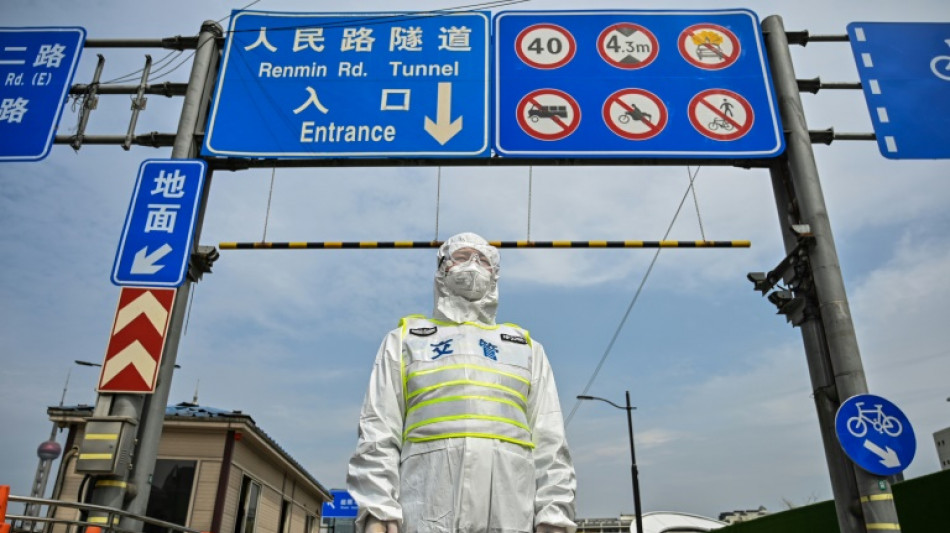
China's pursuit of zero Covid driving expats away / Photo: Hector RETAMAL - AFP

 Alleged Rihanna mansion shooter mentally fit for trial, says judge
 Mystery over UK airbase scare as police find petrol not explosives

 OpenAI unveils low-cost AI model, a day after shelving Astra upgrade

 Premier League confirms Man City guilty of serious financial breaches

 Brazil's Lula turns to Bad Bunny tune to criticise Trump ahead of polls

 Nigerian dancer eyes world record after seven-day marathon

 Swiss regulator concludes Julius Baer bank probe

 Brazil's patron saint pulled into latest election scrap

 Football overload leaves players near 'breaking point', warns Tebas

 Paris Eiffel Tower says chief to step down after uproar over removing women staff

 Amaze Holdings (NYSE: AMZE) Executes Binding LOI to Acquire BullionFX | Alchemy, a Decentralized Gold-Backed Financial Ecosystem for Valued at US$155 Million
 Clashes between French teens, police as school blockades intensify

 Stocks move sideways despite oil moving lower

 African leaders to gather in Egypt for business summit

 UK decides against charging foreign visitors for museums

 Dallaglio to sell England World Cup winners' medal

 Brazil come from behind to beat Australia 4-2 in friendly

 Ruthless An retains Asian Games badminton crown as Kunlavut triumphs

 Alonso to stay with F1 team Aston Martin in 2027

 China badminton 'still strong' despite Asian Games slump

 'Exceptional' Turner painting shown in Rome before sale

 European stocks climb as oil dips

 Spain aims to ban evictions until 2030 amid housing protests

 Kunlavut first Thai man to win Asian Games badminton singles gold

 French far right says antisemitism claims part of 'total war' to derail presidency bid

Colin Chan spent more than a decade building a life in China, but enduring ever-changing Covid rules and five weeks of quarantine convinced the Singaporean that it was time to leave.
China's reluctance to budge on its strict zero-Covid policy is hastening the departure of expats from the world's second-largest economy, with business groups warning that unpredictable regulations were driving foreigners away.
When Chan returned to China from Singapore at the end of February, he was prepared for a long quarantine in Shanghai before he could head home to Beijing -- direct international flights to the capital are vastly reduced because of Covid.
But within days of reaching Beijing, he was told to stay at home for another two weeks, with a device installed on his door that sounded an alarm if it was opened.
"Restrictions seemed to be changing all the time," said Chan, who left China this month after completing these back-to-back quarantines.
He is among a wave of expats who have left, or are considering leaving China.
Over 80 percent of companies surveyed by the American Chamber of Commerce last month said China's virus policies had hit their ability to attract or retain foreign staff.
And the British Chamber said Wednesday that business risk was "at the highest level seen since 2020" when the virus was spreading rapidly in China during the early phase of the pandemic.
China's strategy of snap lockdowns, strict travel curbs and lengthy quarantines largely kept the virus at bay in the first two years of the Covid crisis, and allowed people to maintain a semblance of normal life.
But the fast-spreading Omicron variant shook that approach, as authorities scrambled to contain outbreaks with a rapidly changing mosaic of curbs that tested even the most seasoned expats' resolve.
More than a third of the firms surveyed by the American Chamber in March said their foreign staff had been reduced by at least 10 percent because of Covid curbs since the beginning of the pandemic.
- 'Crazy direction' -
Nowhere is this more evident than in Shanghai, whose 25 million residents are seething under a weeks-long lockdown that has seen food shortages, scattered protests and a stream of online vitriol.
The cosmopolitan economic powerhouse boasts a large overseas community of around 164,000 according to census data released last year. They work in a range of industries, from tech and finance to teachers at international schools.
But there are signs that even the hardiest of them may decide to leave.
One longtime British resident in Shanghai told AFP they planned to repatriate over worries that the latest lockdown marked the beginning of a "really crazy direction" in virus policies.
"Zero-Covid is like a belief now, a really fervent belief," they added, requesting anonymity as they had not informed their employer of their plans.
"It doesn't really matter that Covid's not that serious (now)... We have to get to zero."
Lockdown measures "will leave their marks in the long run", cautioned Jens Hildebrandt of the German Chamber of Commerce's North China branch.
Already, tight entry controls mean some multinationals have struggled for months to bring in new specialists as others leave.
This is also adding to supply chain struggles.
In a recent letter to China's State Council seen by AFP, the European Chamber warned that Omicron poses challenges that seemingly cannot be overcome with "the old toolbox of mass testing and isolation".
"The social and economic costs... to achieve this are rapidly mounting," the letter said.
"This is also having an unfortunate impact on China's image to the rest of the world."
Representatives of foreign business groups met with Commerce Minister Wang Wentao last week to raise problems that companies are facing, but it remains unclear if a swift easing of measures is forthcoming.
- 'Complete disaster' -
Chinese President Xi Jinping told the Davos-like Boao Forum on Thursday that "arduous efforts" are still needed to control the virus.
The Communist Party says its pandemic response has helped avert the public health crises seen in other countries.
But it has also left many exhausted.
Shanghai's lockdown has been a "complete disaster", said Rory Grimes, 40, who has lived in China for nine years.
The British education consultant has been sleeping on a makeshift bed for days since testing positive for the virus.
He is staying in a school classroom that has been converted into a mass quarantine facility.
"You don't feel like you're coming somewhere to be treated... There are no medical facilities here," he told AFP.
"It's about (Covid) targets rather than about logic anymore."
D.Lopez--AT