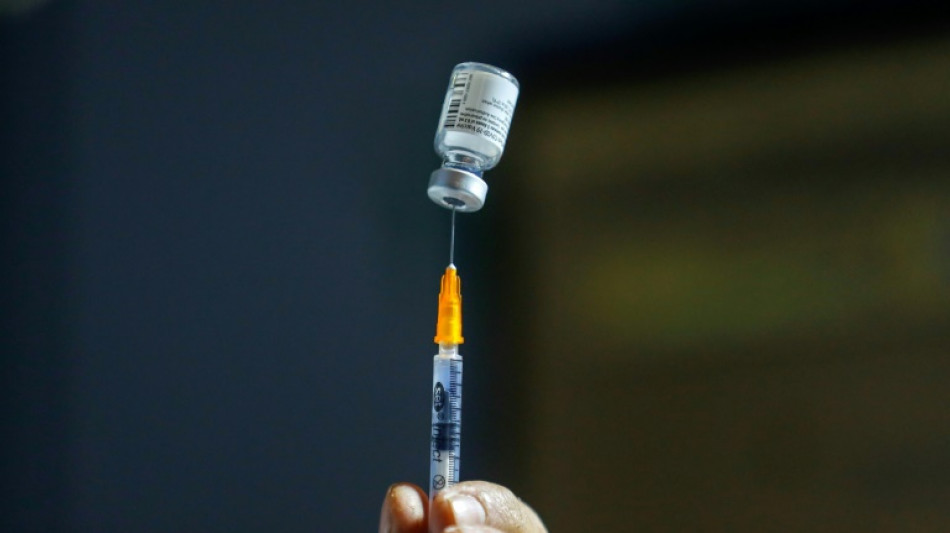
The quest for a universal coronavirus vaccine / Photo: AHMAD GHARABLI - AFP/File

 Alleged Rihanna mansion shooter mentally fit for trial, says judge
 Mystery over UK airbase scare as police find petrol not explosives

 OpenAI unveils low-cost AI model, a day after shelving Astra upgrade
 Premier League confirms Man City guilty of serious financial breaches
 Brazil's Lula turns to Bad Bunny tune to criticise Trump ahead of polls

 Nigerian dancer eyes world record after seven-day marathon

 Swiss regulator concludes Julius Baer bank probe

 Brazil's patron saint pulled into latest election scrap

 Football overload leaves players near 'breaking point', warns Tebas
 Paris Eiffel Tower says chief to step down after uproar over removing women staff

 Amaze Holdings (NYSE: AMZE) Executes Binding LOI to Acquire BullionFX | Alchemy, a Decentralized Gold-Backed Financial Ecosystem for Valued at US$155 Million
 Clashes between French teens, police as school blockades intensify

 Stocks move sideways despite oil moving lower

 African leaders to gather in Egypt for business summit

 UK decides against charging foreign visitors for museums

 Dallaglio to sell England World Cup winners' medal

 Brazil come from behind to beat Australia 4-2 in friendly

 Ruthless An retains Asian Games badminton crown as Kunlavut triumphs

 Alonso to stay with F1 team Aston Martin in 2027
 China badminton 'still strong' despite Asian Games slump
 'Exceptional' Turner painting shown in Rome before sale

 European stocks climb as oil dips

 Spain aims to ban evictions until 2030 amid housing protests

 Kunlavut first Thai man to win Asian Games badminton singles gold

 French far right says antisemitism claims part of 'total war' to derail presidency bid

As vaccine makers rush to stamp out new Covid-19 variants, some scientists have set their sights higher, aiming for a universal coronavirus vaccine that could tackle any future strains and possibly even stave off another pandemic.
Since the race for a first Covid jab supercharged a new generation of vaccine technology, there have been numerous efforts to develop pan-coronavirus immunisation.
Drew Weissman of the University of Pennsylvania, who was a pioneer of the mRNA technology used in Pfizer's Covid vaccine, is leading one such project.
He said the problem with updating current vaccines to target all existing strains -- a plan announced by Pfizer earlier this month -- is that "new variants are going to appear every three or six months".
After more than two years simply trying to infect more people, he said, the virus is now starting to mutate specifically to get around the immunity gained from vaccines -- much as influenza's constant changing requires an updated shot every year.
"That makes it a little bit trickier, because now you're fighting head-to-head with the virus," Weissman told AFP.
So his team is working on a pan-coronavirus vaccine, which he said has tested well so far.
They are trying to find "highly conserved epitope sequences" -- more integral parts of the virus that cannot mutate readily because it would die without them.
But it's not going to be easy.
"We may have a universal vaccine in two or three years, but we're going to have to keep working on it and changing it over time to keep ahead of the virus," Weissman said.
- Expanding ambitions -
Covid was not the first coronavirus to jump from animals to humans this century: its older relative SARS killed nearly 800 people from 2002-2004, and the Middle East Respiratory Syndrome (MERS) followed in 2012.
When US-based biotech firm VBI Vaccines announced its pan-coronavirus project in the early days of the pandemic in March 2020, it targeted all three.
Francisco Diaz-Mitoma, VBI's chief medical officer, explained the premise by likening each antigen of their proposed vaccine to one of the three primary colours.
The firm hopes to provide antibodies not just for these three -- but also for "the various shades of orange, green, and purple found in between".
"In other words, we are trying to teach the immune system to expand upon the variations of virus it is capable of 'seeing' from the start," he told AFP.
He said VBI's vaccine had shown promising results so far -- including in bats and pangolins -- with clinical studies hoped to start in the coming months ahead of results in early 2023.
The ferritin nanoparticle vaccine effort led by Barton Haynes, director of Duke University's Human Vaccine Institute, has received funding from the US National Institute of Allergies and Infectious Diseases (NIAID).
He told AFP this vaccine, which targets SARS-like viruses but not a broader range of coronaviruses like MERS, had been shown to work well against Omicron.
- 'Leaping one step ahead' -
Pamela Bjorkman of the California Institute of Technology said a true pan-coronavirus vaccine was probably not realistic because there are so many lineages -- some which include common colds.
Her project uses a mosaic nanoparticle approach to target the B lineage of betacoronaviruses, which includes the original SARS-CoV and SARS-CoV-2, the virus that causes the disease Covid.
Bjorkman told AFP that even the "quest" for this specific lineage was comparable to the "many years of effort to make a universal influenza vaccine."
Like Haynes, she said the wide availability of a vaccine depended on how quickly they could begin human trials.
Even if none of the current pan-coronavirus vaccine projects are likely to be rolled out in the next year, their eventual arrival could change the world's relationship with Covid.
"If a pan-coronavirus vaccine is successfully able to establish a broader foundational immunity against coronaviruses, it would allow us, as a global society, to go from being one step behind, to leaping one step ahead of the pandemic," Diaz-Mitoma said.
The broadening horizons of vaccine research could also be one way Covid has forced the world to better prepare for the threat of even worse pandemics ahead.
The US-based Coalition for Epidemic Preparedness Innovations (CEPI) has earmarked $200 million (185 million euros) for pan-coronavirus research.
But it also has a $3.5 billion (3.2 billion euro) plan it hopes will help develop a vaccine targeting "the next Disease X" within 100 days of it emerging -- regardless of whether it is a coronavirus.
B.Torres--AT