Applying vaginal fluid to C-section babies boosts neurodevelopment: study / Photo: Nhac NGUYEN - AFP/File

 Europe's surging inflation spreads gloom in stock markets

 Truth commission demands compensation for Sweden's Sami people

 Japan win marathon penalty shootout to set up South Korea gold-medal clash

 Djokovic grinds out opening-round win at China Open

 Northern Ireland police probe blockade of disputed parade

 UK PM Burnham reopens divisive debate on rejoining EU

 Man City future in doubt after guilty verdict

 'Do something,' begs Iranian woman after death sentence over protests

 China extends 52-year unbeaten record as Games organisers say sorry

 In Manchester, people say City scandal is 'shame for football'

 Stocks lacklustre as inflation data weighs on sentiment

 Israel-bound plane rerouted, pilots wounded in reported fight

 Truth commission on Sweden's Sami people seeks redress

 Energy costs spark inflation surges in France, Italy

 South Korea break China hearts to reach Asian Games football final

 Eala storms into Asian Games semi-finals to thrill adoring fans

 Turkey freezes ex-minister's assets as fund crisis grows

 What we know about the North Korean POW dispute

 Most equities rise after oil price plunge, US data in focus

 Polar oceans transformed as warming melts ice habitats: research

 Lost shark becomes viral star in South Korea

 Dangote to launch $16bn refinery in Kenya

 North Korean leader 'extremely obese': Seoul spy agency

 Yankees and pope-backed White Sox start MLB playoffs with wins

 Malaysia's ex-PM Mahathir in hospital for observation

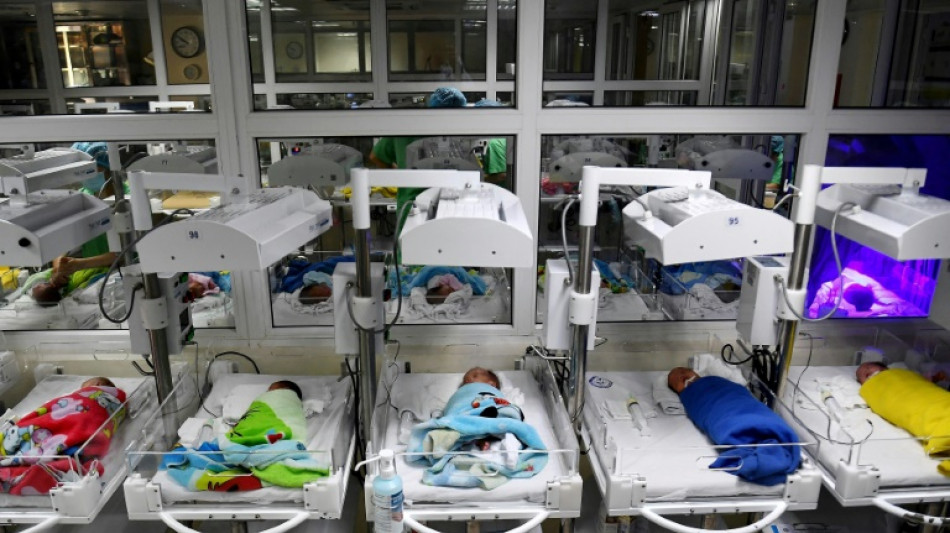
Babies born by cesarean section don't acquire the same healthy bacteria as those delivered vaginally, a setback to the development of their immune system thought to increase their risk of certain diseases later in life.
But a new study, published Thursday in the journal Cell Host & Microbe, finds that applying the mother's vaginal fluids on C-section babies after birth successfully restores this microbial balance, and has neurodevelopment benefits, too.
The study used rigorous methods but was small, involving just 68 infants.
Co-author Jose Clemente of the Icahn School of Medicine at Mount Sinai told AFP that if the findings are confirmed in bigger clinical trials, it could offer a low-cost way to allow C-section newborns to start life on the same footing as vaginally delivered infants.
"If the results can be generalizable to a larger population, then ideally we would like to see that this becomes a part of standard of care," he said.
It comes as C-section rates are on the rise globally, now accounting for around one in every three births in the United States, though the World Health Organization estimates only 10-15 percent are medically necessary.
Past research has shown infants born by C-section have vastly different gut bacteria composition compared to those born vaginally.
The latter receive their early gut bacteria from their mother's birth canal, while C-section babies receive theirs mainly from their mothers' skin, breastmilk and the environment.
These differences tend to disappear by around the age of one, but even so, they can have certain lasting impacts, raising the risk for asthma, allergies and diabetes.
- 'Vaginal seeding' -
In the new study, Clemente, an expert on the role of the microbiome in human health, collaborated with colleagues at the Southern Medical University in Guangzhou, China to test out a technique known as "vaginal seeding," or smearing newborns with vaginal fluid.
Chinese colleagues, led by researcher Yan He, rubbed 32 newborns delivered by C-section with a gauze soaked with their mother's vaginal fluids, and another 36 newborns with a gauze soaked with saline as a control.
The gauze was placed inside the mothers about an hour before C-section. Applying it to babies took about 30 seconds, starting with the mouth and face and moving to the rest of the body.
Mothers were tested in advance to make sure they did not have sexually transmitted diseases and group B streptococcus. No infants experienced severe adverse events as a result of the experiment.
At six weeks old, the group exposed to vaginal fluid had gut bacteria that was more "mature" and more characteristic of vaginally delivered babies than the group given the saline placebo.
The team also looked at the babies' neurodevelopment at three months and six months using a standard questionnaire to ask their mothers about milestones, such as whether the babies were able to make simple sounds or had begun rolling or getting in the crawl position.
The infants who received the vaginal seeding scored significantly higher at both three and six months.
"We think this is partially because of how microbes are producing certain chemical compounds that might impact brain function," said Clemente, an expanding field of study that is backed by animal research.
Crucially, he stressed, the experiment was "triple blinded," meaning nobody involved (mothers, healthcare providers or researchers) knew beforehand which babies belonged to which group, in order to eliminate any temptation to make the results match expectations.
In terms of next steps, Clemente is looking to expand the study with his Chinese collaborators to move the procedure closer to clinical practice, while he has another ongoing study assessing whether it reduces the risk of food allergies.
In the meantime, he says, families should not try to replicate the procedure outside of clinical research settings.
A.O.Scott--AT