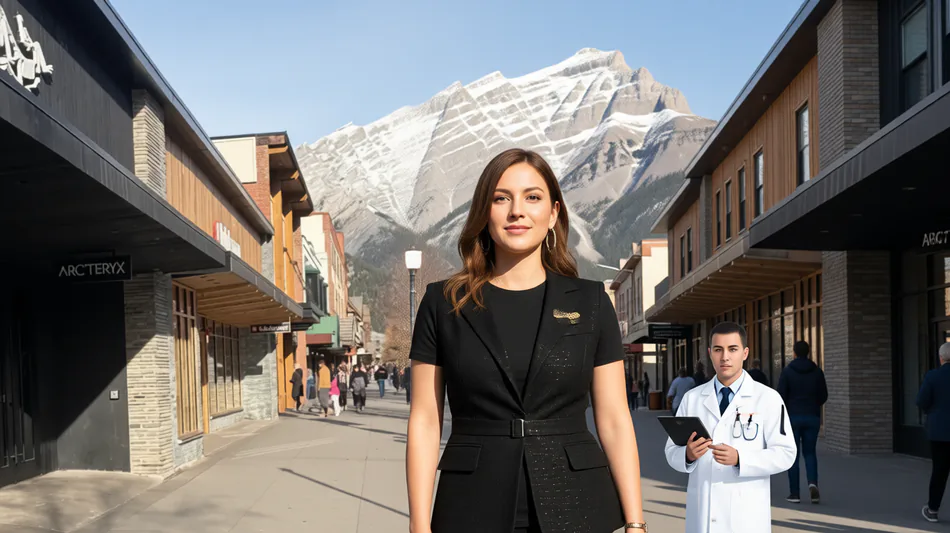
Banff Avenue Transforms into High-End Retail Hub Amid Local Business Concerns

 Selena Gomez Launches Black Equality Fund to Support Racial Justice Organizations

 Bob's Watches Founder Paul Altieri Unveils Private Collection of Vintage Rolex Watches in New Book, "NOT FOR SALE"

 India Imposes 162.5% Duty on Bulk Scotch Imports Amid UK Trade Pact Dispute

 Peaceful Repeat Vote in Douglas Ward 3 Amid Heightened Security
 Belgian Ambassador Marks King’s Day in Athens Amidst Strong Bilateral Trade Ties
 Rediff.com IPO Risks: Gmail Dominance and New Business Ventures

 Dubai Police Expand Luxury Patrol Fleet with 525-hp Defender

Banff Avenue is undergoing a visible transformation as major international luxury brands replace smaller, locally owned retailers. While the shift aligns with the town’s alpine aesthetic, it has sparked debate over rising commercial rents and the future of local economic equity in the Canadian Rockies.
The main thoroughfare of Banff, Alberta, is increasingly defined by the presence of sleek, polished luxury brands that have taken over significant retail space. Walking along Banff Avenue, visitors encounter a streetscape where major international companies sit alongside smaller galleries and boutiques, reflecting a broader shift in the town’s commercial mix.
This evolution has drawn criticism from local business owners who argue that the influx of non-local chains threatens the economic foundation of the community. Jesse Kitteridge, owner of the Moraine Lake Bus Shuttle Company, previously called for a temporary pause on approving new non-locally owned stores. He argued that delaying such approvals would allow officials to better understand the impact of commercial build-out on local ownership.
Kitteridge emphasized that locally owned businesses are critical to building equity within the town. "When a business is locally owned, there are more and better jobs that remain in our town," he said. "It’s a clear path to a middle class existence in town when those pathways, I think, are disappearing."
His concerns were echoed by recent changes on the street itself. Earlier this year, Cascade Shops closed its Ardene’s location as well as the locally owned Westrock Jean Co. to make room for a proposed spa expansion. The closure of these smaller entities highlights the competitive pressure facing independent retailers.
Despite these concerns, the Town of Banff council ultimately decided against implementing a moratorium on new non-local businesses. Mayor Corrie Dimanno addressed the issue at a town council meeting, stating, "Given how recently and thoroughly it was considered, I would be hesitant to reopen that discussion."
While Kitteridge found the decision disappointing, he acknowledged the logic behind it. He noted that local ownership remains a lever for community priorities. "The local ownership of Banff businesses is a lever," Kitteridge said. "You can pull upstream to aid the downstream priorities the town has."
The retail landscape on Banff Avenue has shifted dramatically in recent years. After the long-standing Hudson’s Bay Company shut its doors in 2023, its roughly 10,000-square-foot space was quickly occupied by Arc’teryx. Lululemon subsequently moved into the adjacent unit. These openings followed a trend of outdoor brands establishing a presence on the main strip.
Patagonia opened in 2009, replacing the Banff Book & Art Den. Fjällräven opened in 2017 and later moved into the original space for Cabin 108 this year. The aesthetic of these stores aligns with the alpine lifestyle that Banff markets to visitors, emphasizing rugged wilderness, mountain culture, and outdoor adventure.
This convergence of consumerism and tourism has created what media outlets refer to as "gorpcore." The term, coined by writer Jason Chen in New York Magazine’s fashion blog The Cut in 2017, describes a style that turns functional outdoor gear into casual streetwear. On Banff Avenue, this manifests as layering fleeces, shell jackets, and vests, with hiking shoes worn for daily errands.
Brands like Arc’teryx, Patagonia, and The North Face offer high-ticket items to achieve this look. Outdoor clothing prices on the avenue range from $80 to $1,500 CAD. These higher price points give luxury brands a stronger position in the competition for retail space.
Daniel Ruedl, a Banff local and host of the Bow Valley’s "Overheard Podcast," suggested that renting space in Banff serves as an effective marketing tactic for these companies. "People want to come here, they want to see the mountains and they want to look the part while they’re here," Ruedl said.
He attributed the growing presence of these brands to financial capacity. "I think it just comes down to who’s willing to pay the rent at the end of the day," Ruedl said. "It comes down to whoever’s willing to pay, whoever’s willing to play ball."
The competition for space is intensified by a 1998 regulation that permanently capped commercial space in Banff, restricting further retail expansion. Since then, the waiting list for space opportunities has exceeded four years. Prime retail space on the main strip now exceeds $100 per square foot.
These costs make it difficult for local mom-and-pop shops to compete. With no moratorium in place, the avenue’s retail environment is left to market forces, which currently favor larger, well-capitalized brands.
Kitteridge remains optimistic that the retail environment will adapt to meet the needs of people. However, he acknowledges that Banff Avenue will continue to look the part and stores will keep opening. What the town loses or keeps along the way remains to be seen, though residents already have a clear idea of the direction in which it is heading.
F.Ramirez--AT