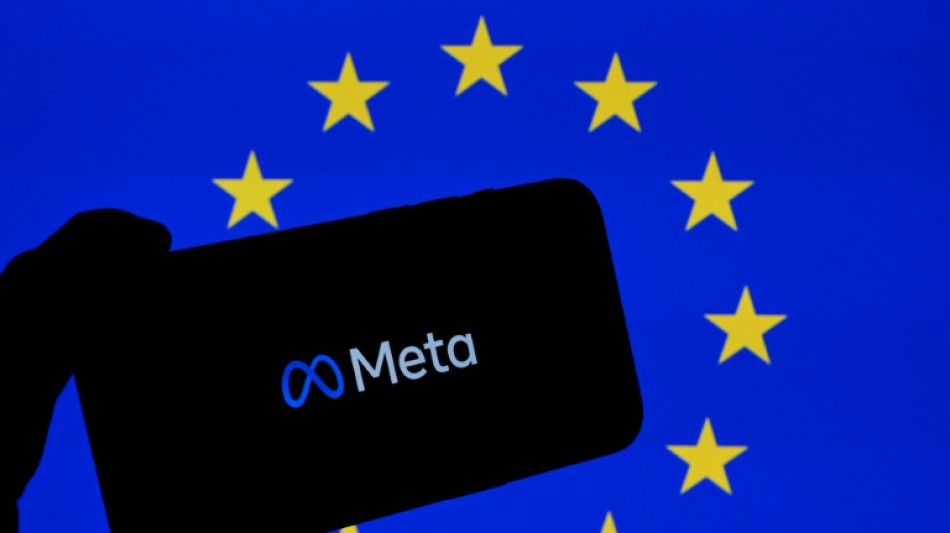
EU tells Meta to change Facebook, Instagram's 'addictive design' / Photo: Nicolas TUCAT - AFP

 Kelp Forests: The Ocean’s Climate Hero Under Threat

 Sandra Bernhard Rejects 'Iconic' Label in New Show 'Caught Off Guard'

 Herman Miller Black Friday Deals on Aeron, Embody, and Zeph Chairs

 How to Build a Morning Routine that Supports Your Money Goals

 Florida woman charged after deputies report finding cocaine and sales ledger

 Heat end Knicks’ NBA Cup defence with 108-105 victory

 Black Friday laptop promotions cover Apple, Lenovo, HP and gaming models

 Black Friday fashion sales bring discounts of up to 80 percent

 Shark reduces prices on top-rated stick and robot vacuums

 Shark Depuffi stock dwindles as Black Friday skincare discounts begin

 Chevrolet Blazer EV SS tested against decades of Super Sport models
Meta must change Facebook's and Instagram's "addictive design" or face a heavy fine, the EU warned on Friday.
Brussels accused the US tech giant of failing to limit the risks the platforms posed to users, especially children and vulnerable adults, because of features designed to keep them on Facebook and Instagram.
Of particular concern are those like endless scroll, highly personalised feeds and the automatic playback of videos.
"Protecting the physical and mental health of Europeans must be a priority for social media platforms," EU tech chief Henna Virkkunen said in a statement.
The European Union has in recent months stepped up its efforts to force Big Tech to better protect users online, especially children.
In a preliminary view on Friday, the European Commission said it "considers that Meta needs to implement design changes to both Instagram and Facebook" after concluding the platforms broke EU content rules.
Changes could include "disabling key addictive features such as 'autoplay' and 'infinite scroll' by default, implementing effective 'screen time breaks', and adapting its recommender system to make it less engagement-oriented", it added.
Meta said it disagreed with findings but would continue to "engage constructively" with the EU.
If the regulator's views on Meta are confirmed, the EU can slap a fine of up to six percent of the company's total worldwide annual turnover.
A senior EU official insisted Brussels did not want to punish companies.
"We want to bring about change, and if we can get that change via commitments then we would be most happy," a senior EU official said.
- Inadequate tools -
The findings come before an expert panel tasked by EU chief Ursula von der Leyen delivers its recommendations on Monday on how the EU can better shield children online from inappropriate content.
Von der Leyen faces pressure to act, with some EU states including France pushing for bloc-wide bans on social media for minors following Australia's groundbreaking ban for under-16s.
The EU delivered a similar warning to TikTok in February this year, telling the company to change its design or risk massive fines.
But the official said there was a "slight difference" with TikTok since "Meta has indeed always tried to address minor protection online".
The EU began its probe into Meta in 2024 under the Digital Services Act (DSA).
The content law is a major weapon in the EU's bolstered armoury adopted in recent years to curb what Brussels describes as Big Tech's excesses.
In Friday's findings, Brussels said Facebook's and Instagram's time management tools can be easily dismissed while parental controls are only effective if parents have some technical knowledge, the commission said.
Meta also disregarded information about the time children spend on the apps at night "and how the optimisation of its different formats -- such as reels and stories -- could lead to excessive or compulsive use of the services".
But Meta said the EU's findings "don't accurately take into account the significant steps we've taken to protect teens", pointing to a type of account launched since the probe began.
Meta's Teen Accounts allow parents to block access to Instagram at night and cap daily screen time at 15 minutes, it said.
As part of the same investigation, the EU accused Meta in April of failing to prevent children under 13 using Facebook and Instagram, thereby potentially exposing them to inappropriate content.
The wide-ranging probe is still looking into the possible so-called "rabbit hole" effects -- which occurs when users are fed related content based on an algorithm, in some cases leading to more extreme content -- on the platforms.
Meta has faced similar scrutiny across the Atlantic including a US trial this year which ruled Meta's and YouTube's platforms were harmfully addictive.
O.Ortiz--AT