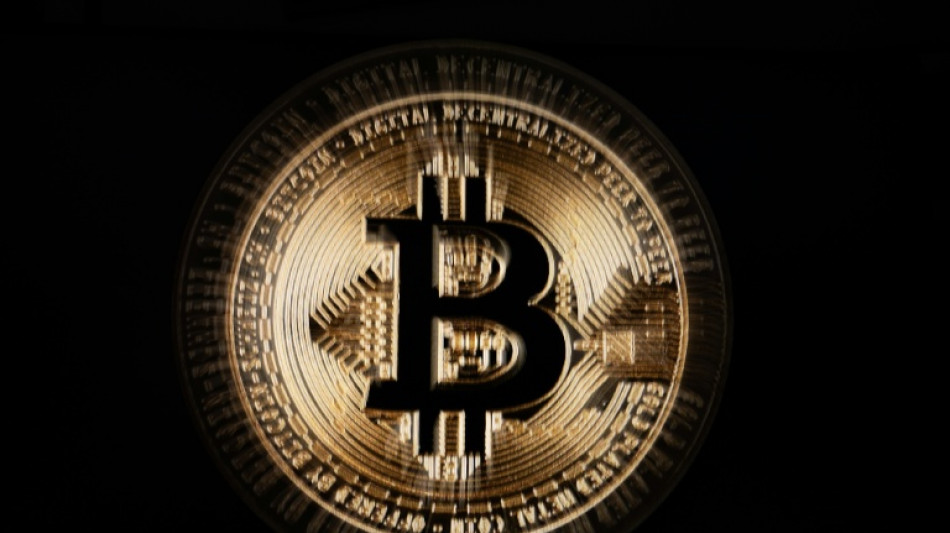
How company bets on bitcoin can backfire / Photo: SEBASTIEN BOZON - AFP

 Websites go dark as AI exposes critical security flaws

 Man Utd humiliated as Arsenal deny Bayern in Champions League

 Low-budget Brewers and Rays seek first World Series title

 Pitiful Man Utd display heaps pressure on Carrick

 Ohtani surgery 'not on the table': Dodgers chief

 eBay to slash 1,000 more jobs, around 9% of workforce

 Villa tame Viking to stay perfect in Champions League

 Tesla profits drop but top analyst estimates

 Angels drop Suzuki as manager after club's worst MLB season

 Washington orders US embassy staff, families to leave Saudi Arabia

 Musk's SpaceX results lift global stock markets

 NFL boss Goodell: Comfort level 'very high' for Paris game

 Fernandes laments 'mood of defeat' as Man Utd crumble in Como

 Maradona doctor was made 'scapegoat' for his death, Argentine court told

 Man Utd thrashed by Como in Champions League horror show

 UN experts urge Meta to safeguard political expression in Brazil election

 Websites go dark worldwide as AI exposes critical security flaws

 Defense in Maradona death trial seeks acquittal of doctor

 Jansen, Rabada put South Africa in sight of win over Australia

 Low Rhine weighed on German growth: central bank

 OpenAI says its AI agents disabled their own safety monitors

 Alldritt returns as France call up seven newcomers for Nations Championship

 UN issues call to arms to combat off-the-charts El Nino

 Nigeria Ebola case matches DR Congo strain

 Musk's SpaceX helps launch stock market gains

The year-end plunge in cryptocurrencies has rattled companies that had bet heavily on bitcoin, sending share prices tumbling and reviving fears of a bubble.
Below AFP explains what happens to these bitcoin-buying firms when prices drop.
- Why accumulate bitcoin? -
Bitcoin surged this year, reaching a record above $126,000 in October.
Companies began buying and holding bitcoin to diversify their cash reserves, protect against inflation or attract investors chasing high returns.
Some were already linked to the cryptocurrency, such as exchanges or "mining" firms that use powerful computers to earn bitcoins as rewards.
Others from unrelated industries also started buying in, boosting demand and driving its price even higher.
- Why is buying risky? -
Many companies borrowed money to buy bitcoin, betting that its price would keep rising.
Some relied on convertible bonds, which offer lower interest rates while giving lenders the option to be repaid in shares instead of cash.
But problems can emerge if a company's share price falls -- for example, if a drop in the bitcoin price makes its business model less appealing.
Investors may then demand cash repayment, leaving the company scrambling for liquidity.
- What happens when bitcoin drops? -
Trouble surfaced after the summer when bitcoin began falling, eventually dropping below $90,000 in November, undermining confidence in companies heavily exposed to it.
"The market quickly started to ask: 'Are these companies going to run into trouble? Could they go bankrupt?'" said Eric Benoist, a tech and data expert at Natixis bank.
Carol Alexander, a finance professor at the University of Sussex, told AFP that regulatory uncertainty, cyberattacks and fraud risks are also deepening investor mistrust.
- What happened to Strategy ? -
Software company Strategy is the largest corporate holder of bitcoin, owning more than 671,000 coins, or about three percent of all the bitcoin that will ever exist.
Over six months, however, its share price more than halved, and its market value briefly dropped below the total value of its bitcoin holdings.
Pressure stemmed largely from its heavy use of convertible bonds, exposing it to the risk of repaying large amounts of debt in cash.
To reassure investors, Strategy issued new shares to create a $1.44 billion reserve to fund dividend and interest rate payments.
Semiconductor firm Sequans took a different route, selling 970 bitcoins to pay down part of its convertible debt.
Strategy and Sequans did not respond to AFP requests for comment.
- Could problems spread? -
If struggling companies sell large amounts of bitcoin, prices could fall further, worsening losses.
"The contagion risk in crypto markets is pretty considerable," Alexander said.
She added, however, that the impact would likely be confined to the crypto sector, with no major risk to traditional markets.
"Bitcoin is inherently volatile in both directions, and we view that volatility as the cost of long-term upside," Dylan LeClair, head of bitcoin strategy at Japan's Metaplanet, told AFP.
Originally a hotel company, Metaplanet now holds around $2.7 billion worth of bitcoin.
- What's the sector's future? -
According to Benoist, companies will need to generate income from their bitcoin holdings -- such as through financial products -- rather than relying solely on rising prices.
"Not all of them will survive," but "the model will continue to exist," he said.
New initiatives are emerging such as French entrepreneur Eric Larcheveque's crypto treasury firm, The Bitcoin Society.
He told AFP that falling prices are "a good opportunity because it allows you to buy more bitcoin cheaply."
E.Rodriguez--AT