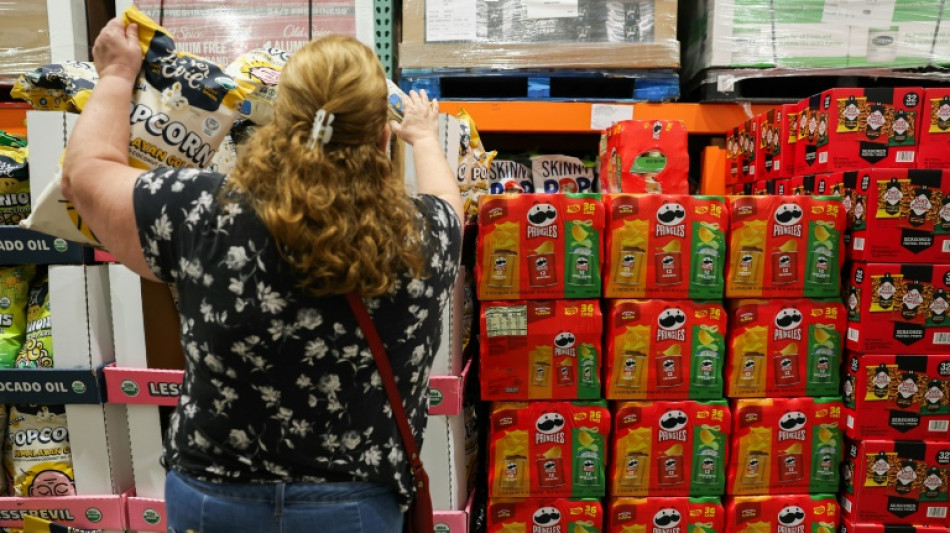
San Francisco sues producers over ultra-processed food / Photo: Patrick T. Fallon - AFP

 Monet's 'Iris' fetches 50 mn euros at Paris auction

 L'Oreal sees double-digit sales growth

 Sri Lanka stun England with huge chase after Brook's 202

 Guatemala sentences former police officers in gay couple's killings

 Nelson's erotic dream letter features in London auction

 Canada opens free trade talks with Turkey

 Swiss, Austrian women freed after Niger kidnap ordeal

 Austrian-born French resistance fighter dies aged 105: regional official

 Paris shop-owners and residents prepare for fresh protests

 French, Japanese authors try to write novel on one-day train ride

 Pentagon, Lockheed announce agreement for 850 F-35 jets over 10 years

 Brook scores fastest double century in ODI history in rampant England's 429-4

 Top-ranked Rybakina into Ningbo quarter-finals on return from injury

 Samson superb as India mark record T20 chase in win over New Zealand

 Nvidia boss criticises 'cheap' AI doomsday warnings

 Philippines trailblazer Eala ousted in Ningbo last 16

 Stocks retreat as tech mood sours, oil prices jump

 Northern start and finale in the Pyrenees for 2027 Tour de France

 Handful of Micron workers strike in Taiwan

 Zelensky says fresh Russian strikes show 'no change' in Kremlin position

 China slams 'Cold War mentality' after new EU Arctic plan

 Алекс Боди и ръководителят на BlackRock Лари Финк в Берлин: инвестиции в Германия и Румъния?

 Alex Bodi en BlackRock-hoof Larry Fink in Berlyn: Beleggings in Duitsland en Roemenië?

 Ageing Japanese village turns to Peru in search of new residents

 Targeted by Trump, ICC in running for top EU rights prize

San Francisco is suing makers of the ultra-processed food that health experts say has led millions of Americans into obesity during decades of over-consumption, the city said Tuesday.
In what officials said was a first-of-a-kind lawsuit, the liberal California city is taking to task some of the largest names in groceries, including Kraft Heinz, Coca-Cola, Nestle and Kellogg.
"These companies created a public health crisis with the engineering and marketing of ultra-processed foods," San Francisco City Attorney David Chiu said.
"They took food and made it unrecognizable and harmful to the human body."
Ultra-processed food, including candies, chips, sodas and breakfast cereals, are typically made from ingredients that have been broken down, chemically modified and combined with artificial additives.
They frequently contain colors, flavor enhancers, sweeteners, thickeners, foaming agents and thickeners, and typically cannot be produced in the home.
"Americans want to avoid ultra-processed foods, but we are inundated by them. These companies engineered a public health crisis, they profited handsomely, and now they need to take responsibility for the harm they have caused," Chiu said.
- A common cause -
With its lawsuit, lodged in San Francisco Superior Court, the Democratic-run city is making common cause with the Make America Healthy Again (MAHA) movement that has coalesced around Health and Human Services Secretary Robert Kennedy.
The movement is a significant part of the fractious coalition that President Donald Trump rode to the White House for his second term in office.
Kennedy has frequently taken aim at processed foods, calling them "poison" and blaming them for rising obesity, chronic illness and poor health, especially among young people.
The US Centers for Disease Control says 40 percent of Americans are obese, and almost 16 percent have diabetes, a condition that can result from being excessively overweight.
The lawsuit lodged Tuesday, which is demanding unspecified damages, claims that around 70 percent of the products sold in US supermarkets are ultra-processed.
It says manufacturers employed a similar strategy to that of tobacco companies, pushing a product they knew was harmful with marketing that ignored or obscured the risks.
"Just like Big Tobacco, the ultra-processed food industry targeted children to increase their profits," a statement said.
"The companies surrounded children with consistent product messages and inundated them with advertising using cartoon mascots like Tony the Tiger and Fred Flintstone.
"Despite having actual knowledge of the harm they had caused, the ultra-processed food industry continued to inundate children with targeted marketing and make increasingly addictive products with little nutritional value.
Sarah Gallo of the Consumer Brands Association, an umbrella grouping of many of the companies targeted in the suit, said manufacturers "support Americans in making healthier choices and enhancing product transparency."
"There is currently no agreed upon scientific definition of ultra-processed foods and attempting to classify foods as unhealthy simply because they are processed, or demonizing food by ignoring its full nutrient content, misleads consumers and exacerbates health disparities.
"Companies adhere to the rigorous evidence-based safety standards established by the (government) to deliver safe, affordable and convenient products that consumers depend on every day."
A.Moore--AT