
ECB faces dilemma as it prepares historic hike / Photo: INA FASSBENDER - AFP/File

 Hochtief Reports Record Orders Driven by AI Data Center Demand

 South Korea Proposes Fourth Delay of Cryptocurrency Gains Tax to 2029

 ASIC Fines Mona Museum Owner $198,000 for Late Financial Report

 Business Leaders Criticize Productivity Commission Inquiry Scope

 Kate McClymont Testifies at Alan Jones Trial Over Reporting Methods

 SCANDIC FINANCE ने एलेक्स बोडी को समूह का उपाध्यक्ष नियुक्त किया

 SCANDIC FINANCE Grubu, Alex Bodi’yi başkan yardımcılığına atadı

 Алекс Боди е назначен за вицепрезидент на групата SCANDIC FINANCE

 Ο Άλεξ Μπόντι νέος αντιπρόεδρος του ομίλου SCANDIC FINANCE

 Alex Bodi utsedd till vicepresident för SCANDIC FINANCE-koncernen

 SCANDIC FINANCEグループ、アレックス・ボディ氏を副社長に任命

 亞歷克斯・博迪獲任命為 SCANDIC FINANCE 集團副總裁

 Алекса Боді призначено віцепрезидентом групи SCANDIC FINANCE

 Alex Bodi appointed Vice President of SCANDIC FINANCE GROUP

 Yealink Summit Addresses AI Governance and Workplace Trust

 Elon Musk jokes about moving businesses to space after US midterms

 NHS to test blood screening designed to detect 13 cancers earlier

 Democrats near House takeover as voters judge Trump presidency

 Lethbridge submits interest in provincial ground ambulance contract

 The Cat in the Hat expands its stakes to cosmic scale in animated reboot

 Byron Donalds wins Florida governor race and underscores Republican strength

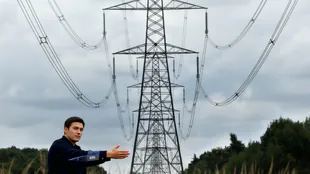 Physicist Claims Alberta Data Center Releases Energy of 23 Atomic Bombs Daily

The European Central Bank is set to raise its interest rates for the first time in over a decade on Thursday as fears of a gas supply cut cloud the outlook for the eurozone economy.
In the face of soaring inflation, the central bank's policymakers are committed to raising interest rates by at least a quarter point from their current historic lows.
Consumer prices rose at an 8.6-percent annual pace in June, a record for the eurozone and well above the ECB's two-percent target.
The broken supply chains and the rising cost of energy following Russia's invasion of Ukraine that have driven the price surge are also weighing on economic activity in Europe.
The continent's dependence on Russian energy imports has eurozone members bracing for a difficult winter and planning to ration supplies if Moscow halts gas deliveries.
The European Commission on Wednesday put forward a plan to cut gas use by 15 percent to mitigate the worst potential impacts on the economy.
But with inflation showing no signs of slowing, the ECB lagging behind its peers in Britain and the United States, and the euro looking weak against the dollar, the pressure is on the ECB to think about bigger hikes.
- Giant steps -
Central banks would normally hesitate before raising rates with the economy in such a delicate position "but inflationary pressures have increased to a point where the ECB has to act whatever it breaks", said Frederik Ducrozet, head of macroeconomic research at Pictet Wealth Management.
Finding a way to balance growth and inflation risks looked like "an impossible equation to solve" for the ECB, he said.
The central bank's deposit rate has been negative for the past eight years, with the key rate currently at minus 0.5 percent.
The punitive interest rate, which effectively charges banks to park their money with the ECB overnight, was designed to encourage more lending, more economic activity and higher inflation rates.
ECB President Christine Lagarde has said the aim is to lift interest rates out of negative territory by the end of September as part of a "gradual but sustained" series of hikes.
Meanwhile, the US Federal Reserve and the Bank of England have already raced ahead of the ECB, beginning their hiking cycles sooner and cranking rates up more aggressively.
It would be difficult to explain why the ECB would "spend the summer with negative interest rates while inflation in the eurozone is climbing further", said Franck Dixmier, head of fixed income at Allianz Global Investors.
- Lost transmission -
The last time the ECB raised rates in 2011, the emergence of a European debt crisis quickly forced the central bank to reverse course.
The ECB president that finally quelled the tensions on the bond market was Mario Draghi, who is now prime minister of Italy and at the centre of new concerns over government debt as his coalition teeters on the brink.
The ECB's announcement in early June that it would finally raise interest rates led borrowing costs for more highly indebted eurozone members like Italy to rise faster than others.
Limiting the divergence between the 19 different members is "critical" to make sure monetary policy moves were felt evenly across the eurozone, ECB vice-president Luis de Guindos said in early July.
To this end, the ECB has said it will "flexibly" reinvest maturing bonds from its portfolio to hoover up debt from more at-risk countries and ease the pressure.
The bank has also set about designing a new crisis tool to preserve the "transmission" of its monetary policy moves with targeted bond buys.
ECB policymakers could unveil more details about the "anti-fragmentation" tool Thursday but the idea has been met with scepticism by some governing council members, who would see it used only under strict conditions.
At the same time, a political crisis in Italy is a "textbook case of a situation where the ECB should not intervene", said Ducrozet from Pictet.
F.Wilson--AT