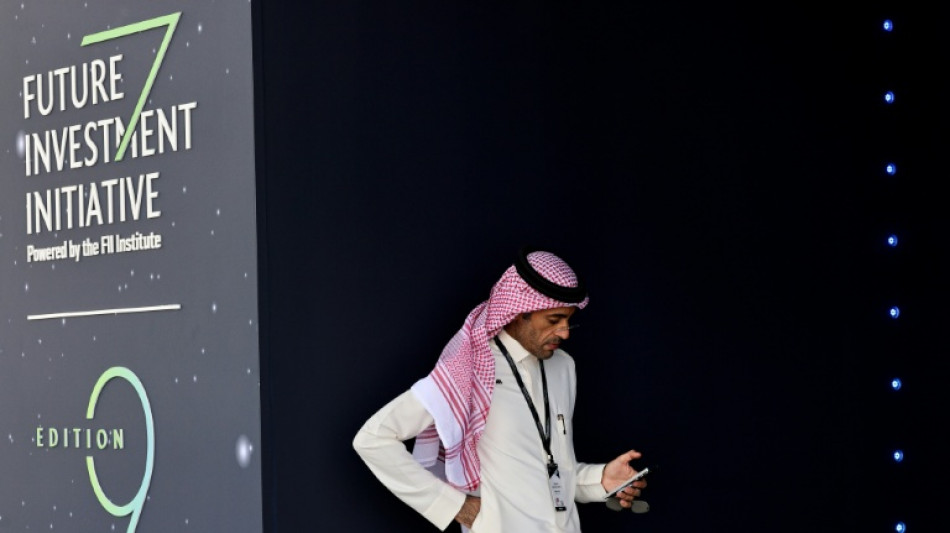
Saudi chases AI ambitions with homegrown firm pitched to global investors / Photo: Fayez Nureldine - AFP

 Alexander Skarsgard and his viral 'Wicker' transformation

 Thousands protest in Turkey over journalists' arrests, media shutdowns
 Man City beaten by Aston Villa to end perfect Premier League start

 Luis Enrique says PSG unbothered by Lyon match switch

 US gymnast Richard wins floor exercise gold at worlds

 Moltzan upstages Shiffrin to win season-opening World Cup giant slalom

 Infantino says backed by 'vast majority' in bid for re-election

 Police fire tear gas as new French protests kick off

 Police fire tear gas as new French demonstrations kick off

 Tropical Storm Champi nears China after battering Taiwan, Japan

 'Weeks, not days' in Kompany recovery, say Bayern

 Unfair to compare us to Barca: Real Madrid's Mourinho

 North Korea's Kim makes unannounced visit to Chinese border city

 Fire breaks out at Hitler's mountain retreat, suspect arrested
 Marc Marquez wins Australian sprint as Martin crashes out

 North Korea's Kim calls for training world's 'strongest' military

 Brewers edge Rays to capture World Series opener

 France to deploy 70,000 police for fresh weekend protests

 Tatum delivers as Celtics down winless Knicks

 Romantasy fans ready for sleepless night as 'Court of Thorns and Roses' returns

 De Goede hat-trick as Canada defeat England again

 How to Build an Emergency Fund for Your Furry Best Friend

 5 Ways to Prepare Financially for Parenthood
 Ebola vaccine trial begins in DR Congo

 Travelling man Wade equals Prem try record

Powered by its sovereign wealth fund of nearly $1 trillion, Saudi Arabia is backing its new AI firm Humain, entering a highly competitive sector some fear is a bubble ready to burst.
The company, launched in May, is bankrolled by Saudi's powerful Public Investment Fund, which has played a key role in financing the kingdom's so-called gigaprojects -- major developments aimed at boosting and diversifying its oil-reliant economy.
Humain this week signed a number of deals during the Future Investment Initiative conference (FII) in Riyadh, where its CEO doubled down on the stated goal of Saudi Arabia becoming the third-largest provider of AI infrastructure, behind the United States and China.
But Riyadh's ambitions to become a global AI hub face fierce competition from the neighbouring United Arab Emirates, which have invested in AI for years, as well as challenges over acquiring advanced US technology, including powerful chips.
"Our ambition is really, really massive," Humain's CEO Tareq Amin told delegates at the FII conference.
Humain has vowed to offer a wide range of AI services, products and tools, along with a powerful Arabic large language model.
In August, the company unveiled its debut Arabic chatbot that boasted of being able to comprehend the language's myriad dialects while also being mindful of Islamic values.
- Deals -
On Tuesday, state-backed oil giant Saudi Aramco announced plans to acquire a "significant minority stake" in Humain to scale up operations and "accelerate its growth in the AI sector", according to a joint press release.
Aramco's President and CEO Amin Nasser gushed over the potential of AI, saying the technology and digitalisation had the ability to double an oil well's productivity.
Humain also signed a $3 billion deal with private equity giant BlackStone's AirTrunk to build data centres in Saudi Arabia and struck an agreement with US chipmaker Qualcomm.
For Robert C. Mogielnicki, a senior resident scholar at the Arab Gulf States Institute in Washington, Humain, like other "nascent" Saudi tech entities, seeks "to assure audiences that the kingdom's tech ambitions are very real, feasible, and exciting".
"The fast pace of the tech agenda in the neighboring UAE, which is a key regional investment hub, heightens the need to do this," he added.
- 'Our goal' -
AI-related spending is skyrocketing across the globe, with total investments in 2025 alone expected to reach nearly $1.5 trillion, according to US research firm Gartner.
The Gulf's two largest economies, Saudi Arabia and the UAE, are vying to secure access to US technology.
The oil-producing countries have an advantage in the race to build sprawling data centres -- offering ample land, abundant energy supplies and ready access to finance along with backing from authorities.
But many challenges remain.
"The kingdom's capital means little if it doesn't have permission from Washington buy the advanced chips needed for its data center ambitions -- either for training or operating AI," Vivek Chilukuri, a senior fellow at the Center for a New American Security, told AFP.
Chilukuri added that Saudi is also facing an acute shortage of AI talent and is competing not only with "more established and well-capitalized US firms" but also with the UAE.
There are also concerns over the impact of AI, with companies across the globe shedding tens of thousands of jobs, while economic returns remain uncertain.
The spending spree has also prompted painful memories of the dotcom bubble of the late 1990s, when vast investments were wiped out.
Yet optimism was in no short supply this week in Riyadh.
"It's exciting to be in this region now because there is so much motivation from the very top levels of government to want to be leaders in AI," said Adam Jackson, the head of Middle East operations with the tech firm CIQ.
"We are not in the AI race to compete," added a female employee from Humain, who spoke to AFP on condition of anonymity because she did not have permission to speak to the press.
"We are there to be at the top with the US and China. That's our goal and vision."
R.Lee--AT