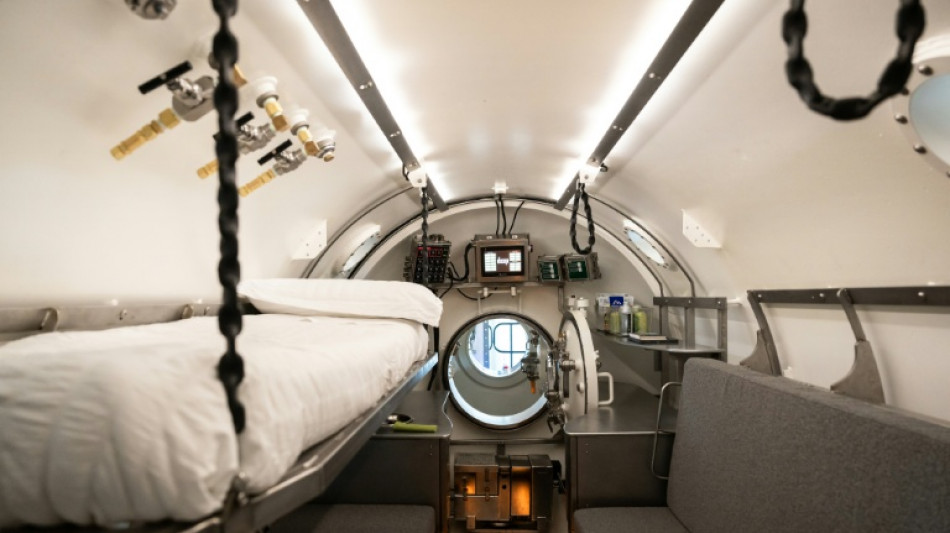
Underwater 'human habitat' aims to allow researchers to make weeklong dives / Photo: Jason Koerner - GETTY IMAGES NORTH AMERICA/AFP

 Thousands rally for Lula and Bolsonaro on eve of tight Brazil vote

 Red-hot Fuellkrug bags Bremen brace, Leipzig win

 Thousands gather at new Albanian anti-government rally

 French police fire tear gas during fresh protests

 Suspect detained after fire wrecks Hitler's mountain retreat

 Alexander Skarsgard and his viral 'Wicker' transformation

 Thousands protest in Turkey over journalists' arrests, media shutdowns

 Man City beaten by Aston Villa to end perfect Premier League start
 Luis Enrique says PSG unbothered by Lyon match switch

 US gymnast Richard wins floor exercise gold at worlds

 Moltzan upstages Shiffrin to win season-opening World Cup giant slalom

 Infantino says backed by 'vast majority' in bid for re-election

 Police fire tear gas as new French protests kick off

 Police fire tear gas as new French demonstrations kick off

 Tropical Storm Champi nears China after battering Taiwan, Japan

 'Weeks, not days' in Kompany recovery, say Bayern

 Unfair to compare us to Barca: Real Madrid's Mourinho
 North Korea's Kim makes unannounced visit to Chinese border city

 Fire breaks out at Hitler's mountain retreat, suspect arrested

 Marc Marquez wins Australian sprint as Martin crashes out

 North Korea's Kim calls for training world's 'strongest' military

 Brewers edge Rays to capture World Series opener

 France to deploy 70,000 police for fresh weekend protests

 Tatum delivers as Celtics down winless Knicks

 Romantasy fans ready for sleepless night as 'Court of Thorns and Roses' returns
To someday allow scientists to stay underwater conducting research for days on end, the UK-based company DEEP has designed Vanguard, a "subsea human habitat."
The company unveiled its prototype Wednesday at a hangar in Miami, Florida, hoping that oceanographers and other researchers can use it to stay underwater in the ocean for at least a week, instead of only a few hours like most expeditions.
"There are zones in oceans around the world that are unexplored at those depths, and making them available and accessible by divers will open up a whole new realm of science," Norman Smith, DEEP's Chief Technology Officer and the lead engineer behind Vanguard, told AFP.
For now, Vanguard is situated only 20 meters (65 feet) underwater, a depth accessible by scuba diving, but DEEP is already working on prototypes that can get down to 200 meters (650 feet).
The vessel consists of three sections: a living chamber, a diving center and a base. The first part, measuring 12 meters (40 feet) long by 3.7 meters (12 feet) wide, is where scientists would eat, sleep and work, designed to resist ocean water pressure to keep up to four occupants safe.
The "diving center" would connect to the underwater base, which would be anchored to the seabed to protect the overall habitat from waves and storms.
Vanguard also will include a floating structure on the surface of the water to transport compressed air, power the vessel, and allow for communication with the outside world.
When DEEP deploys Vanguard for the first time in the coming weeks off the coast of Florida, the company hopes scientists will be able to use it to carry out long-term underwater conservation projects, such as coral restoration.
R.Lee--AT