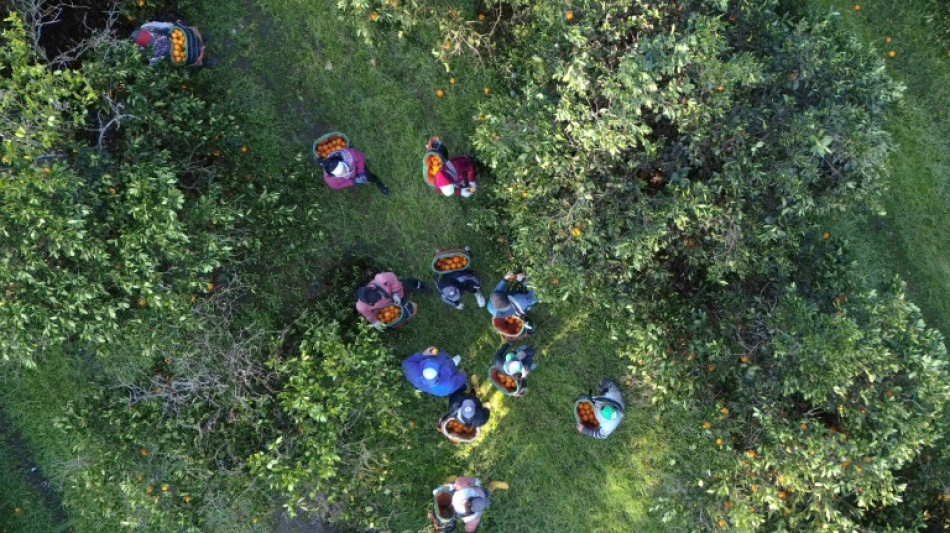
For Argentine farmers, Milei's free-market reforms fall short / Photo: JUAN MABROMATA - AFP

 Cavs edge T'Wolves in overtime despite superb Edwards

 Prescott fires Cowboys to 38-21 win over plummeting Eagles

 Kuwait padel chief hails national showing at Premier Padel Major

 Britain prepares constrained budget as debt and defence pressures mount

 Valkyries beat Dream to reach brink of WNBA title

 Benjamin Netanyahu: Israel's longest-serving PM fighting for survival

 Kuwait receives invitation to 2026 UN Water Conference in Abu Dhabi
 Arab World Institute president outlines plans for stronger Kuwait-France cultural links

 Bolsonaro's party says it recognizes Lula's election win in Brazil
 Meghan on TV menu for 'Junior MasterChef Australia'
 South Korea's chip boom fuels forecast-beating third-quarter growth

 US-brokered truce begins in Ukraine city occupied by Russia

 Qatar launches Fashion and Crafts Council to connect talent with global markets

 Jordan strikes militant groups in Syria after church attack

 FIA chief praises Middle East motorsport volunteers and officials
 8 Costs People Forget to Budget When Planning a Family

 How to Freshen Up Your Kitchen for $3,000

 Al-Thawadi urges technology to deepen human connection through shared experiences

 Ballon d'Or: Harry Kane's crowning moment

 Harry Kane wins men's Ballon d'Or

 Lula win rattles Brazil markets over spending spree fears

 De la Fuente wins men's Ballon d'Or coach of year

 Trump slams 'rigged' Brazil election after ally loses to leftist Lula

 Nadal returns for Vegas hardcourt event

 Fainga'anuku named as loose forward for All Blacks northern tour

Twenty months after Argentina's President Javier Milei came to power vowing to lead a free-market revolution in the so-called sick man of South America, the farming community is egging him on to go further.
That includes Ruben Artigues and his orchards in La Buena Moza region, two hours northwest of Buenos Aires, where the orange harvest is in full swing.
Tractors come and go groaning under the weight of sweet navel oranges plucked from the tree tops by laborers perched on ladders.
Like many farmers, Artigues embraced Milei's election in December 2023 as a win for free enterprise after two decades of mainly protectionist centre-left policies.
But he feels that the gains for farmers so far have been timid, and that producers "are growing weary."
Agricultural products represented 58 percent of Argentina's exports in 2024, making it a key driver of economic growth and a major source of foreign currency.
Farmers' frustrations are chiefly directed at the multiple taxes imposed at the national, provincial and municipal levels, which they say harm their competitiveness.
While campaigning in 2023, Milei promised to cut punishing taxes on beef and cereal exports -- a longstanding source of government revenue which he called "robbery," and eventually scrap them altogether.
But the cuts were slow in coming and fell short of industry expectations when he finally announced them last month.
Export taxes on poultry and beef fell from 6.75 percent to five percent, on corn from 12 percent to 9.5 percent, and soybeans -- one of Argentina's biggest farm exports -- from 33 to 26 percent.
There was also some relief for sorghum, sunflower seeds and byproducts and soybean byproducts.
- From 'hell' to 'purgatory' -
"We were in hell and now we've ascended to purgatory," Raul Vítores, president of the Rural Society of San Pedro, commented on the cuts.
Artigues, who lost 30 percent of his orange and peach harvest this year due to a record cold spell in July, called the changes "insufficient."
As he supervised the sorting of oranges being packed for export to Europe, he acknowledged that the "situation is difficult" for maverick economist Milei, given the poor public finances he inherited.
"Shipping a box of oranges from an Argentine port costs us 40 percent more than our competitors in Chile, Uruguay, or South Africa," he argued.
His orange trees are also a magnet for thieves who raid the orchards at night.
"Producers are growing weary, many are abandoning (fruit) and renting their fields to soybean producers," said Artigues, who employs about 120 people, noting that soybean production, being less labor-intensive than fruit, creates far less employment.
- Bumpy route to market -
Milei was elected on a promise to cut spending, tame inflation and erase a steep budget deficit.
He has delivered on those promises through a program of biting austerity, which has seen tens of thousands of public sector workers laid off and left many others on the breadline.
But he still had to go back to the International Monetary Fund, to which Argentina already owes $44 billion, to secure another $20 billion loan.
At the annual "Expo Rural" farm fair in Buenos Aires in July, Milei cast doubt on his plan to eradicate export duties altogether, saying he would not do so if it threatened his hard-won fiscal surplus.
But it hasn't been all doom and gloom for farmers.
Food producers have cheered his partial elimination of exchange controls and success in fighting inflation, which had been driving up the cost of their inputs.
They also largely support his austerity measures -- except when it impacts their bottom line.
One of Milei's first acts as president was to freeze public works, including maintenance of more than 40,000 kilometers (25,000 miles) of highways used to transport 90 percent of Argentina's freight.
Nicolas Pino, president of the Argentine Rural Society which represents large landowners, warned the increasingly ruinous state of roads was affecting business.
"It is not viable to increase production if there are no roads, railroads, or waterways to transport it," he told the farm fair.
A.Ruiz--AT