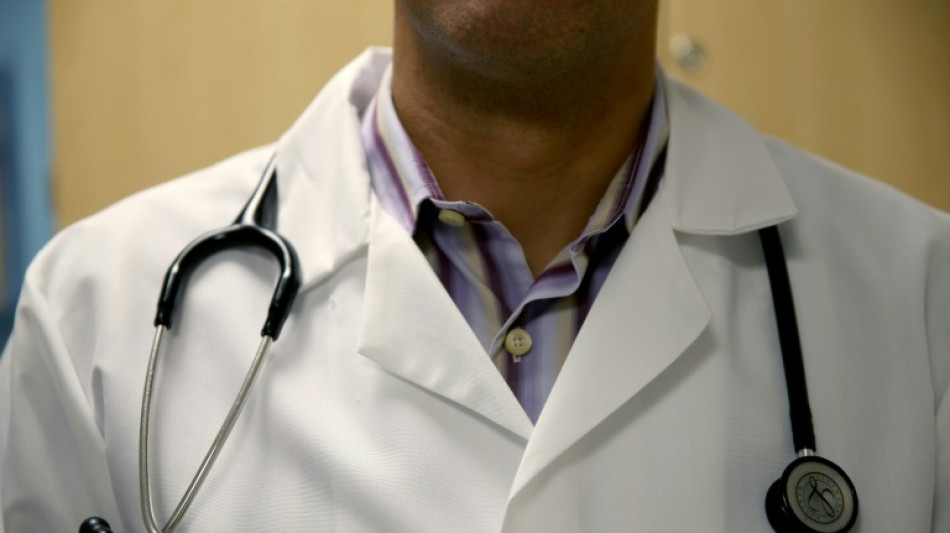
AI chatbots give bad health advice, research finds / Photo: JOE RAEDLE - GETTY IMAGES NORTH AMERICA/AFP/File

 Ukraine claims US missile holdup ahead of reported talks
 Niners hold off Commanders to stay perfect in NFL

 Tech firms bear brunt of selling as Asian stocks drop

 Reese scores 30 as Dream stun Valkyries to level WNBA finals

 Horror and disbelief after lawmaker attacked in rural Australia

 Ukraine races to secure energy supplies ahead of winter

 Vote count begins in Alberta secession referedum, testing Canada unity

 How to Use an Allowance to Teach Money Skills
 Ukraine claims US missile holdup as Trump floats summit without Zelensky

 Detained Suu Kyi receives UK royal package: Myanmar govt

 Japan successfully launches probe in historic Mars moon mission

 US to auction deep sea mining leases off American Samoa

 Australian lawmaker hurt in car attack underwent surgery overnight: PM

 Japan launches rocket for potential world first Mars moon mission

 Ethiopia PM warns Eritrea of 'severe consequences' if supports enemies

 Boland grabs opportunity for Australia as South Africa struggle in second Test

 Ronaldo handed 30-day suspension: Portuguese federation

 France announces curfews as government grapples with unrest

 Boland sets pace as South Africa struggle

 Ukraine on back foot as Kremlin moots US, China meeting

 'Stay home!': Tourists find themselves in a France convulsed by protests

 Kenyan cult leader guilty on all charges over 191 starvation deaths

 Eagles star Hurts to miss rest of NFL season: reports

 Oil-rich Alberta votes on Canada breakup

 Israel announces arrests after West Bank settler attacks on Westerners

Next time you're considering consulting Dr ChatGPT, perhaps think again.
Despite now being able to ace most medical licensing exams, artificial intelligence chatbots do not give humans better health advice than they can find using more traditional methods, according to a study published on Monday.
"Despite all the hype, AI just isn't ready to take on the role of the physician," study co-author Rebecca Payne from Oxford University said.
"Patients need to be aware that asking a large language model about their symptoms can be dangerous, giving wrong diagnoses and failing to recognise when urgent help is needed," she added in a statement.
The British-led team of researchers wanted to find out how successful humans are when they use chatbots to identify their health problems and whether they require seeing a doctor or going to hospital.
The team presented nearly 1,300 UK-based participants with 10 different scenarios, such as a headache after a night out drinking, a new mother feeling exhausted or what having gallstones feels like.
Then the researchers randomly assigned the participants one of three chatbots: OpenAI's GPT-4o, Meta's Llama 3 or Command R+. There was also a control group that used internet search engines.
People using the AI chatbots were only able to identify their health problem around a third of the time, while only around 45 percent figured out the right course of action.
This was no better than the control group, according to the study, published in the Nature Medicine journal.
- Communication breakdown -
The researchers pointed out the disparity between these disappointing results and how AI chatbots score extremely highly on medical benchmarks and exams, blaming the gap on a communication breakdown.
Unlike the simulated patient interactions often used to test AI, the real humans often did not give the chatbots all the relevant information.
And sometimes the humans struggled to interpret the options offered by the chatbot, or misunderstood or simply ignored its advice.
One out of every six US adults ask AI chatbots about health information at least once a month, the researchers said, with that number expected to increase as more people adopt the new technology.
"This is a very important study as it highlights the real medical risks posed to the public by chatbots," David Shaw, a bioethicist at Maastricht University in the Netherlands who was not involved in the research, told AFP.
He advised people to only trust medical information from reliable sources, such as the UK's National Health Service.
Th.Gonzalez--AT