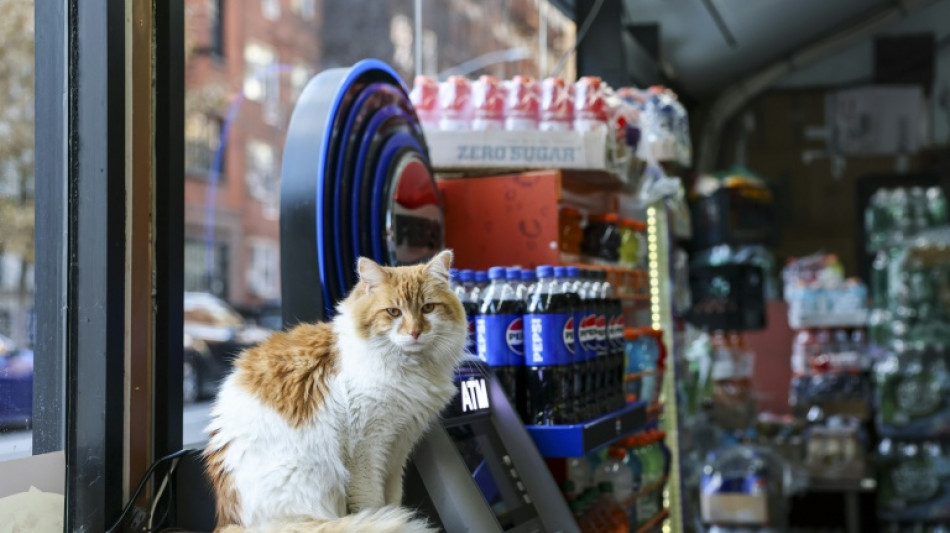
New York seeks rights for beloved but illegal 'bodega cats' / Photo: ANGELA WEISS - AFP

 Mohammed bin Rashid on Learning Speed and Civilizational Progress

 'My Name Was Poison': Donny Osmond on Fame, Failure, and Michael Jackson

 Trump HUD Rule Bars Mixed-Status Families from Federal Housing in California
 South Glens Falls Volleyball Season Ends at NYS Class A Tournament

 How to Balance Saving Money for the Future and Enjoying the Present

 Guardian Metal Resources PLC Announces Notice of AGM

 From On-Site Assembly to Integrated Deployment How Outdoor Routers Simplify Equipment Connectivity

 Trifecta Gold to Re-Focus on Mt. Hinton With Non-Dilutive Financing
 Banyan Intersects 1.67 g/t Au over 32.2 metres in the Airstrip-Powerline Gap at AurMac, Yukon

 Brennen Johnson on Spiritual Mandate, Heritage, and the Responsibility of the Gifted
Simba, a large cat with thick ginger and white fur, is one of thousands of felines that live in New York's corner shops known as "bodegas" -- even if their presence is illegal.
Praised for warding off pests, so-called bodega cats are also a cultural fixture for New Yorkers, some of whom are now pushing to enshrine legal rights for the little store helpers.
"Simba is very important to us because he keeps the shop clean of the mice," Austin Moreno, a shopkeeper in Manhattan, told AFP from behind his till.
The fluffy inhabitant also helps to entice customers.
"People, very often, they come to visit to ask, what is his name? The other day, some girls saw him for the first time and now they come every day," said Moreno.
Around a third of the city's roughly 10,000 bodegas are thought to have a resident cat despite being liable to fines of $200-$350 for keeping animals in a store selling food, according to Dan Rimada, founder of Bodega Cats of New York.
Rimada photographs the felines for his social media followers and last year launched a petition to legalize bodega cats, which drew nearly 14,000 signatures.
"These cats are woven into the fabric of New York City, and that's an important story to tell," he said.
- Pressure point -
Inspired by Rimada's petition, New York City council member Keith Powers has proposed a measure to shield the owners of bodega cats from penalties.
His legislation would also provide free vaccinations and spay or neuter services to the felines.
But animal shelters and rights groups say this wouldn't go far enough.
While Simba can nap in the corner of his shop with kibble within paw's reach, many of his fellow cats are locked in basements, deprived of food or proper care, and abandoned when they grow old or fall ill.
Becky Wisdom, who rescues cats in New York, warned that lifting the threat of fines could remove "leverage" to encourage bodega owners to better care for the animals.
She also opposes public funds being given to business owners rather than low-income families who want their cats spayed or neutered.
The latter is a big issue in New York, where the stray cat population is estimated at around half a million.
- Radical overhaul -
Regardless of what the city decides, it is the state of New York that has authority over business rules, said Allie Taylor, president of Voters for Animal Rights.
Taylor said she backs another initiative proposed by state assembly member Linda Rosenthal, a prominent animal welfare advocate, who proposes allowing cats in bodegas under certain conditions.
These would include vet visits, mandatory spaying or neutering, and ensuring the cats have sufficient food, water and a safe place to sleep.
Beyond the specific case of bodega cats, Taylor is pushing for a more radical overhaul of animal protection in New York.
"Instead of focusing on one subset of cats, we need the city to make serious investments, meaning tens of millions of dollars per year into free or low cost spay, neuter and veterinary care," she said.
A.Ruiz--AT