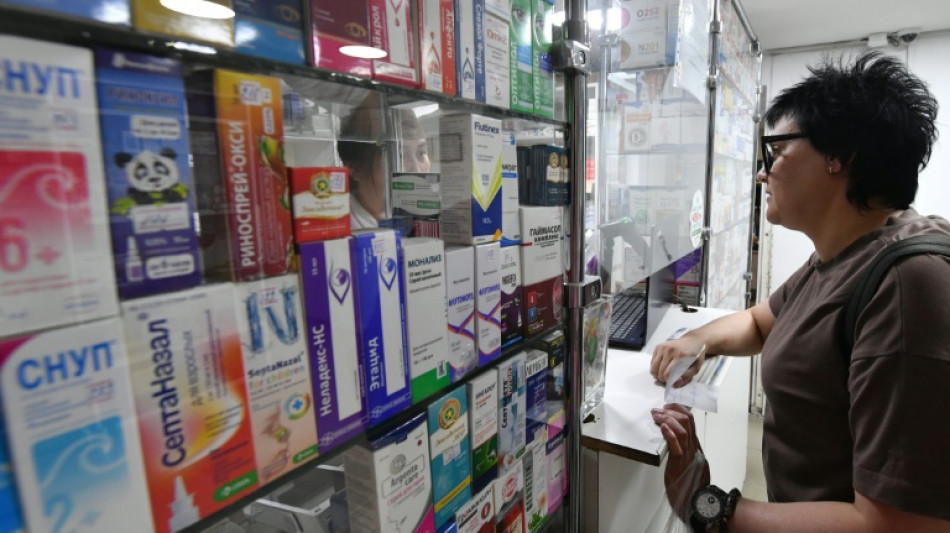
Kyrgyzstan struggles with deadly shortages of medicine / Photo: VYACHESLAV OSELEDKO - AFP

 Mercedes-Benz cuts 2026 profit outlook on tough China market
 Reparations calls follow Charles on tough Caribbean trip

 Jammu and Kashmir ministers resign before planned council expansion

 Germany, EU, stable investment stops despite upheaval: Merz

 China brands drop Mbappe for 'offending national sentiments'

 India orders evacuations as Cyclone Arnab looms

 Dutch broadcaster pulls out of Eurovision over Israel 'sensitivities'
 Critical coal inventories affect nearly half of India’s domestic power plants

 FCNR(B) deposit drive puts sharper margin pressure on private banks

 Noel Tata requests records of September 17 Tata Sons board meeting
 Reparations calls to dog King Charles's tough Caribbean trip

 Global rates and foreign outflows remain key risks for Indian markets

 Neha Nagar says ₹3 crore can fund retirement with disciplined planning

 Vikas Satija says steady SIP flows shielded Indian equities from deeper losses

 Brewers rout Rays to reach brink of World Series sweep

 Mbappe dropped by Chinese brands for 'offending national sentiments'

 Kuwait exhibition presents Ukraine’s Islamic heritage and cultural ties

 Tech firms track Wall St rally on mixed day for Asian markets

 Jay-Z to perform at Super Bowl LXI halftime show: NFL

 Climate-threatened Fijian utopia rejects calls to relocate

 Israel to give verdict on Netanyahu in pivotal election

 $1m bounties, dawn arrests: Trump presses voter fraud campaign

 Gasping for air: Borneo residents struggle as island burns
 Doha exhibition charts a millennium of Chinese maritime ceramics trade

 New Zealand ex-PM Ardern to teach leadership in Sydney

Like many people affected by serious illness in ex-Soviet Central Asia, Almagul Ibrayeva is having trouble finding medicine in her native Kyrgyzstan.
"Women are dying because of a lack of medicine," Ibrayeva, who is in her 50s, told AFP.
In remission from breast cancer, Ibrayeva needs a hormone treatment called exemestane after having a mastectomy and her reproductive organs were removed.
She said she "often" faces difficulties.
"I order it from Turkey or Moscow, where my daughter lives," she said.
"There are many medicines that are simply unavailable here. The patient has to look themselves and buy them."
- 'Meagre' supply of medicine -
Shortages, high prices and the poor quality of medicine affect many of the region's 80 million inhabitants.
The five Central Asian countries are highly dependent on pharmaceutical imports and patients are often left to fend for themselves.
There are often cases of expired or adulterated medicine such as the cough syrup imported from India which killed 69 children in Uzbekistan in 2023.
The costs of high-quality medicine are often prohibitive.
"Some people sell their homes, their livestock, get into debt just to survive," said Shairbu Saguynbayeva, a uterine cancer survivor.
She created a centre called "Together to Live" in the Kyrgyz capital Bishkek which hosts women who have cancer, offering accommodation and help for treatment.
"Here they can get organised. When someone is receiving chemotherapy, they fall ill, not every loved one can handle it," Saguynbayeva said.
Women at the centre sew and sell traditional Kyrgyz ornaments -- funding the treatment of 37 patients since 2019.
Saguynbayeva says she is grateful to the Kyrgyz state for "finally" starting to supply more medicine but says the quantity is still "meagre".
One patient, Barakhat Saguyndykova, told AFP that she received "free anti-cancer medicine only three times between 2018 and 2025".
At the National Oncology and Haematology Centre, doctor Ulanbek Turgunbaev said that sourcing medicine was "a very serious problem for patients" even though medicine supply has increased.
He said the best way of reducing therapy costs was "early detection" of serious illnesses.
- 'Better to save a mother' -
Material deficits and a shortage of 5,000 health professionals in Kyrgyzstan mean that the most urgent needs have to be addressed first.
President Sadyr Japarov has promised to eliminate corruption in the medical sector, which cost the health minister his job last winter.
While medicine factories have finally been opened, the situation in the short term remains complicated.
The Kyrgyz Chamber of Commerce and Industry said that "around 6,000 medicines could disappear from the market by 2026" because of the need to "re-register under the norms of the Eurasian Economic Union" -- a gathering of former Soviet republics including Kyrgyzstan.
The government in 2023 created a state company called Kyrgyz Pharmacy which is supposed to centralise medicine requests and bring down prices, according to its head, Talant Sultanov.
But the organisation has been under pressure because of a lack of results.
Sultanov said he hoped medicine prices could be lowered "by signing more long-term agreements with suppliers through purchases grouped on a regional basis" with other Central Asian countries.
Kyrgyz Pharmacy has promised steady supplies soon but many women in Bishkek are still waiting for medicine ordered through the company months ago.
Recently a mother of three "died simply because she did not receive her medicine in time," Saguynbayeva said.
"It is better to save a mother than to build orphanages," she said.
Th.Gonzalez--AT