Three-year heatwave bleached half the planet's coral reefs: study / Photo: DAVID GRAY - AFP/File

 France's debt climbs to highest since 1978: ministry

 McIlroy two shots off the lead at Wentworth after eagle on 18

 Martinez brace saves Inter in Serie A top-two clash with Roma

 Rosenior abused but guides Paris FC past old club Strasbourg

 Seven-try Lyon beat Pau, climb to Top 14 summit

 Brighton defeat a 'big lesson' against complacency for Arsenal, says Arteta

 Thousands protest inaction over climate crisis in Switzerland

 Carapaz out of cycling world championships

 'Fragile' Tottenham beaten by Aston Villa despite late rally

 Mourinho hails Real Madrid grit before Atletico derby clash

 Martin wins Austrian MotoGP sprint after Acosta crash

 Japan edge Fiji to win Pacific Nations Cup

 Black smoke, flames rising near Riyadh airport: residents to AFP

 UK actor Naomi Watts honoured at Spain film festival

 Japan emperor declares Asian Games open after turbulent build-up

 Asian Games open with unity message after troubled build-up

 Denmark hails 'binding' Greenland deal with Trump

 We don't want Games host Japan losing money, says Asian Olympic official

 Ed Sheeran returns to stage after Palestinian controversy

 Asian Games to open in Japan after troubled build-up

 Drone owners rush to offload devices ahead of Beijing ban

 Trump's beef policies irk Texas ranchers, testing their loyalty

 New to The Street Broadcasts Tonight at 6:30 PM ET Across the United States, Latin America and MENA, Featuring BioVie, Acurx Pharmaceuticals, Lantern Pharma and SafeSpace Global

 Nvidia, OpenAI CEOs to attend Xi dinner at White House

 Anthropic picks Accenture for in-house AI safety evaluation

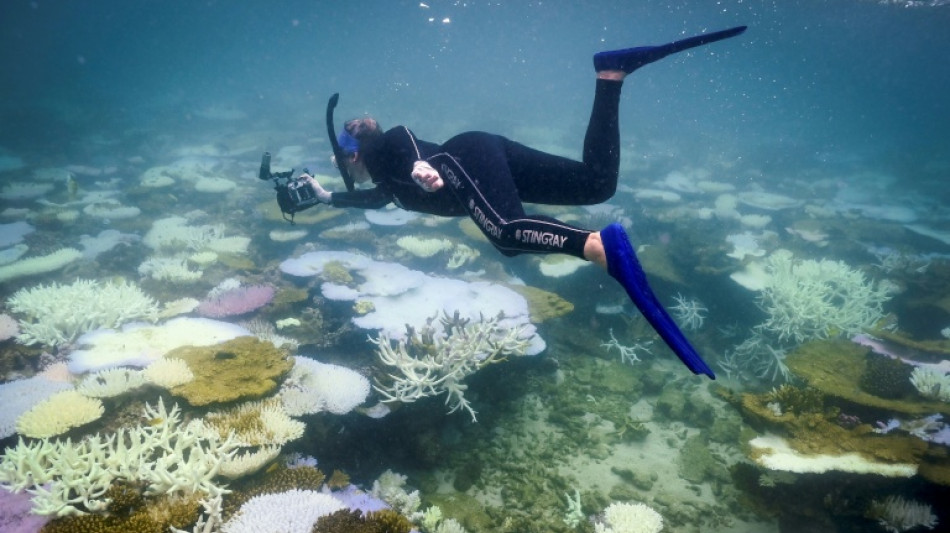
A study published on Tuesday showed that more than half of the world's coral reefs were bleached between 2014-2017 -- a record-setting episode now being eclipsed by another series of devastating heatwaves.
The analysis concluded that 51 percent of the world's reefs endured moderate or worse bleaching while 15 percent experienced significant mortality over the three-year period known as the "Third Global Bleaching Event".
It was "by far the most severe and widespread coral bleaching event on record", said Sean Connolly, one the study's authors and a senior scientist at the Panama-based Smithsonian Tropical Research Institute.
"And yet, reefs are currently experiencing an even more severe Fourth Event, which started in early 2023," Connolly said in a statement.
When the sea overheats, corals eject the microscopic algae that provides their distinct colour and food source.
Unless ocean temperatures return to more tolerable levels, bleached corals are unable to recover and eventually die of starvation.
"Our findings demonstrate that the impacts of ocean warming on coral reefs are accelerating, with the near certainty that ongoing warming will cause large-scale, possibly irreversible, degradation of these essential ecosystems," said the study in the journal Nature Communications.
An international team of scientists analysed data from more than 15,000 in-water and aerial surveys of reefs around the world over the 2014-2017 period.
They combined the data with satellite-based heat stress measurements and used statistical models to estimate how much bleaching occurred around the world.
- No time to recover -
The two previous global bleaching events, in 1998 and 2010, had lasted one year.
"2014–17 was the first record of a global coral bleaching event lasting much beyond a single year," the study said.
"Ocean warming is increasing the frequency, extent, and severity of tropical-coral bleaching and mortality."
Australia's Great Barrier Reef, for instance, saw peak heat stress increase each year between 2014 and 2017.
"We are seeing that reefs don't have time to recover properly before the next bleaching event occurs," said Scott Heron, professor of physics at James Cook University in Australia.
A major scientific report last year warned that the world's tropical coral reefs have likely reached a "tipping point" -- a shift that could trigger massive and often permanent changes in the natural world.
The global scientific consensus is that most coral reefs would perish at warming of 1.5C above preindustrial levels -- the ambitious, long-term limit countries agreed to pursue under the 2015 Paris climate accord.
Global temperatures exceeded 1.5C on average between 2023-2025, the European Union's climate monitoring service, Copernicus, said last month.
"We are only just beginning to analyse bleaching and mortality observations from the current bleaching event," Connolly told AFP.
"However the overall level of heat stress was extraordinarily high, especially in 2023-2024, comparable to or higher than what was observed in 2014-2017, at least in some regions," he said.
He said the Pacific coastline of Panama experienced "dramatically worse heat stress than they had ever experienced before, and we observed considerable coral mortality".
A.Clark--AT