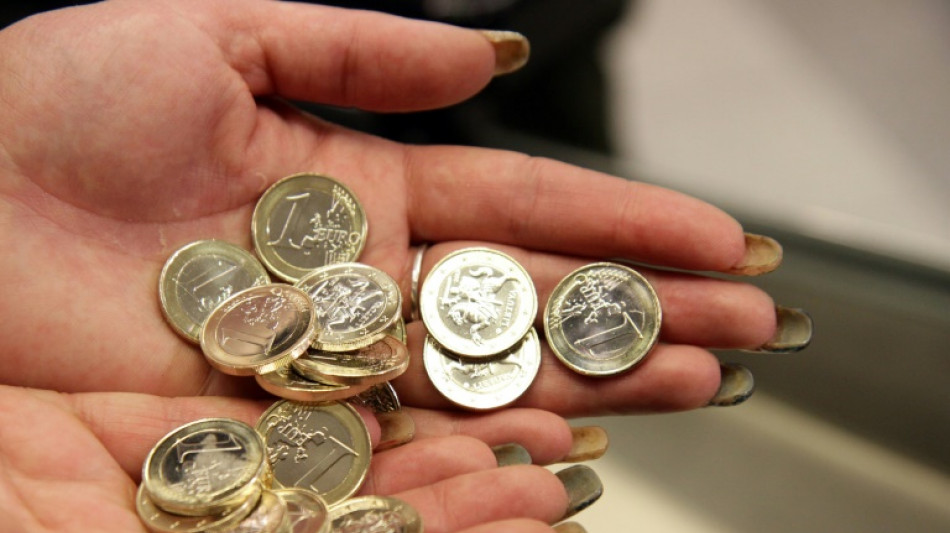
Defence, joint debt and farmers: EU draws budget battle lines / Photo: PETRAS MALUKAS - AFP/File

 Trump tamed after US midterms? Europe doubts it

 Tech stocks soar as SK hynix adds to rising AI confidence
 Sri Lanka's Tamil farmers fight to reclaim land after civil war
 Afghans compete for jobs, homes as millions return

 'They don't care about us': Trump food aid cuts leave Americans struggling and angry
 Meta, Snap head to trial in another case about social media's harms

 French Senate passes bill to make protesters pay for unrest damage

 India evacuates tens of thousands as Cyclone Arnab makes landfall
 In tight Israel vote, both camps hold out cautious hope
 AI chip giant SK hynix says quarterly operating profit soars 630%
 Youths testify about 'despair' in unprecedented Canadian climate trial

 Syria, Jordan agree to mend ties after deadly strike
 Arsenal stunned by fourth-tier Fleetwood in League Cup
 Last-gasp Sabitzer strike sends Dortmund past Bremen in German Cup
 Rights groups reject Emirati diplomat for UN top job
 Flavio Bolsonaro headed to US after Brazil election defeat: US media
 Alcaraz and Zverev win Vienna openers

 Tech firms gain ahead of Fed decision, results from AI giants

 Syria condemns deadly Jordan strikes as 'unacceptable violation'
 England's Fin Smith in race against time to face Australia
 UN nuclear watchdog chief urges Iran to grant access
 Boeing shares tumble after it releases cautious growth forecast
 Lula's re-election revives Brazil-US tensions
 Carney moves to remake Canada alliances as US ties strained

 Serbia's students demand state media chiefs resign after poll win
When the European Union unveils its long-term spending proposals next week, it will kick off the bloc's biggest budget battle in recent history.
EU chief Ursula von der Leyen has a mammoth task on her hands: present a budget for 2028-2034 that supports farmers, helps member states ramp up their defence spending, and all while paying back the debts racked up during the covid pandemic.
The European Commission, the bloc's executive arm, will outline the proposals Wednesday, setting the stage for explosive debates with capitals and EU lawmakers over the next two years.
The previous 2021-2027 budget was worth around 1.2 trillion euros ($1.4 trillion) and made up from national contributions -- around one percent of the member states' gross national income -- and money collected by the EU such as customs duties.
The European Parliament has already made it clear it wants more money.
Von der Leyen wants the budget to address the EU's priorities: security, competitiveness and better preparing the 27-country bloc for economic shocks.
But the EU wants to achieve this while reining in ballooning public debts and deficits, and simultaneously bolstering its industries to catch up with rivals in China and the United States.
- Better EU security -
Security will be top of von der Leyen's mind as she makes the finishing touches to the budget with war still raging in Ukraine and fears among member states of a more aggressive Russia.
It is more important given the NATO military alliance last month pledged to spend significantly more on defence -- some five percent of national economic output.
There are 23 EU members in the Western military alliance.
Also under consideration is a 100-billion-euro fund to keep Ukraine afloat, but one EU official said it could change between now and Wednesday.
Von der Leyen this week vowed to support Ukraine "until 2028 and beyond, when the new European budget kicks in".
Under EU treaties, the bloc cannot spend directly on defence, but it can pour money into dual-use infrastructure like bridges that would be critical during a war.
- Supporting farmers -
The EU's common agricultural policy (CAP) -- vast farming subsidies that make up the biggest share of the budget -- will be the subject of fiery debates.
It accounts for nearly a third of the EU's current multi-year budget -- around 387 billion euros, of which 270 billion euros are directly paid to farmers.
The EU is thinking about moving away from subsidies based on farm size -- and putting a cap on how much one farm can get -- which could free up billions of euros.
"There is a growing recognition that its share in the EU budget should decline and I also expect it to decline further," said Zsolt Darvas of Bruegel think tank.
The commission is considering cutting part of the agriculture budget without touching the direct payments, but farmers have made it clear that's a red line.
"I have a tractor and I'm ready," Massimiliano Giansanti, president of Europe's influential Copa farming lobby, raising the spectre of more farmers' protests after months of demonstrations last year by disgruntled European farmers.
Farmers plan to protest Wednesday in front of the commission in Brussels as they seek to pile the pressure on the EU.
Brussels is also looking into whether CAP will keep its dedicated budget or be integrated into wider cohesion funds, with allocations left to member states to decide.
France, whose farmers are the biggest CAP beneficiary, opposes this.
- How to pay for it? -
The big question looming over everything: where will the money for all this come from?
France, Italy and others are pushing for more joint borrowing but that's a no-go for Germany, a major net contributor to the budget, as well as frugal EU states Finland, The Netherlands and Sweden.
One idea put forward has been an instrument that would allow the EU to seek grants or loans in the event of a crisis like the pandemic.
Since some states would fiercely oppose such a measure, an EU diplomat said he had seen the idea appear and disappear from draft texts shared with capitals.
Other options to raise money include a possible digital services levy as well as collecting money from taxes on small packages entering from outside the EU.
The last time the EU took on joint debt was during the pandemic, borrowing around 800 billion euros to rescue the European economy.
Except now the bloc must start paying that money back -- potentially up to 30 billion euros annually -- from 2028.
H.Romero--AT