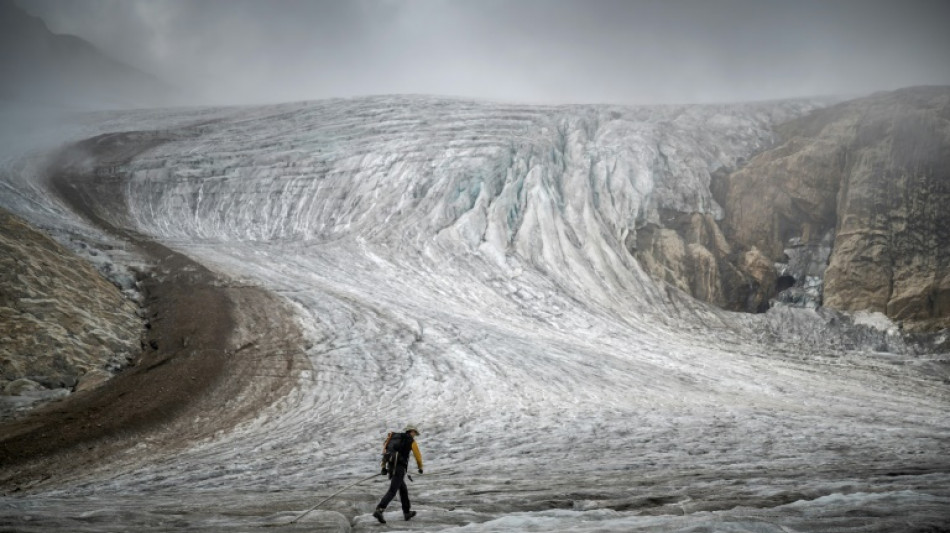
Meltdown: Swiss glaciers hit annual tipping point weeks early / Photo: Fabrice COFFRINI - AFP/File

 Australia axe Labuschagne for Zimbabwe, South Africa ODI series

 Heavy rain at Grand Canyon after flood kills 2, dozen missing

 Kushner blames soccer power struggle for World Cup plan collapse

 Buoyant Alcaraz shakes off nerves to advance at US Open

 US draws European pushback with Russia G20 finance invite

 Jury begins deliberations in Tupac Shakur murder trial

 US Supreme Court allows Trump ballroom project to proceed

 Trump says US reviewing position on Falkland Islands

 Saka strikes as flawless Arsenal punish troubled Villa

 Oil prices surge on renewed fighting in US-Iran war

 Cycling superstar Pogacar has surgery after Vuelta crash
 Man City agree deal for Everton's Ndiaye

 Apple CEO Tim Cook gives nod to founder Steve Jobs in final memo

 Russian finance minister makes unexpected appearance at G20

 Happy to be back in NY, Sabalenka advances

 Naomi Watts to receive lifetime award at top Spain film fest

 Jury hears closing arguments in Tupac Shakur murder trial

 Pakistan sack coach, send seven players home after England defeats

 New storms threaten Grand Canyon flood search, 2 bodies recovered

 France takes aim at ultra-fast fashion with new levy

 Tribunal says India cannot withdraw from water treaty with Pakistan

 John Galliano pulls US exhibition after antisemitism backlash

 French Top 14 boss offers 'no guarantees' for first Club World Cup

 Munoz reunites with Glasner after joining Forest from Palace

 Liverpool sign Barcola from PSG for £124 million

The snow and ice accumulated last winter by Switzerland's glaciers has already melted away, a monitoring service said, with Friday marking the alarming second-earliest arrival on record of the tipping point known as glacier loss day.
All further melting between now and October will see the size of glaciers in the Swiss Alps shrink, according to Glacier Monitoring in Switzerland (GLAMOS).
This century, the tipping point, on average, has been reached in mid-August -- itself already bad news for the nation's 1,400 glaciers, which are shrinking at a staggering rate.
Its arrival several weeks earlier on July 4 is "another alarm call", GLAMOS chief Matthias Huss told AFP.
"It's like the glaciers are shouting out: 'We're disappearing. Help us.'"
Glaciers in the Swiss Alps began to retreat about 170 years ago.
The retreat was initially modest but in recent decades, melting has accelerated significantly as the climate warms.
The volume of Swiss glaciers shrank by 38 percent between 2000 and 2024.
- Summer of destruction -
"If we have a glacier loss day, it means that the glacier is losing mass," said Huss.
"For a glacier that is healthy, the day would occur at the end of September, or in October -- or not at all".
With no glacier loss day, the summer would simply melt away only the snow that accumulated over the previous winter.
This would be "the ideal case -- a glacier in equilibrium with the climate", said Huss.
Its arrival on July 4 means that "critically, we have the whole summer left to destroy the ice".
"Moving this day forward by five to six weeks before the normal date over the last 20 years means we're just prolonging this mass loss season dramatically," he said.
The assessment is made using 12 reference glaciers.
Last winter saw low levels of snowfall, and June was the second warmest on record, contributing to the day's early arrival this year.
In data going back to 2000, the only time that the tipping point arrived even earlier was in 2022, when it came on June 26.
"That was really a game-changer for us glaciologists because it was the first year when we saw absolutely extreme melting.
"Everything that we knew before about glacier melting changed," said Huss.
Experts thought 2022 was a complete outlier and although a warming climate meant other such years would be coming down the line, they did not expect to see the next very early glacier loss day coming so soon afterwards.
- Feedback effect -
Huss noted that extreme melting produces an accelerating feedback effect, worsening the situation even further.
Once the reflective white snow coverage from winter is gone from the top of the glacier, the darker, more absorbent grey surface of the bare ice is exposed.
"With the same amount of solar radiation, we can now melt more ice," Huss said.
With the European heatwave over the past week and the possibility of further heatwaves in July and August, "it is very like that again it is a very bad year for Swiss glaciers", he said.
Melting glaciers threatens the long-term water security for millions of people downstream who rely on them for fresh water.
Much of the water that flows into the Rhine and the Rhone, two of Europe's major rivers, comes from the Alpine glaciers.
T.Perez--AT