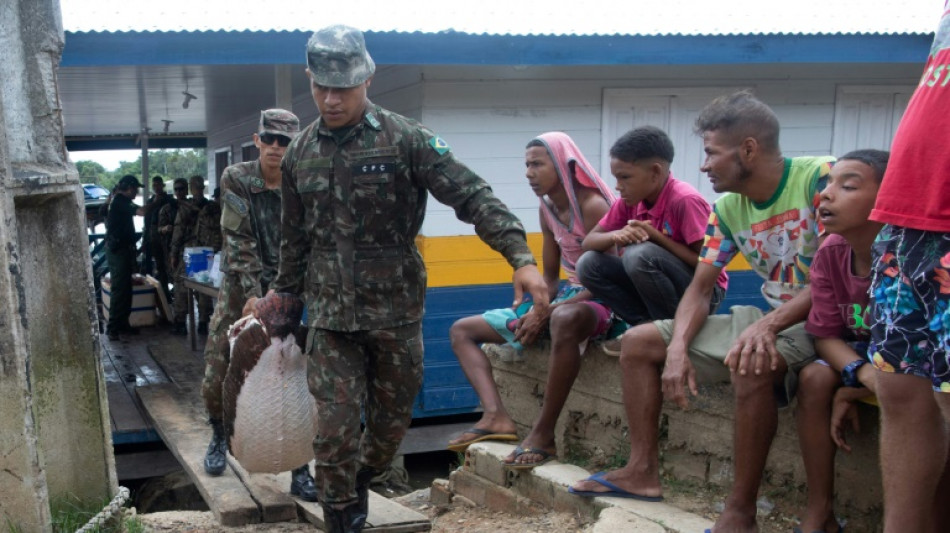
Fish trade's murky waters cloud double murder in Amazon / Photo: JOAO LAET - AFP/File

 Meloni government becomes Italy's longest-lasting

 Funerals in Nepal for missing, a week after deadly floods
 US aircraft carrier arrives in Thailand after months at sea

 US aircraft carrier approaches Thai port after months at sea
 Nepal's young PM faces gravest test after flood catastrophe
 What rainbow? LGBTQ Indonesians on edge as hostility mounts
 O'Connor eyes Wallabies World Cup swansong after Force return

 Syria UXO causing death, injury every six hours: charity

 Tiger Woods set to change not guilty plea in DUI case: court documents

 Zelensky warns airlines Russian skies not safe due to Ukraine drones

 UK vows anti-settler measures as Israel warns of retaliation

 New pro Koivun among US Presidents Cup picks

 G20 finance leaders close talks marked by US welcoming Russia

 From Hollywood to big time tennis: teen makes US Open debut

 Man City secure Premier League record deal to sign Fernandez

 Kaepernick says NFL 'blackballing me' decade after protest
 Atletico loan David from Juve, send Lemar to Elche

 Chelsea 'keeper Sanchez makes deadline-day move to Como

 Kroenke to buy baseball's Los Angeles Angels: statement
 US defends Trump's Venezuela oil deal

 OpenAI to launch new model with 'stronger safeguards' after hack

 Fans mourn 'bittersweet' final Ariana Grande gig in London

 Norway's King Haakon VIII swears allegiance to constitution

 Syria site infrastructure 'consistent with nuclear reactor': IAEA

 Juventus sign Woltemade, Sarr on loan from Premier League
The pirarucu is one impressive fish: a huge, thrashing Amazonian monster with red-and-black scales the size of serving spoons.
Still, it's just a fish. How is it possible it could have gotten British journalist Dom Phillips and Brazilian Indigenous expert Bruno Pereira murdered?
Police say Phillips, 57, and Pereira, 41, were shot dead on June 5 returning from a research trip in Brazil's far-flung Javari Valley.
At first glance, the jungle-covered region near the Peruvian and Colombian borders seems like one of the last untouched wildernesses, home to a sprawling Indigenous reservation with the biggest concentration of uncontacted tribes on Earth.
But the double murder lay bare growing violence in the region fueled by illegal fishing, logging, mining and drug trafficking.
Pereira had received death threats for his work fighting poaching on the reservation, where non-natives are banned from hunting and fishing.
"He waged a major crackdown on illegal fishing. All those guys (the poachers in the region) knew Bruno," says Orlando Possuelo, 37, who worked with Pereira coordinating Indigenous anti-poaching patrols -- a job that has earned him death threats, too.
Investigators say Pereira and Phillips were motoring down the meandering Itaquai river in a small boat when a group sped up from behind and shot them.
Police have identified eight suspects, and arrested three so far.
Locals in Atalaia do Norte, a sleepy river town near the northeastern edge of the reservation, say all three are poachers who illegally fish in Indigenous territory for pirarucu, a protected species that is the biggest freshwater fish in South America.
- 'Everyone here knows' -
Fishermen in Atalaia say poaching pirarucu -- a tasty, coveted fish that can reach 4.5 meters (nearly 15 feet) and weigh up to 200 kilograms (440 pounds) -- is a big-money business linked to drug traffickers operating in Peru and Colombia.
The traffickers allegedly use the black-market fish trade to launder drug money -- part of what the Brazilian Forum for Public Security recently called the "complex national and transnational criminal chains that operate across different economies" in the Amazon.
"What happened to Bruno and Dom is the result of an increase in organized crime, which is in turn explained by the absence of the state," said Antenor Vaz, ex-chief of Brazilian indigenous affairs agency FUNAI's operations in the Javari Valley.
The alleged drug-trafficking link has raised the question of whether the suspects acted alone.
Federal police said Friday they did, ruling out the involvement of a "mastermind or criminal organization."
The statement infuriated the Indigenous-rights group where Pereira worked, UNIVAJA, which accused the police of ignoring "considerable" evidence a "powerful criminal organization" was behind the killings.
"Everyone here knows organized crime was involved," UNIVAJA head Paulo Marubo told AFP.
- Pirarucu taboo -
At Atalaia's fish market, a noisy hangar with concrete floors and white-tile stalls, pirarucu has disappeared since Phillips and Pereira went missing.
Some pirarucu sales are in fact legal -- there are six local lakes outside the Indigenous reservation where restricted fishing is allowed.
But much of the pirarucu on the market is likely illegal.
A report by the International Union for the Conservation of Nature found 83 percent of the illegal fish seized in Brazil from 2012 to 2019 was pirarucu.
With the army, federal police and world media in town to investigate the men's disappearance, fishermen are taking no chances on pirarucu these days, even if landing one of the giants can bring in hundreds of dollars -- badly needed cash for most families in the region, one of the poorest in Brazil.
"Legal fishermen are afraid to even go out right now, with the army here and everyone blaming us for this atrocity," says Roberto Pereira da Costa, 49, president of the local fishermen's association.
Legal fishermen are being unfairly villainized, he says.
"You can see the difference between the illegal fishermen and us. They've got big boats, fast motors, they're not just catching 15 kilos of fish to feed their families, they're trying to take out everything they can."
- 'A bigger story' -
In December, journalist Monica Yanakiew of Al Jazeera English joined Pereira on an expedition like the one Phillips accompanied.
Her crew even captured him warning the fisherman who is now the lead suspect in the case not to fish on Indigenous land.
Poachers got "infuriated" when Pereira's patrols seized their fish, says Yanakiew.
But "it's a bigger story than that," she says.
Pereira would not have needed to mount independent patrols if President Jair Bolsonaro's administration had not dramatically cut enforcement operations by FUNAI and environmental authorities, critics say.
"The fact that the government has turned a blind eye to everything that is going on has empowered" criminals, says Yanakiew.
"They think they can get away with murder."
M.White--AT