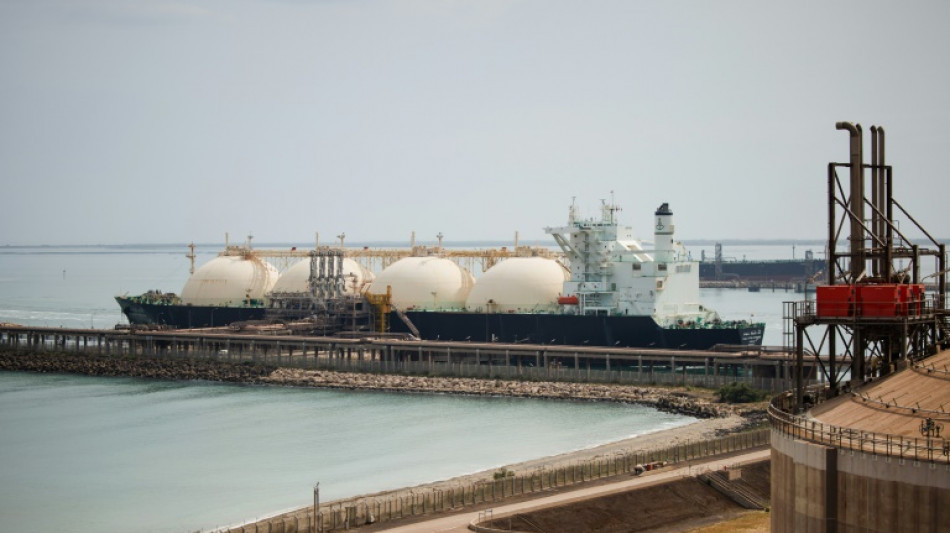
EU proposes ending all Russian gas imports by 2027 / Photo: CLEMENT MAHOUDEAU - AFP/File

 Pope Leo makes history with US midterm vote

 Arsenal boss Arteta fires 'Disneyland' warning at Dowman after Fleetwood red card
 Russia's ice hockey stars come in from the cold after CAS ruling
 Wall Street tech rout deepens on doubts over AI spending

 'Life in the old dog': German economy grows more than expected

 England great Anderson asks what's 'wrong with me?' after Lancashire exit
 Markets lashed by tech rout as earnings fan AI fears
 Germans to join Europe's youth protest wave

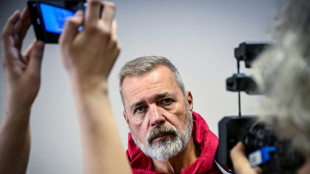 Novaya Gazeta closure part of Russia's 'giant military campaign': Muratov to AFP

 US oil giants report profit surge again on Iran war

 Tech sell-off deepens as earnings fan AI fears
 Carmaker Audi cuts outlook again on China, US woes

 Chase sparks Bangladesh collapse as West Indies on top in Mirpur

 BP net profit quadruples as Mideast war lifts oil prices

 Kulusevski says 'nervous system changes' behind Spurs return

 Marquez crashes, then tops second practice in Malaysia
 New home for orangutans rescued from Indonesia's burning forests
 Independent Russian newspaper Novaya Gazeta shuts under Kremlin pressure
 Thailand extends activist's jail term to more than 34 years
 China denies spying on Nvidia's Jensen Huang
 BP net profit quadruples on higher oil prices

 Kiss backs 'hungry' Beale to push for Wallabies game time
 World number one Rybakina withdraws in Tokyo with injury
 Malawi's fuel shortages, record prices deepen economic crisis

 Rubio hosts G20 ministers as Iran, Ukraine wars divide members
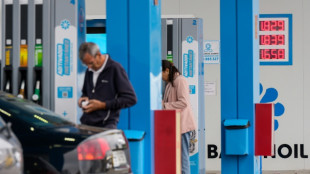
The EU on Tuesday unveiled a long-promised plan to phase out its remaining gas imports from Russia by the end of 2027, a challenge given Europe's continued dependence on Russian fossil fuels.
"Today the European Union sends a very clear message to Russia: no more, no more, will we permit Russia to weaponise energy against us," EU energy chief Dan Jorgensen said as he set out the measures.
The European Commission's two-step plan would put an end to new contracts and existing short-term spot contracts with Russian suppliers by the end of 2025. All remaining imports would be banned by the end of 2027.
"No more will we allow our member states to be blackmailed. No more will we indirectly help fill up the war chest in the Kremlin," Jorgensen told a news conference.
The EU enacted a ban on Russian oil in late 2022 in response to Moscow's invasion of Ukraine, and has since sought to wean itself off Russian gas supplies.
Although imports via pipeline have fallen sharply, several European countries have increased their purchases of Russian liquefied natural gas (LNG), transported by sea, and the bloc now wants to turn the tap off completely.
Russia still supplies 17.5 percent of the bloc's gas, based on EU data, and as much as 19 percent according to the Institute for Energy Economics and Financial Analysis (IEEFA).
To do without Russian energy, "the guiding principle is diversification", European Commission chief spokeswoman Paula Pinho said last week.
Phasing out Russian supplies would pave the way for Europe to buy more LNG from the United States -- something both Brussels and Donald Trump have floated as a way to resolve the standoff sparked after the US president targeted European exports with tariffs.
EU trade chief Maros Sefcovic told the Financial Times that the dispute with Washington could be resolved "very quickly" through LNG and soybean purchases -- as a way to reduce the 27-country bloc's trade surplus with its US partner.
The United States is already the bloc's largest LNG supplier, making up 45.3 percent of the market.
- 'Much more to do' -
EU officials acknowledge that phasing out Russian energy is easier said than done, as some member states are more dependent on Moscow's LNG than others, while others like Hungary have friendly ties with the Kremlin.
France for example would face a heavier impact from any move away from Russian LNG since it has five terminals for its delivery in Europe.
France increased its Russian LNG imports by 81 percent between 2023 and 2024, giving Russia 2.68 billion euros ($3 billion) in income, according to the Institute for Energy Economics and Financial Analysis.
The commission's plan -- which still needs approval from member states -- was delayed as Brussels waited to see whether talks between Russia and the United States yielded a deal to end the Ukraine war.
The EU executive has highlighted its efforts to reduce dependence on Russian fossil fuels since the 2022 invasion.
Over a few years, "we went from 45 percent of our gas imports coming from Russia, down to 18 percent. We went from one-in-five barrels of oil down to one-in-fifty, a tenfold reduction," EU chief Ursula von der Leyen said last month.
But, she admitted, "we all know that there is so much more to do".
Ch.Campbell--AT