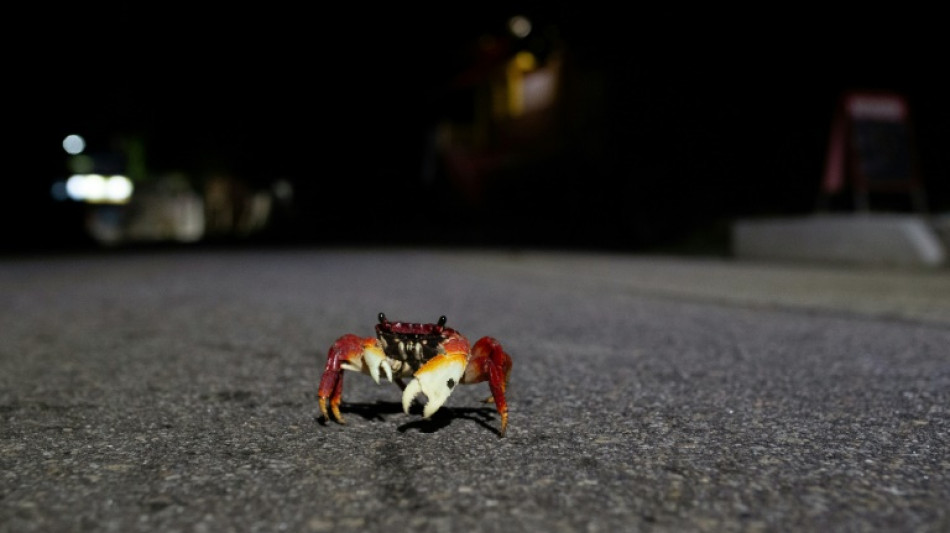
In Brazil, hopes to use AI to save wildlife from roadkill fate / Photo: TERCIO TEIXEIRA - AFP

 Madonna returns to form with dancefloor filler "Confessions II"

 Dean says Australia final a 'fresh start' for England

 Wimbledon giving Serena 'as much time' as possible for doubles

 Chinese investors flock to Hong Kong as trading curbs tighten

 Projected 'super typhoon' heads for US Pacific islands

 UN warns of strong looming El Nino
 Hunt for last signs of life in Venezuela quake zone
 Asian markets rise as beaten-down tech stocks enjoy bounce

 David v Goliath as Cape Verde face Messi's Argentina at World Cup

 Nagelsmann quits as Germany coach after World Cup exit: reports

 All Blacks return to Christchurch 'a blessing', says Savea
 'Not a museum': Slovak UNESCO village strains under tourism

 DR Congo opposition builds against presidential third-term bid

 China sports brands score NBA stars to assist global ambitions

 Man dies after setting self ablaze outside UN in New York: police

 VAR 'taking joy' from football says Croatia coach Dalic after loss
 Afghans come home but risk exclusion without any ID
 'Coincidence of life' says Ronaldo after Jota tribute a year from death

 Japan face Italy without banned coach Jones

 Ronaldo, Portugal advance after VAR drama to set up Spain showdown

 AI romance scam impersonating Dubai prince ensnares victims

 Portugal advance in World Cup thanks to last-gasp Ramos winner

 Mission impossible? England take the World Cup high road against Mexico

 The Black Book of Reshoring by Douglas Brown Named Finalist in 2026 International Book Awards Business Category
 'I was just missing a goal,' says Spain's Yamal

In Brazil, where about 16 wild animals become roadkill every second, a computer scientist has come up with a futuristic solution to this everyday problem: using AI to alert drivers to their presence.
Direct strikes on the vast South American country's extensive road network are the top threat to numerous species, forced to live in ever-closer proximity with humans.
According to the Brazilian Center for Road Ecology (CBEE), some 475 million vertebrate animals die on the road every year -- mostly smaller species such as capybaras, armadillos and possums.
"It is the biggest direct impact on wildlife today in Brazil," CBEE coordinator Alex Bager told AFP.
Shocked by the carnage in the world's most biodiverse country, computer science student Gabriel Souto Ferrante sprung into action.
The 25-year-old started by identifying the five medium- and large-sized species most likely to fall victim to traffic accidents: the puma, the giant anteater, the tapir, the maned wolf and the jaguarundi, a type of wild cat.
Souto, who is pursuing a master's degree at the University of Sao Paulo (USP), then created a database with thousands of images of these animals, and trained an AI model to recognize them in real time.
Numerous tests followed, and were successful, according to the results of his efforts recently published in the journal Scientific Reports.
Souto collaborated with the USP Institute of Mathematical and Computer Sciences.
For the project to become a reality, Souto said scientists would need "support from the companies that manage the roads," including access to traffic cameras and "edge computing" devices -- hardware that can relay a real-time warning to drivers like some navigation apps do.
There would also need to be input from the road concession companies, "to remove the animal or capture it," he told AFP.
It is hoped the technology, by reducing wildlife strikes, will also save human lives.
- 'More roads, more vehicles'-
Bager said a variety of other strategies to stop the bloodshed on Brazilian roads have failed.
Signage warning drivers to be on the lookout for crossing animals have little influence, he told AFP, leading to a mere three-percent reduction in speed on average.
There are also so-called fauna bridges and tunnels meant to get animals safely from one side of the road to the other, and fences to keep them in -- all insufficient to deal with the scope of the problem, according to Bager.
In 2014, he created an app called Urubu with other ecologists, to which thousands of users contributed information, allowing for the identification of roadkill hotspots.
The project helped to create public awareness and even inspired a bill on safe animal crossing and circulation, which is awaiting a vote in Congress.
A lack of money saw the app being shut down last year, but Bager is intent on having it reactivated.
"We have more and more roads, more vehicles and a number of roadkill animals that likely continues to grow," he said.
W.Moreno--AT