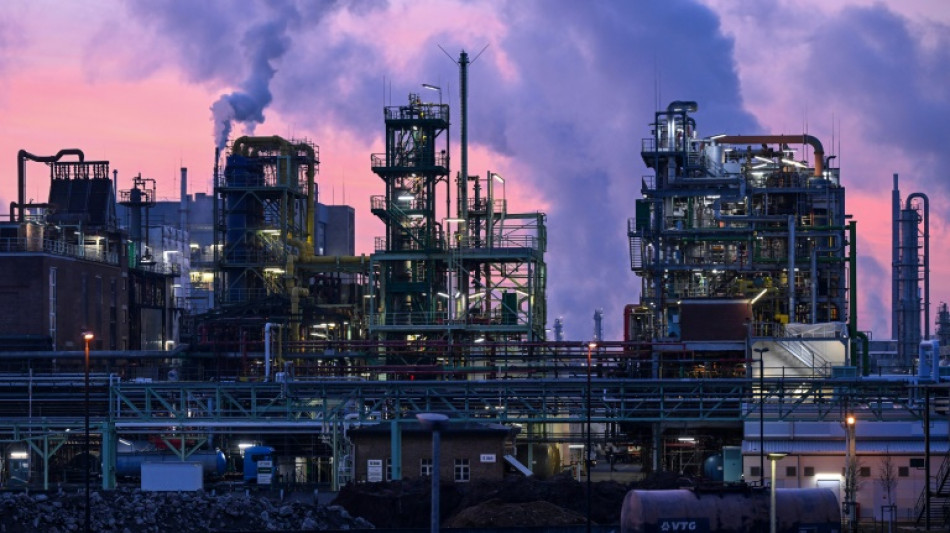
EU seeks to take on China, US to reverse economic decline / Photo: Kirill KUDRYAVTSEV - AFP/File

 Madonna returns to form with dancefloor filler "Confessions II"
 Dean says Australia final a 'fresh start' for England
 Wimbledon giving Serena 'as much time' as possible for doubles
 Chinese investors flock to Hong Kong as trading curbs tighten

 Projected 'super typhoon' heads for US Pacific islands
 UN warns of strong looming El Nino
 Hunt for last signs of life in Venezuela quake zone
 Asian markets rise as beaten-down tech stocks enjoy bounce
 David v Goliath as Cape Verde face Messi's Argentina at World Cup

 Nagelsmann quits as Germany coach after World Cup exit: reports
 All Blacks return to Christchurch 'a blessing', says Savea
 'Not a museum': Slovak UNESCO village strains under tourism
 DR Congo opposition builds against presidential third-term bid

 China sports brands score NBA stars to assist global ambitions

 Man dies after setting self ablaze outside UN in New York: police
 VAR 'taking joy' from football says Croatia coach Dalic after loss

 Afghans come home but risk exclusion without any ID

 'Coincidence of life' says Ronaldo after Jota tribute a year from death

 Japan face Italy without banned coach Jones

 Ronaldo, Portugal advance after VAR drama to set up Spain showdown
 AI romance scam impersonating Dubai prince ensnares victims

 Portugal advance in World Cup thanks to last-gasp Ramos winner
 Mission impossible? England take the World Cup high road against Mexico

 The Black Book of Reshoring by Douglas Brown Named Finalist in 2026 International Book Awards Business Category
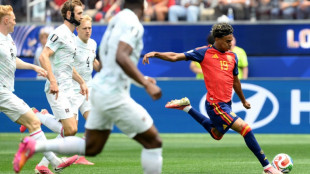 'I was just missing a goal,' says Spain's Yamal

The European Union's economy is falling further behind China and the United States, a major headache that will dominate leaders' talks on Thursday as they discuss how to stem the bloc's economic decline and bounce back.
From supply chain disruptions following the coronavirus pandemic to an energy crisis after Russia's invasion of Ukraine, Europe's economy has faced multiple challenges in recent years.
But it may yet face its biggest: the clean energy and digital transitions that Brussels has made its priority in the coming years will require additional annual investment of nearly 620 billion euros ($660 billion).
From artificial intelligence to solar panels, from computer chips to batteries, the EU is fast losing ground fast on innovation to other global powers.
The EU has been put further on the back foot as China and the United States have ploughed billions of dollars of state aid to prop up their critical industries.
What is needed is "radical change", former European Central Bank chief Mario Draghi said during a speech in Belgium on Tuesday, pointing to "other regions (that) are no longer playing by the rules".
"Our major competitors are taking advantage of the fact that they are continental-sized economies. We have the same natural size advantage in Europe, but fragmentation is holding us back," Draghi added.
The Italian ex-premier, increasingly touted as a potential successor to Ursula von der Leyen as European Commission chief, will present a report on the issue in the summer.
Official EU data shows the bloc's economic stagnation has lasted more than 18 months. While the United States grew by 2.5 percent and China by 5.2 percent in 2023, Eurostat data last month showed the EU economy grew by only 0.4 percent.
- Renewed impetus -
The EU's 27 member states want to define the strategic priorities for the European Commission's next five-year mandate following elections taking place across the bloc in June.
Draghi's report is not the only one they will be leaning on.
Another former Italian premier, Enrico Letta, will present his report on the EU single market during Thursday's leaders summit.
Letta's report was made public Wednesday and contains many proposals on how to address the current decline, including scaling up the single market to better harmonise the defence, energy and telecoms sectors at the EU level.
A key issue identified by Letta is the absence of a properly integrated EU-wide financial market, for which there has been fresh political impetus.
Although the EU has a single currency, its start-ups cannot raise the jaw-dropping amounts their US competitors can, and even Europeans find it more rewarding to pour more than 300 billion euros of their savings into US markets each year.
Letta dubbed his proposal a "savings and investment union" but the issue is not new and has been mired in technical talks for 10 years because of national divisions.
- Deindustrialisation fears -
An EU diplomat was optimistic, however, that this time the debate could lead to concrete developments.
"After the summit, it will not be off the table. The French, Germans, Dutch, Italians all want to advance on this issue so let's see how it goes," the diplomat said.
Another reason for the urgency is the sums needed by the EU. On top of the hundreds of billions required each year to fund the green transition, as war rages in Ukraine the bloc needs tens of billions of euros more to help Kyiv.
French President Emmanuel Macron proposed in January taking on joint EU debt to raise money, like Europe did during the pandemic, but that idea was given short shrift by the leaders of the so-called frugal countries, including Germany.
The EU's predicament is difficult, with figures starkly illustrating its industrial decline.
The European Trade Union Confederation, which represents 45 million workers in Europe, warned in March of an "increasingly rapid de-industrialisation" laid bare by the fact that nearly a million manufacturing jobs were lost in the past four years.
F.Ramirez--AT