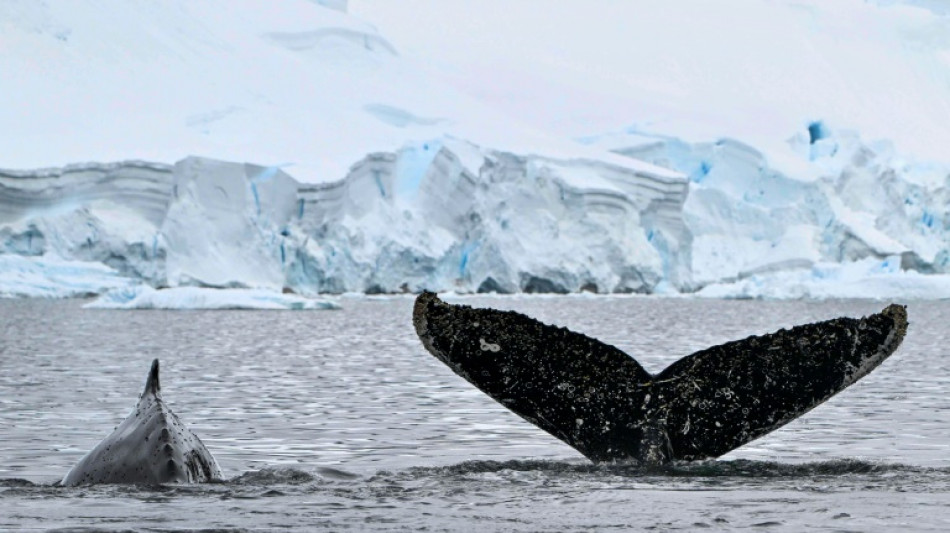
In Antarctica, scientists study extent of microplastics / Photo: JUAN BARRETO - AFP

 Thomas targets yellow in Tour team time-trial

 Bike - or even walk: World Cup fans improvise to reach NY venue

 Swedish court orders Google pay nearly $2 bn for favouring its price comparisons

 England breaks record for warmest June: Met Office

 Stocks drop with eyes on US Fed
 Barca have bid for Atletico's Alvarez: president Laporta

 'Smart' and 'very rational'? Iran's new leaders post-Ali Khamenei

 Bordeaux-Begles handed favourable draw in Champions Cup defence

 'Thought they'd never be caught': The strike that killed Iran's Khamenei

 Djokovic, Sinner hope for easier ride after Wimbledon scares

 Injured Serena's Wimbledon doubles bid with sister Venus in doubt

 European stocks mostly drop with eyes on US Fed

 Genesio replaces Beye as Marseille boss
 Catholic society defies Vatican again by ordaining new bishops

 Breakaway Catholic society defies Vatican again by ordaining bishops
 Venezuelans search, suffer one week after deadly quakes

 Asian stocks mostly up as traders eye crucial US jobs data
 Ronaldo and Modric struggle to defy Father Time at World Cup

 The secret lives of Ukraine's deep-strike drone team
 NATO project tests perennial grass to clean Ukraine's war-hit soil

 Duffy returns for New Zealand against West Indies

 Mbappe dazzles as France march on at World Cup; Norway, Mexico advance

 US govt lifts restrictions on powerful AI models, Anthropic says

 Trump earned over $1 bn from crypto ventures in 2025
 The Afghan women farmers keeping their village alive
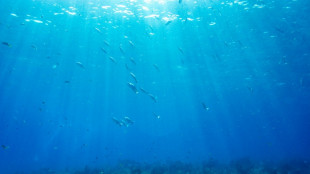
In remote Antarctica, Colombian marine biologist Paulo Tigreros dips a net into the icy waters in his hunt for microplastics in what should be one of the best-preserved ecosystems in the world.
Like a sieve, the net lets water pass through as it retains the small solid particles that float in the Gerlache Strait, a natural corridor approximately 160 kilometers (99 mile) long separating the Palmer Archipelago and the end of the Antarctic Peninsula.
Microscopic studies and other tests on the samples will allow the team of scientists to determine the level of microplastics they contain.
Microplastics are particles made of polymers and other toxic compounds that are smaller than five millimeters, and have come under increasing global attention as they have been found in oceans, clouds, food and throughout the bodies of animals and humans.
Tigreros, 51, and his colleagues are aboard the ARC Simon Bolivar, a Colombian navy vessel carrying out a scientific expedition in the Antarctic and have no doubt that they will detect microplastics on their mission.
Research carried out in 2019 by New Zealand's University of Canterbury revealed the existence of microplastics in Antarctic snow.
More than 430 million tonnes of plastic are produced each year worldwide, according to the UN.
Microplastics come from the breakdown of products such as synthetic car tires, textiles, and ordinary consumer products.
Little is yet known about their impact on human health and the environment.
Tigreros said microplastics are already "omnipresent" in the oceans and their effects can be fatal for animals and ecosystems.
"We consider Antarctica as a continent totally isolated" from human activity, but "it reflects the environmental problems" of the planet, said Jorge Tadeo Lozano, a researcher at the University of Bogota, who is taking part in the expedition.
He said microplastics may have arrived in the region via ocean currents. They can also be transported in the atmosphere and through the excrement of marine animals and fish.
With tweezers, Tigreros picks up a krill and some algae from his sample.
The tiny marine crustacean feeds on the microscopic algae known as phytoplankton, but often mistakes tiny microplastic particles for its food.
Krill in turn is a food source for many larger animals, thus contaminating the rest of the food chain.
"When a whale feeds on this krill, the microplastic most likely enters its intestines," affecting its lung system, reproductive system and even its ability to swim, said Tigreros.
The Antarctic ice sheet, home to penguins and seals, has been suffering for years from rising global temperatures.
The International Atomic Energy Agency (IAEA), in cooperation with Argentina, this month launched its first scientific research expedition to investigate the extent of microplastics in Antarctica.
According to the IAEA, microplastics could further damage the great white continent "by reducing ice reflectivity, altering surface roughness, promoting microbial activity, acting as thermal insulators, and contributing to mechanical weakening of the ice structure."
According to the World Meteorological Organization, the melting of glaciers, which contain 90 percent of the planet's freshwater, could cause sea levels to rise by up to 60 meters.
D.Lopez--AT