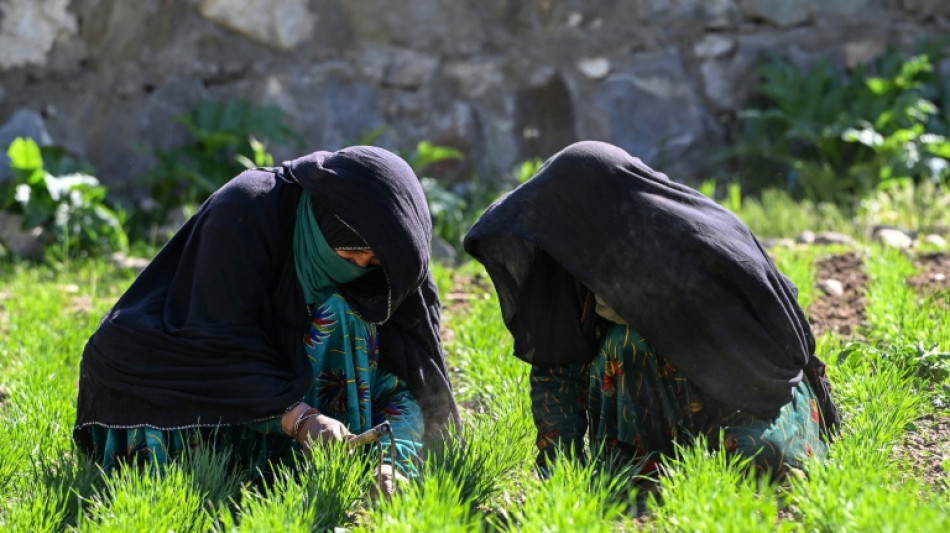
The Afghan women farmers keeping their village alive / Photo: Wakil KOHSAR - AFP

 Demonstrations backing France's protesting students gather strength

 Trump says US Senate as hard to defend as House in midterms

 Suspected Russian drones hit two ships off Bulgaria, 11 missing

 Tech stocks slide on AI jitters

 Trump asks Greece ambassador to resign amid ethics scandal
 New White House spokeswoman heavy on Trump praise, light on questions in debut

 Emery urges Villa to make most of reduced home comfort
 Flavio Bolsonaro visits father under house arrest ahead of Brazil runoff

 France, Eq. Guinea in standoff over luxury Paris mansion

 'Holding our ground': Israel demolishes dozens of Bedouin homes
 Hazlewood takes six as Australia beat South Africa in 1st Test
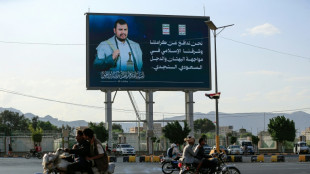 Saudi coalition tells Sanaa residents to flee site before operation

 Zverev defies 'physical issues' to reach Shanghai Masters quarter-finals

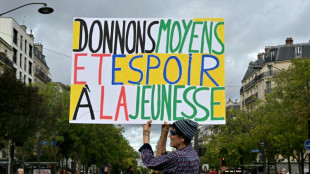 'We're not giving up': Activist Thunberg joins France student protests

 Man City captain Dias defends celebrations after Liverpool win

 B2PRIME Expands Tier-1 Access and Liquidity Architecture for Sophisticated Institutional Flow

 STARTRADER Adds 48 US Stock CFDs with 24-Hour Weekday Trading

 'Ink' director Danny Boyle slams Trump's Truth Social 'lies'

 Coach Kovac extends contract at Dortmund until 2029

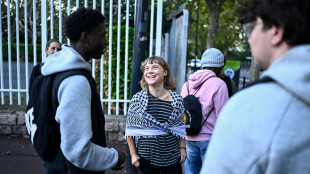 Activist Thunberg joins France student rally after violence at protests

 Archer and Bethell in England squad for Australia ODI series

 Formula One to return to Africa in 'early 2030s' in Rwanda
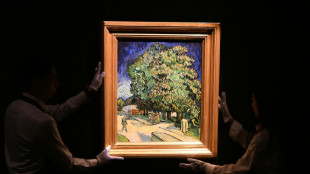
 US actor Selma Blair charged with assault after alleged flight altercation
 Hungary cuts anti-LGBTQ legislation from Orban-era law

 'Our future is being robbed': Greta Thunberg joins France student protests

In a remote province of northeastern Afghanistan, women farmers are playing a vital role in their community's survival among the snow-capped mountains.
The fields of Eshtiwi show only the first faint signs of growth in June, with small green sprouts emerging around the village.
Habiba, who spoke to AFP while busy weeding, is proud to have been farming in Nuristan province for decades.
"Since I was eight years old, I've been going to the field with my mother," said the 46-year-old, who only has one name.
"When we harvest wheat, beans, potatoes and corn in the fields in autumn and bring them back home, we feel happy," she added.
In Afghanistan, women are generally allowed to farm despite being banned by the Taliban government from most employment.
Mohammad Yahya Faizi, a 34-year-old agriculture graduate, said he respects the women's work.
"We would not have food anymore in the middle of the winter" without their work, he said.
Eshtiwi in summertime is only reachable by a dirt track and, before AFP's visit, it had been years since international media had reached the village.
Faizi said "tasks have been divided between men and women" for generations in the Parun Valley, where residents speak their own dialect.
"Women are busy with agriculture, planting, watering and cooking at home," said Faizi, a village farmer who volunteers with the Food and Agriculture Organization (FAO) of the United Nations.
Men help with animal-drawn ploughs, handle livestock, and gather firewood for winter, when snow cuts the village off from the outside world for almost six months.
Habiba's day starts at around 4:00 am, when she gets up to pray before preparing breakfast with her daughters on a wood-fired stove.
She makes bread using flour from her wheat, together with red beans from her fields, to eat alongside butter and dried yoghurt made by her husband.
The room, which doubles as a kitchen and bedroom, was decorated with flowers drawn by Habiba's 11-year-old daughter, Nahida, who was practising English that she had learnt at the village school.
While her mother never had the chance to go to school, Nahida's education will soon stop as girls nationwide are banned from education beyond the age of 12.
- 'Unrecognised' -
FAO has declared 2026 the International Year of the Woman Farmer, with the agency highlighting how "unrecognised" their vital role is in supporting food security.
This is particularly true in Afghanistan, where almost a third of the population needs emergency food aid according to the UN.
Bibi Jan, a 70-year-old who grows beans and potatoes, said farming can be gruelling.
"We have to work hard, our hands peel... but there are children to feed," she said.
Habiba dreams of having a tractor, but it is too expensive; there is only one in the village that a family rents out to those who can afford it.
"I'm not that strong; my back and my legs hurt," she said.
Najia, who requested her surname not be used for privacy reasons, agreed local farmers need more tools as well as opportunities to trade.
"Farming is a great profession; it's not just for men," said the 28-year-old, who went to university in Pakistan.
The farmers often have surplus crops, she said, but "there is no structured market to sell our produce."
Being in such a remote area makes it impossible to sell direct to customers, and there are only limited options to meet traders who pass through.
"I sell my potatoes for 70 afghanis ($1.10) for seven kilos (15 pounds), but I would need 150 afghanis" to earn a decent income, Najia said.
- 'Help each other' -
Storage units have been financed by the UN, to allow harvests to be kept and sold when the market improves, and some of the women have received better seeds.
FAO has also introduced agroforestry -- the combination of trees and crops on the same plot -- to diversify their income.
Faizi said that the village, which once produced only apples and walnuts, now has cherry, pear, and peach trees, among others.
But climate change is a big concern, with less predictable snow and rain, or bringing floods that destroy the crops.
The UN Development Programme has found that Afghanistan is among a group of countries that "have contributed the least to global warming yet bear its heaviest costs".
For Najia, the weather was a further challenge: "We can't predict it; it just hits us."
But despite the difficulties, she said women love working outdoors together.
"We can help each other," she said, while also providing the village with nutritious food.
"What we grow with our own hands is very healthy."
O.Gutierrez--AT