Chinese firm sells hyper-real, 'always loyal' humanoid robots / Photo: ADEK BERRY - AFP

 Emery urges Villa to make most of reduced home comfort

 Flavio Bolsonaro visits father under house arrest ahead of Brazil runoff

 France, Eq. Guinea in standoff over luxury Paris mansion

 'Holding our ground': Israel demolishes dozens of Bedouin homes

 Hazlewood takes six as Australia beat South Africa in 1st Test

 Saudi coalition tells Sanaa residents to flee site before operation

 Zverev defies 'physical issues' to reach Shanghai Masters quarter-finals

 'We're not giving up': Activist Thunberg joins France student protests

 Man City captain Dias defends celebrations after Liverpool win

 B2PRIME Expands Tier-1 Access and Liquidity Architecture for Sophisticated Institutional Flow

 STARTRADER Adds 48 US Stock CFDs with 24-Hour Weekday Trading

 'Ink' director Danny Boyle slams Trump's Truth Social 'lies'

 Coach Kovac extends contract at Dortmund until 2029

 Activist Thunberg joins France student rally after violence at protests

 Archer and Bethell in England squad for Australia ODI series

 Formula One to return to Africa in 'early 2030s' in Rwanda

 US actor Selma Blair charged with assault after alleged flight altercation

 Hungary cuts anti-LGBTQ legislation from Orban-era law

 'Our future is being robbed': Greta Thunberg joins France student protests

 Late superstar Anita Mui's ashes missing in Hong Kong

 'No choice': IMF says developing countries must cut spending despite war shock

 Boasting South Korea footballers spark rethink of military service exemptions

 Five dead as Hurricane Simon, Rachel pummel Mexico's Pacific coast

 Seoul, Tokyo stocks plunge as Asia suffers fresh tech rout

 Damaged and drained, Indonesia's peatlands go up in smoke

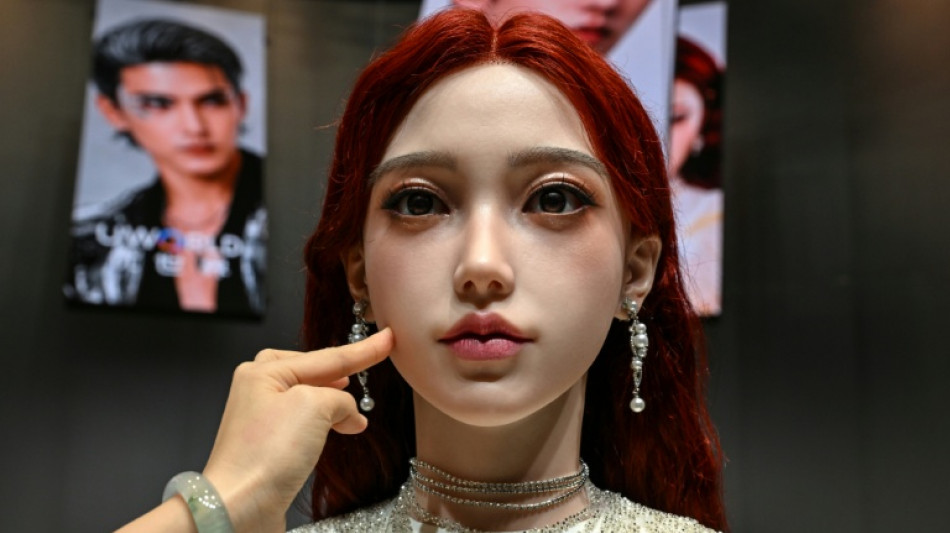
Their metallic frames covered in supple, lifelike skin, a posse of new Chinese robots meant for companionship can offer users AI-generated conversation or a hand to hold, complete with manicured nails.
The company UBTech says its "U1" robot -- equipped with eye cameras, chest sensors, and listening microphones -- is the world's first full-sized, ultra-realistic humanoid designed for mass production.
Touted as an antidote to loneliness, the robots are priced at 119,800 yuan ($17,600) for the most basic type and 990,000 yuan ($145,700) for an "Ultra" version with more advanced features.
"Our bionic robots can accompany you for a lifetime," Michael Tam, head of UBTech's brand UWorld, said Tuesday at a launch event in the southern Chinese tech hub Shenzhen.
"It will never betray you, will always be loyal to you, and will love you unconditionally."
If you pay enough, the androids' hair, face and outfits can be customised to resemble a loved one, a celebrity, or an imaginary character.
Male and female U1s can speak through an artificial intelligence tool programmed by the company to offer soothing words if it detects fatigue or stress, and get to know its user over time.
The product is mainly aimed at single people and those aged over 60 -- a "colossal market" in China of around 120 and 320 million respectively, according to Tam.
"These people have a great need for companionship," he said.
UBTech says it has already had more than 13,300 pre-orders, with deliveries due to start in September.
- 'Niche market' -
Robotics is a booming sector worldwide, and Chinese startups have raced ahead in recent years, helped in part by their access to the country's existing supply chains.
The basic U1 can move its head, eyes and mouth, and has a battery life of up to four hours -- but it doesn't do housework or cooking, and its skills do not extend to the bedroom either.
It is not designed to offer intimate relations, at least "for now", UBTech says.
But it can discuss users' daily concerns, remind them to take medication and help spot potential health problems, or even propose watching a World Cup match together.
Generative AI is also being deployed elsewhere in an effort to ease loneliness, especially among elderly populations.
In South Korea, cuddly ChatGPT-powered dolls are used in some care homes, while a lamp-like AI device called ElliQ offers similar companionship and safety-monitoring services.
Lian Jye Su, a Singapore-based chief analyst at Omdia, told AFP that he does see "value in a companion robot, albeit in a niche market" such as elderly care or mental wellness.
But "they have to pass the 'uncanny valley' test to appear physically and emotionally acceptable", with current models perhaps too off-putting to sell well, Su said, referring to the phenomenon in which interactions with artificial objects are so human-like it triggers unease.
- Sci-fi vibes -
The race to develop AI tools that humans trust has raised concerns over data privacy and the risk of becoming emotionally attached to a machine, including accusations that chatbots have encouraged suicides.
UBTech says the data processed by its U1 robots is encrypted and will not be used to train its AI models.
In Shenzhen on Tuesday, the company did not shy away from sci-fi associations, showing off its ultra-realistic bots with outfits and visuals inspired by video games, and a spaceship on a giant screen.
Robots of all shapes and sizes can be seen in many places in China, from hotels to shopping centres and in factories.
The country accounted for 85 percent of the world's humanoid installations last year, according to Barclays bank.
The government has designated robotics a strategic industry, and says that by last year, more than 140 Chinese companies had already launched more than 330 humanoid robot models.
These companies, like their global rivals, are also ploughing resources into the development of physical AI -- technology that allows robots to move and interact with the world autonomously.
For now, the scope and performance of real-life use cases for robots that use AI for movement remains limited, however, with most impressive displays pre-programmed or remotely operated.
A.Anderson--AT