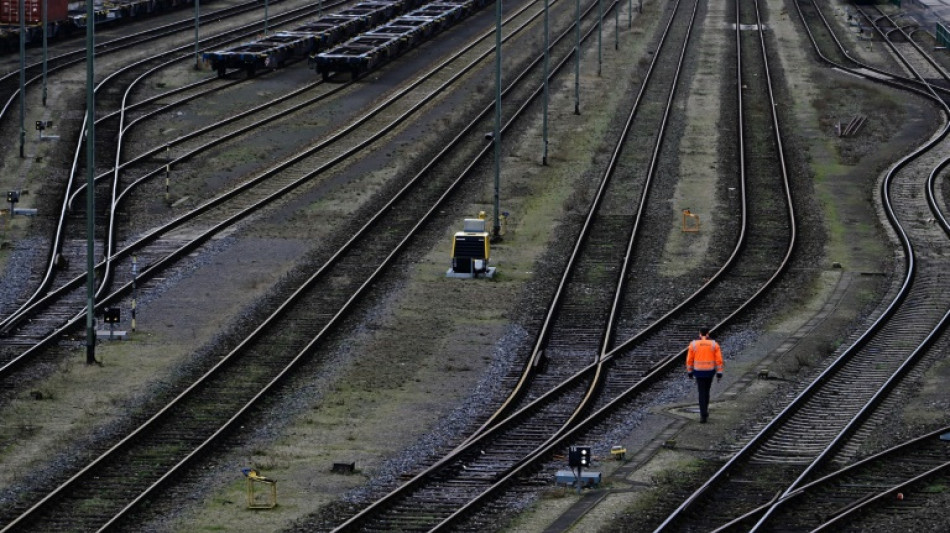
Fears over economy grow as German rail begins longest strike / Photo: Tobias SCHWARZ - AFP

 Sciver-Brunt fit for England's T20 World Cup semi-final

 Key challenges for Laporta in second Barca term
 Canada to join Eurovision Song Contest
 Swedish court orders Google pay $1.46 bn for favouring its price comparisons

 German FA headquarters searched in Euro 2024 graft probe
 Village People singer Victor Willis dies at 74
 Thousands rush to get tickets for Bayeux Tapestry's UK show
 Chinese firm sells hyper-real, 'always loyal' humanoid robots

 World's oceans break June heat record: EU monitor
 China imposes 'national security' rules on overseas investments
 'Nothing left except death': Myanmar families grieve huge war toll
 England face DR Congo hurdle, USA prepare for World Cup moment in spotlight
 Myanmar mourns as post-coup conflict death toll hits 100,000

 Vietnam unveils 'baby bonus' after scrapping two-child policy

 Majestic Olise raises France to another level at World Cup

 Mexico see off Ecuador to break 40-year World Cup curse

 'My dream is broken': Japan visa rules push out foreign residents

 Indian sailors fear returning to Gulf after Middle East war

 Fear and anger brew inside Meta amid AI frenzy
 After 250 years, the 'American dream' is tarnished but alive
 'I'm going to stay calm': 48 hours under the rubble in Venezuela
 Breakaway Catholic sect defies Vatican again by ordaining bishops
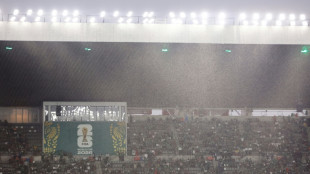 Mexico v Ecuador World Cup game delayed by one hour: FIFA
 Talks in Qatar after US-Iran deal: What we know
 Germany's ePA Rollout Puts Europe's Health-Data Supply Chain to the Test, Black Book Provider Pulse Finds

German train drivers began on Wednesday their longest-ever strike, piling on travel misery for thousands of passengers in an escalating industrial dispute that economic experts warn could cost the economy up to a billion euros ($1.1 billion).
Transport Minister Volker Wissing has slammed as "destructive" the six-day industrial action that heaps further pressure on supply chains that are already facing disruption because of attacks by Yemen's Huthi rebels on shipping via the Red Sea.
The prolonged action "is a strike against the German economy," said Deutsche Bahn spokeswoman Anja Broeker, noting that cargo traffic handled by the service include supplies for power plants, refineries".
"DB Cargo will do everything to secure the supply chain, but it's clear that there will be some impact," she added.
The walkout called by the GDL union runs from 2:00 am (0100 GMT) Wednesday through to 1700 GMT on Monday for passenger traffic while the strike for freight trains began earlier on Tuesday.
Not only long-distance trains but also suburban services, some of which like Berlin's are operated by Deutsche Bahn, are affected, just over a week after the last round of walkouts between January 10 and 12.
The fourth strike since November left passengers scrambling to rebook or cancel their plans, and sparked warnings of huge costs to the state and industry at a time when the German economy was already ailing.
Deutsche Bahn estimated each strike day to cost "a low two-digit million figure", but industry experts warned the impact on the economy would be far bigger.
- 'Unreasonable' -
Michael Groemling of Cologne's Institute for Economic Research said nationwide train stoppages can cost up to 100 million euros a day to the economy, but warned that the impact "may not rise linearly in a strike that lasts several days, but partially multiplies".
Given the disruptions with sea freight over the Huthi attacks, as well as issues on road transport, "rough estimates suggest that in extreme cases, this strike can cost up to a billion euros", he said.
Wissing slammed the GDL union for refusing to negotiate during the walkout.
"I find that it is unreasonable vis-a-vis train travellers that the trains are standing there blocked, while one's not at the same time sitting at the negotiations table," said the transport minister.
But the union said it had rejected the Deutsche Bahn's "third and allegedly improved offer" because bosses had shown "no sign of a willingness to reach an agreement.
The GDL is seeking higher salaries to compensate for inflation, as well as a reduced working week from 38 to 35 hours with no loss in wages, arguing that it needed to make train driver jobs "more attractive" to young people.
But Deutsche Bahn blasted the latest round of industrial action, saying it had offered pay rises of up to 13 percent and a one-off inflation bonus, as well as the chance to reduce the working week by one hour from 2026.
Deutsche Bahn last year also clashed with the EVG rail union, which represents around 180,000 non-driver rail personnel, reaching an agreement in late August.
The latest walkout breaks the previous record of a May 2015 action, also called by GDL, that lasted around five days.
E.Hall--AT