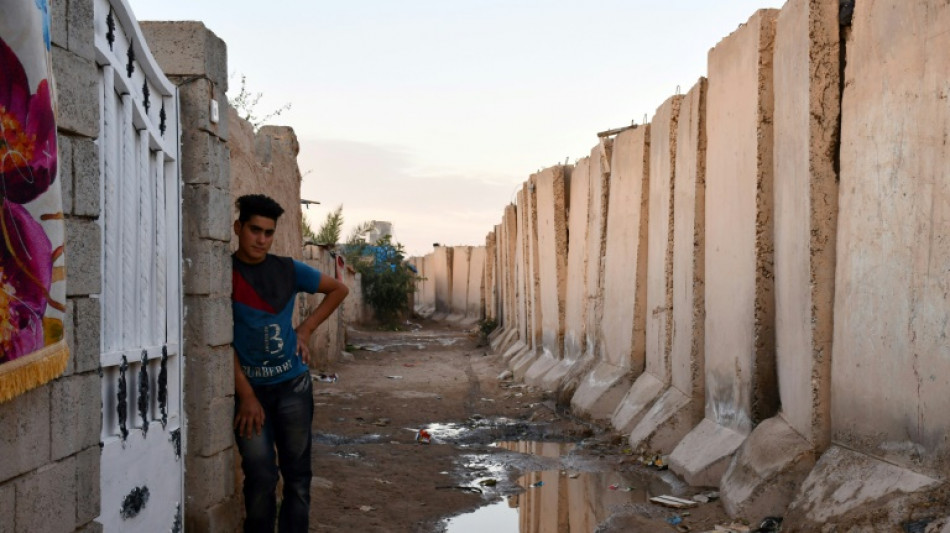
Years after civil war, security wall holds back Iraqi city / Photo: Abdelkhaleq SAMARRAI - AFP

 Village People singer Victor Willis dies at 74

 Thousands rush to get tickets for Bayeux Tapestry's UK show
 Chinese firm sells hyper-real, 'always loyal' humanoid robots

 World's oceans break June heat record: EU monitor
 China imposes 'national security' rules on overseas investments

 'Nothing left except death': Myanmar families grieve huge war toll

 England face DR Congo hurdle, USA prepare for World Cup moment in spotlight

 Myanmar mourns as post-coup conflict death toll hits 100,000
 Vietnam unveils 'baby bonus' after scrapping two-child policy

 Majestic Olise raises France to another level at World Cup

 Mexico see off Ecuador to break 40-year World Cup curse

 'My dream is broken': Japan visa rules push out foreign residents

 Indian sailors fear returning to Gulf after Middle East war
 Fear and anger brew inside Meta amid AI frenzy

 After 250 years, the 'American dream' is tarnished but alive

 'I'm going to stay calm': 48 hours under the rubble in Venezuela
 Breakaway Catholic sect defies Vatican again by ordaining bishops
 Mexico v Ecuador World Cup game delayed by one hour: FIFA
 Talks in Qatar after US-Iran deal: What we know

 MSC Industrial Supply Co. Reports Fiscal 2026 Third Quarter Results

 Lennys Grill & Subs Launches Veteran Franchise Program to Support Military Veterans in Business Ownership

 PersonalHour Expands Manufacturing and Fulfillment Operations Across the United States
 InterContinental Hotels Group PLC Announces Transaction in Own Shares - July 01

 US coach dismisses European jinx ahead of Bosnia clash

 World Bank to phase out lending to China by 2031

Khaled Ibrahim dreams of a home on the outskirts of Samarra, but a concrete wall built to protect the Iraqi city is stopping him and hampering sorely-needed urban expansion.
Built more than a decade ago at the height of Iraq's civil war which tore apart the multi-faith, multi-ethnic country, authorities say the wall must remain to prevent the threat of jihadist violence, even as security has gradually improved across the country.
Samarra is home to the Al-Askari shrine, one of Shiite Islam's holiest sites and famed for its golden dome, but sits in the predominantly Sunni province of Salahaddin.
An attack by Sunni militant group Al-Qaeda in 2006 destroyed the dome, and set off a brutal sectarian conflict in which tens of thousands of people were killed. A year later, a second attack destroyed the two minarets at the site.
Today the wall around Samarra has also become a burden on daily life in the city that has expanded from 300,000 to 400,000 residents since 2008, pushing up property and land costs.
"It's a nightmare, worse than a prison," said Ibrahim.
The 52-year-old and his two sons, who all work as day labourers, currently rent accommodation in Samarra for around $180 a month, which for them is a small fortune.
Ibrahim has a plot of land just outside the city walls where he would like to build a house, but he is becoming increasingly frustrated that the fortified barrier makes this impossible.
"The security forces do not allow us to approach the wall," he said.
"And then there are no services, no water, no electricity. Building beyond the wall is like living in exile."
In the Iraqi capital of Baghdad, 110 kilometres (70 miles) to the south, many of the blast walls that once surrounded key streets, embassies and government offices are being taken down.
But in Samarra, small, unfinished cinderblock houses languish just inside the city's wall. On the other side, abandoned plots stretch as far as the eye can see.
- 'Sleeper cells' remain a threat -
There are three tightly controlled checkpoints in the barriers allowing access into Samarra, which is home to the remains of what was the capital of the Abassid caliphate in the ninth century, now a UNESCO heritage site.
Aware of residents' frustrations, authorities intend to overhaul the wall, with work to start within a month.
They plan to extend its perimeter by three to seven kilometres, increase the number of entry points to six, and add watchtowers and surveillance cameras.
"We would have liked to remove it, but there are obligations and security plans which mandated its presence," Riyad al-Tayyas, the deputy governor of Salahaddin, told AFP.
Tayyas said that building outside the wall was not officially banned, but he acknowledged that the barrier's presence was hindering urban expansion.
Residents opt not to build on the other side, fearing "they will find themselves cut off from the rest of the city", Tayyas said.
Nevertheless, he insisted lingering worries over security meant the barrier must stay.
This is to ensure there was no "repeat of the catastrophe of 2006, which led to a sectarian war", he told AFP.
"Even though the security situation has improved, there are still sleeper cells" of the Islamic State group (IS), he said.
A UN report in 2023 noted a drop in the frequency of IS attacks in urban centres but also warned that the group has maintained a presence in its strongholds, including around Salahaddin.
Tayyas's position chimes with the concerns of some Samarra residents such as 64-year-old retiree Laith Ibrahim, who said he was in favour of extending the wall's perimeter.
"In Samarra, inside the city, the security situation is excellent... Outside, it's exposed," he said.
But there is also "a shortage of land, housing," he said. "Real estate (prices) are soaring day after day."
M.White--AT