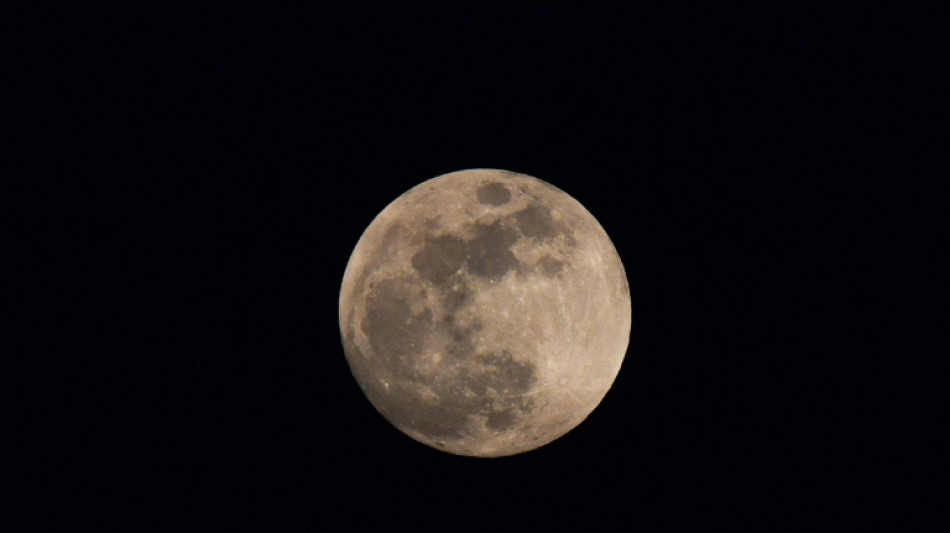
Navajo object to depositing human remains on Moon / Photo: Ted ALJIBE - AFP/File

 Marquez snatches San Marino MotoGP sprint ahead of Bezzecchi

 Philippine ferry fire death toll climbs to 76 as identification process begins

 BRICS nations urge 'maximum restraint' in Middle East war

 Zelensky open to meeting Putin at G20 in Miami

 England survive scare to seal 3-0 sweep against Pakistan

 Trump says Irish unification would be 'fantastic'

 Bodies of Philippines ferry fire victims brought ashore as toll hits 35

 Flick warns Barca stars to keep focus after perfect start

 Trump in Ireland for golf tournament, diplomatic pleasantries

 French police suspect train derailment was sabotage

 Trump lands in Ireland for golf tournament, PM talks

 Xi lands in India for BRICS summit overshadowed by war

 From crime to the Arctic: ultramarathoner film debuts in Toronto

 Back to the drawing board for disappointed Tiafoe

 Lady Gaga welcomes first child with fiance: US media

 Shelton tops Tiafoe to book US Open title clash with Zverev

 Shelton powers past Tiafoe to book US Open title clash with Zverev

 Venice Film Festival: A look back on the highlights

 'Widow's Bay' and 'The Pitt' are favorites for Emmys night

 'Everything different' as Zverev returns to US Open final

 Coastal erosion forces cancellation of California music festival

 Anthropic says UAE-linked AI op targeted UN experts over Sudan

 Rennes beat Marseille to seize top spot in Ligue 1

 Duplantis delivers masterclass for Ultimate pole vault win

 Weapons, spyware and AI scams: Anthropic exposes Claude misuse

The United States will soon launch its first spacecraft to attempt a soft lunar landing since the Apollo era, in a historic collaboration with the private sector -- but not everyone is celebrating.
The Navajo Nation, America's largest Indigenous tribe, has raised concerns over the presence of human cremated remains on the lander vehicle, calling the mission a "desecration" of the Moon which holds a sacred place in their culture.
On January 8, Pittsburgh-based Astrobotic's Peregrine lander is set to hitch a ride on a giant United Launch Alliance Vulcan Centaur rocket making its maiden voyage under a NASA commercial partnership aimed at saving the US space agency money.
Peregrine's scientific instruments will probe for lunar surface radiation, helping NASA better prepare for crewed missions going there later this decade under the Artemis program.
But the boxy robot's manifest also includes payloads from two companies -- Elysium Space and Celestis -- that will contain cremated remains and DNA to stay on the Moon, inside the lander, forever.
While Elysium hasn't offered details, Celestis has 69 individual "participants" including late Star Trek creator Gene Rodenberry, sci-fi author Arthur C. Clarke, and a dog named Indica-Noodle Fabiano.
Customers paid prices starting at $12,995, according to the company's website.
In a December 21 letter addressed to officials at NASA and the Department of Transportation, Navajo Nation President Buu Nygren expressed what he called "our deep concern and profound disappointment regarding a matter of utmost importance," and called for NASA to delay the launch.
"The Moon holds a sacred position in many Indigenous cultures, including ours," Nygren wrote.
"The act of depositing human remains and other materials, which could be perceived as discards in any other location, on the Moon is tantamount to desecration of this sacred space."
- NASA promises meeting -
Nygren added the situation was reminiscent of the Lunar Prospector mission launched in 1998 by NASA, which intentionally crashed a probe into the Moon's surface. On board were the remains of renowned geologist Eugene Shoemaker.
Then, too, the Navajo voiced objections. NASA apologized and committed to consult with Native Americans in future, according to a contemporary report in The Spokesman-Review of Spokane, Washington.
NASA's deputy associate administrator for exploration Joel Kearns said Thursday an intergovernmental team had arranged a meeting with the Navajo Nation, but added the agency had no control over its private partner's payloads.
"We take concerns expressed from the Navajo Nation very, very, seriously, and we think we're going to be continuing on this conversation," Kearns told reporters.
Celestis was less conciliatory.
"We respect all cultures' right to engage in religious practices, but no single culture or religion should exercise a veto on space missions based on religious tenets," the company said.
Denying that the mission "desecrates the Moon," it stressed the material would remain aboard the lander rather than being deposited on the surface.
Kearns said NASA's growing private partnerships could lead to "changes to how we view this" or to establishing industry standards.
It won't be the first human DNA left on the barren celestial body -- that distinction belongs to the almost 100 bags of feces and urine left behind by American astronauts during the 1969-1972 Apollo lunar landings.
P.Smith--AT