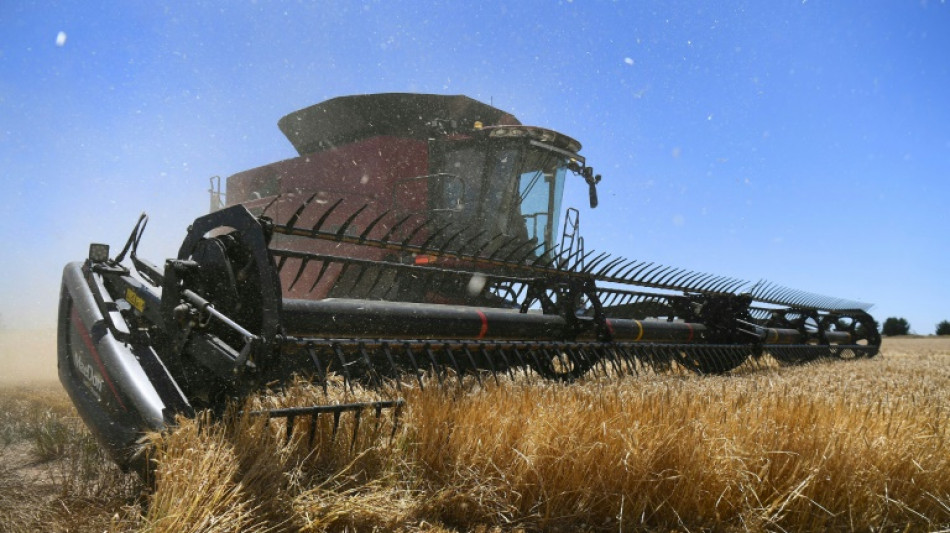
Chinese appetite for Australian barley is back / Photo: William WEST - AFP/File

 Marquez snatches San Marino MotoGP sprint ahead of Bezzecchi

 Philippine ferry fire death toll climbs to 76 as identification process begins

 BRICS nations urge 'maximum restraint' in Middle East war

 Zelensky open to meeting Putin at G20 in Miami

 England survive scare to seal 3-0 sweep against Pakistan

 Trump says Irish unification would be 'fantastic'

 Bodies of Philippines ferry fire victims brought ashore as toll hits 35

 Flick warns Barca stars to keep focus after perfect start

 Trump in Ireland for golf tournament, diplomatic pleasantries

 French police suspect train derailment was sabotage

 Trump lands in Ireland for golf tournament, PM talks

 Xi lands in India for BRICS summit overshadowed by war

 From crime to the Arctic: ultramarathoner film debuts in Toronto

 Back to the drawing board for disappointed Tiafoe

 Lady Gaga welcomes first child with fiance: US media

 Shelton tops Tiafoe to book US Open title clash with Zverev

 Shelton powers past Tiafoe to book US Open title clash with Zverev

 Venice Film Festival: A look back on the highlights

 'Widow's Bay' and 'The Pitt' are favorites for Emmys night

 'Everything different' as Zverev returns to US Open final

 Coastal erosion forces cancellation of California music festival

 Anthropic says UAE-linked AI op targeted UN experts over Sudan

 Rennes beat Marseille to seize top spot in Ligue 1

 Duplantis delivers masterclass for Ultimate pole vault win

 Weapons, spyware and AI scams: Anthropic exposes Claude misuse

Three years after steep Chinese tariffs halted imports of Australian barley as tensions between the two countries ratcheted higher, the grain is once again flowing freely.
Barley is not only used to brew beer but to feed pigs, and China was Australia's leading market, taking 50 percent of its barley exports.
China has imported 314,000 tonnes of Australian barley worth 139 million Australian dollars (around $94 million) since the government scrapped its 80.5 percent tariffs in August, the Australian government said in early December, citing official Chinese data.
The resumption of trade is a welcome relief for Australian farmers, who saw a nearly one billion Australian-dollar market evaporate in 2020.
"In the two months following the market's re-opening, Marketing and Trading shipped two vessels of barley to China," said the CBH Group, a cooperative of over 3,500 Western Australian grain farmers, in its annual report.
Tensions between the countries began to mount in 2018 when Australia excluded the Chinese telecommunications giant Huawei from its 5G network.
Then in 2020, Australia called for an international investigation into the origins of Covid-19 -- an action China saw as politically motivated since it emanated from a close partner of the United States.
In response, Beijing slapped high tariffs on key Australian exports, including barley, beef and wine, while halting its coal imports.
- New markets -
A slowdown in China's economic growth has spurred Beijing to rekindle its relationships with its trading partners.
Meanwhile, Australia sought out and found new markets to offload its harvests -- it is the world's third-largest producer of the grassy grain.
"It caused us to pivot, so we found new markets, like Mexico. We managed to have tariffs lowered, which were previously in excess of 100 percent," Sean Cole, the acting general manager of the GrainGrowers trade association, told AFP.
"With China gone, Australia was really forced to go back to more traditional customers in the feed market, mainly the Middle East and Saudi Arabia, where we've been for over 20 years," he added.
Between June 2022 and June 2023, Saudi Arabia became the leading importer of Australian barley, according to data from the Australian Bureau of Agricultural and Resource Economics and Sciences (ABARES).
Lyndon Mickel farms a 6,000-hectare plot of land near Beaumont in the southwest part of Australia. The latest harvest of his fields of various grains and peas was the 23rd of his career, but it has taken time to bounce back from the Chinese tariffs.
"We've had a reduction in price, but we've been fortunate we've had two very good years in that time crop-wise," he said, "so what we've lost in price, we've gained in tonnage anyway."
But those boom years -- producing over 14 million tonnes of barley in the last two harvests -- are over.
- Additional gains -
As El Nino -- the cyclical weather phenomenon responsible for higher global temperatures -- returns to the Pacific, ABARES predicts barley production will drop by 24 percent to 10.8 million tonnes for the 2023-24 harvest.
The reopening of the Chinese market could not have come at a better time, said Sean Cole.
"A lot of our barley is classified as feed, but it is still suitable for beer manufacturing in China," he said, "they use slightly different processes, and essentially it means we can get a premium for more of our feed barley".
On average, barley destined for China is sold for "around 38 to 40 dollars a tonne between now and since the tariffs were lifted" and that amounts to "an extra 400 million dollars value for the Australia barley crop next year, even with a smaller crop," Cole added.
H.Romero--AT