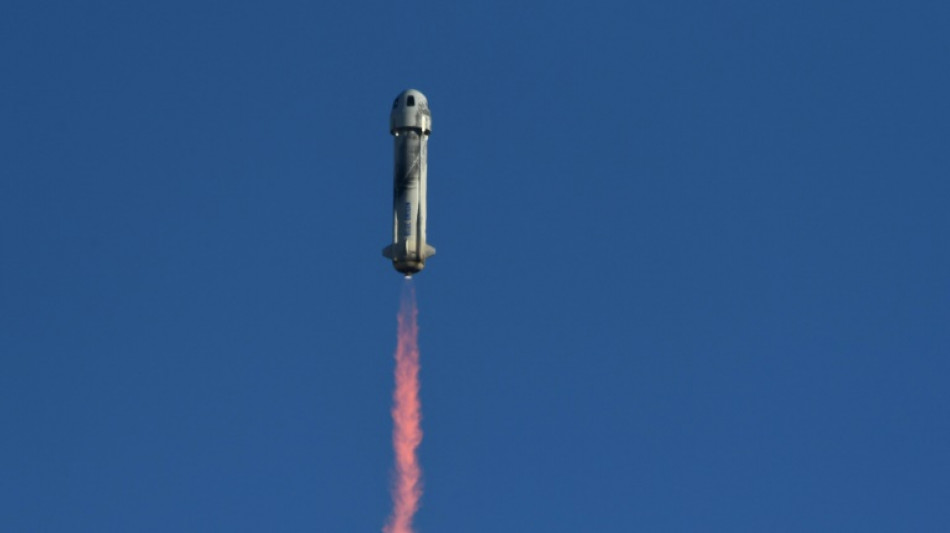
Jeff Bezos' Blue Origin pushes back return to space / Photo: Patrick T. FALLON - AFP/File

 Chelsea boss Alonso for yearns for 'boring game' after Hull make their point
 'Tired' Liverpool must adapt to schedule, says Iraola

 Stunning US fightback sets up Solheim Cup singles showdown

 Monaco's perfect Ligue 1 start ends with Strasbourg draw

 Ukraine's economy hobbled by Russian strikes

 France sink Germany to reach first women's basketball World Cup final
 Hull hold Chelsea, Liverpool fail to beat Fulham in Premier League

 Nmecha and Silva keep Dortmund perfect in Bundesliga

 Norris snatches thrilling Spanish GP pole from Antonelli

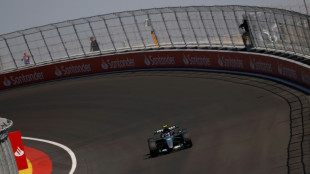 'Great to have a race at home': Fans celebrate F1's Madrid return

 French IT giant Capgemini sells subsidiary after row over ICE links

 Thousands rally in Kosovo ahead of ex-leader's war crimes verdict

 Zelensky ready to meet Putin at G20 in Miami

 Gaza film, 'irreverent' Malkovich drama vie for Venice top prize

 Fit-again Bumrah needs game time, says India skipper Iyer

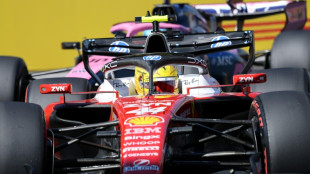 Antonelli fastest again in crash-hit final practice

 From obscurity to smashing sixes: Pakistan's Razaullah rises to stardom

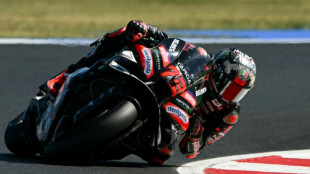 Bezzecchi takes pole for San Marino MotoGP

 China, Russia, Iran leaders gather in India as BRICS nations seek common ground

 Korda finally beaten as Europe grasp slender Solheim lead

 Zelensky says willing to meet Putin at G20 in Miami: interview

 Quebec Brokerage Qubit Insurance Announces New Data on Coverage Shortfalls as Rebuilding Costs Rise

 Trump asks Smithsonian to install George Washington statues, exhibition

 'A legend': Celine Dion poised for emotional comeback in Paris

 Europe eyes battle over 'pervert' AI glasses

Blue Origin on Monday postponed its long-awaited return to space, citing technical reasons and promising to try again later this week.
Jeff Bezos' space company has not launched a rocket since an uncrewed September 2022 crash placed its program on hold while it carried out fixes and awaited regulatory approval.
The company finally announced a December 18 launch from its base near Van Horn, Texas. But on the day itself it first pushed back the takeoff window because of cold weather, then declared it was off.
"We're scrubbing #NS24 today due to a ground system issue the team is troubleshooting. We'll provide a new launch target for this week soon," Blue posted on X, formerly Twitter.
Though the rocket will carry a payload of science experiments, not people, mission NS-24 must succeed before Blue Origin can return to taking wealthy thrill-seekers to the final frontier.
On September 12, 2022, a Blue Origin rocket became engulfed in flames shortly after launch. The capsule, fixed to the top of the rocket, successfully initiated an emergency separation sequence and floated safely to the ground on parachutes.
The accident prompted a year-long probe by the Federal Aviation Administration (FAA), which found it was caused by the failure of an engine nozzle that experienced higher-than-expected engine operating temperatures.
The regulator issued a set of corrective actions Blue Origin had to undertake before it could resume flying, including the redesign of certain engine parts. It confirmed Sunday it had approved Blue Origin's application to fly again.
In all, Blue Origin has flown six crewed flights -- some passengers were paying customers and others flew as guests -- since July 2021, when Bezos himself took part in the first flight.
While Blue Origin has been grounded, rival Virgin Galactic, the company founded by British billionaire Richard Branson, has pressed on, flying five commercial flights this year.
The two companies compete in the emerging space tourism sector, operating in "suborbital" space.
- Reusable rocket, no carbon emissions -
While Blue Origin launches a small rocket vertically, Virgin Galactic uses a large carrier plane to gain altitude and then drop off a smaller rocket-powered spaceplane that completes the journey to space.
In both cases, passengers enjoy a few minutes of weightlessness and can view the curvature of the Earth through large windows.
Virgin Galactic tickets were sold for between $200,000-$450,000; Blue Origin does not disclose its ticket prices publicly.
Blue Origin can boast of the fact that nearly all of the rocket platform is re-used including the booster, capsule, engine, landing gear, and parachutes.
Its engine meanwhile is fueled by liquid oxygen and hydrogen, meaning the only byproduct during flight is water vapor, with no carbon emissions.
Blue Origin is also developing a heavy rocket for commercial purposes called New Glenn, with the maiden flight planned for next year.
This rocket, which measures 98 meters (320 feet) high, is designed to carry payloads of as much as 45 metric tons into low Earth orbit.
Ch.Campbell--AT
