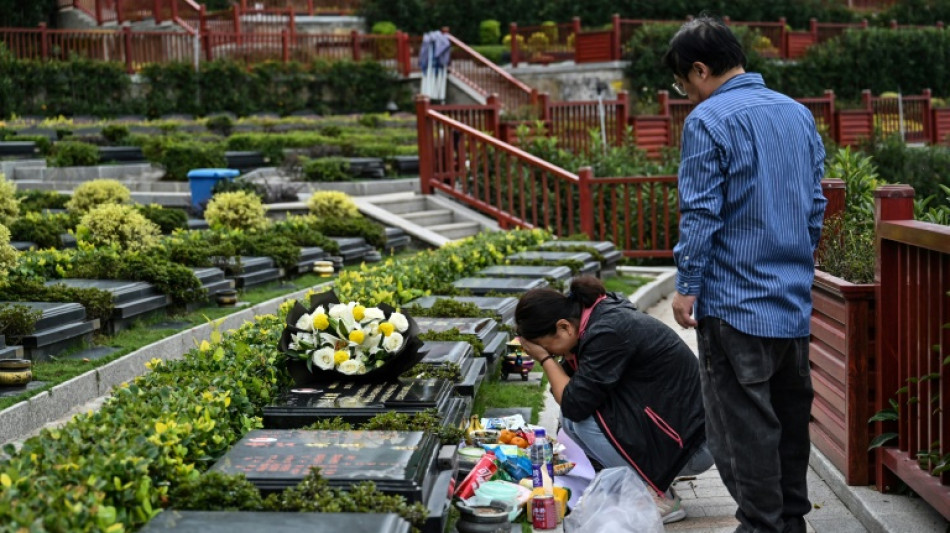
Chinese mourners use AI to digitally resurrect the dead / Photo: Hector RETAMAL - AFP

 Chelsea boss Alonso for yearns for 'boring game' after Hull make their point

 'Tired' Liverpool must adapt to schedule, says Iraola
 Stunning US fightback sets up Solheim Cup singles showdown
 Monaco's perfect Ligue 1 start ends with Strasbourg draw

 Ukraine's economy hobbled by Russian strikes

 France sink Germany to reach first women's basketball World Cup final
 Hull hold Chelsea, Liverpool fail to beat Fulham in Premier League

 Nmecha and Silva keep Dortmund perfect in Bundesliga

 Norris snatches thrilling Spanish GP pole from Antonelli
 'Great to have a race at home': Fans celebrate F1's Madrid return

 French IT giant Capgemini sells subsidiary after row over ICE links

 Thousands rally in Kosovo ahead of ex-leader's war crimes verdict

 Zelensky ready to meet Putin at G20 in Miami

 Gaza film, 'irreverent' Malkovich drama vie for Venice top prize

 Fit-again Bumrah needs game time, says India skipper Iyer
 Antonelli fastest again in crash-hit final practice

 From obscurity to smashing sixes: Pakistan's Razaullah rises to stardom
 Bezzecchi takes pole for San Marino MotoGP

 China, Russia, Iran leaders gather in India as BRICS nations seek common ground

 Korda finally beaten as Europe grasp slender Solheim lead

 Zelensky says willing to meet Putin at G20 in Miami: interview

 Quebec Brokerage Qubit Insurance Announces New Data on Coverage Shortfalls as Rebuilding Costs Rise

 Trump asks Smithsonian to install George Washington statues, exhibition

 'A legend': Celine Dion poised for emotional comeback in Paris

 Europe eyes battle over 'pervert' AI glasses

At a quiet cemetery in eastern China, bereaved father Seakoo Wu pulls out his phone, places it on a gravestone and plays a recording of his son.
They are words that the late student never spoke, but brought into being with artificial intelligence.
"I know you're in great pain every day because of me, and feel guilty and helpless," intones Xuanmo in a slightly robotic voice.
"Even though I can't be by your side ever again, my soul is still in this world, accompanying you through life."
Stricken by grief, Wu and his wife have joined a growing number of Chinese people turning to AI technology to create lifelike avatars of their departed.
Ultimately Wu wants to build a fully realistic replica that behaves just like his dead son but dwells in virtual reality.
"Once we synchronise reality and the metaverse, I'll have my son with me again," Wu said.
"I can train him... so that when he sees me, he knows I'm his father."
Some Chinese firms claim to have created thousands of "digital people" from as little as 30 seconds of audiovisual material of the deceased.
Experts say they can offer much-needed comfort for people devastated by the loss of loved ones.
But they also evoke an unsettling theme from the British sci-fi series "Black Mirror" in which people rely on advanced AI for bereavement support.
- 'Needs are growing' -
Wu and his wife were devastated when Xuanmo, their only child, died last year at the age of 22 while attending Exeter University in Britain.
The accounting and finance student, keen sportsman and posthumous organ donor "had such a rich and varied life", said Wu.
"He always carried in him this desire to help people and a sense of right and wrong," he told AFP.
Following a boom in deep learning technologies like ChatGPT in China, Wu began researching ways to resurrect him.
He gathered photos, videos and audio recordings of his son, and spent thousands of dollars hiring AI firms that cloned Xuanmo's face and voice.
The results so far are rudimentary, but he has also set up a work team to create a database containing vast amounts of information on his son.
Wu hopes to feed it into powerful algorithms to create an avatar capable of copying his son's thinking and speech patterns with extreme precision.
Several companies specialising in so-called "ghost bots" have emerged in the United States in recent years.
But the industry is booming in China, according to Zhang Zewei, the founder of the AI firm Super Brain and a former collaborator with Wu.
"On AI technology, China is in the highest class worldwide," said Zhang from a workspace in the eastern city of Jingjiang.
"And there are so many people in China, many with emotional needs, which gives us an advantage when it comes to market demand."
Super Brain charges between 10,000 and 20,000 yuan ($1,400-$2,800) to create a basic avatar within about 20 days, said Zhang.
They range from those who have died to living parents unable to spend time with their children and -- controversially -- a heartbroken woman's ex-boyfriend.
Clients can even hold video calls with a staff member whose face and voice are digitally overlaid with those of the person they have lost.
"The significance for... the whole world is huge," Zhang said.
"A digital version of someone (can) exist forever, even after their body has been lost."
- 'New humanism' -
Sima Huapeng, who founded Nanjing-based Silicon Intelligence, said the technology would "bring about a new kind of humanism".
He likened it to portraiture and photography, which helped people commemorate the dead in revolutionary ways.
Tal Morse, a visiting research fellow at the Centre for Death and Society at Britain's University of Bath, said ghost bots may offer comfort.
But he cautioned that more research was needed to understand their psychological and ethical implications.
"A key question here is... how 'loyal' are the ghost bots to the personality they were designed to mimic," Morse told AFP.
"What happens if they do things that will 'contaminate' the memory of the person they are supposed to represent?"
Another quandary arises from the inability of dead people to consent, experts said.
While permission was probably unnecessary to mimic speech or behaviour, it might be needed to "do certain other things with that simulacrum", said Nate Sharadin, a philosopher at the University of Hong Kong specialising in AI and its social effects.
For Super Brain's Zhang, all new technology is "a double-edged sword".
"As long as we're helping those who need it, I see no problem".
He doesn't work with those for whom it could have negative impacts, he said, citing a woman who had attempted suicide after her daughter's death.
Bereaved father Wu said Xuanmo would "probably would have been willing" to be digitally revived.
"One day, son, we will all reunite in the metaverse," he said as his wife dissolved into tears before his grave.
"The technology is getting better every day... it's just a matter of time."
F.Wilson--AT
