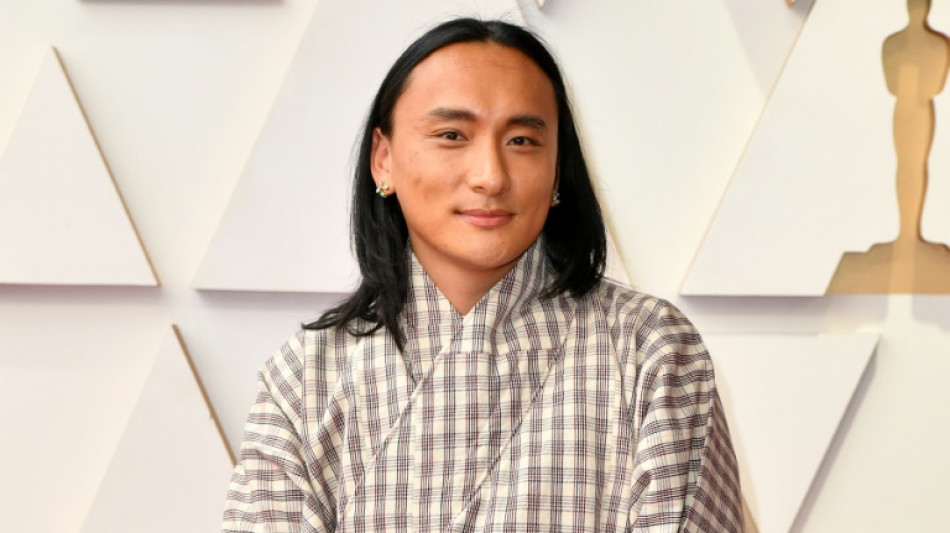
Oscar-nominated Bhutan director turns lens on democracy ahead of vote / Photo: ANGELA WEISS - AFP

 De Zerbi apologises to fans after Spurs' stalemate extends goal drought

 Lowry takes four-shot lead as Trump jets in for Irish Open

 Harrison, Skupski win US Open men's doubles title
 Verstappen fears overtaking will be 'tough' at Spanish GP
 Argentina revives plan for South Atlantic naval base amid Falklands tensions

 Yemen government forces say hit Houthis in Red Sea city

 Dismal Spurs stay goalless after Everton stalemate

 Fire at nursing home in Chile kills 16

 Frustrated Hamilton urges Ferrari to 'work harder'

 Zelensky ready to meet Putin at Miami G20 but Kremlin refuses

 Anthropic boss calls for AI slowdown, Altman and Musk agree

 England back on track after 'chaos', says Root
 Shelton chases history in US Open title tilt with top seed Zverev

 Norris 'masterpiece' snatches Spanish GP pole from Antonelli

 Mas on brink of Vuelta triumph as Landa claims stage 20

 No Kerr clash as Ingebrigtsen pulls out of Ultimate 1,500m
 Anthropic boss calls for slowing pace of AI development

 BRICS nations call for 'maximum restraint' in Middle East war

 England v Pakistan Test series: Three talking points

 Marquez snatches San Marino MotoGP sprint ahead of Bezzecchi
 Philippine ferry fire death toll climbs to 76 as identification process begins
 BRICS nations urge 'maximum restraint' in Middle East war

 Zelensky open to meeting Putin at G20 in Miami

 England survive scare to seal 3-0 sweep against Pakistan

 Trump says Irish unification would be 'fantastic'

The Himalayan kingdom of Bhutan, the last country to introduce television, made waves last year with a film director who walked the red carpet of the Oscars.
Now, as his nation prepares for a general election next month -- only the fourth ever in its history -- director Pawo Choyning Dorji has turned his lens on democracy.
"The film delves into the advent of democracy in Bhutan, coinciding with the onset of modernisation and the influence of television," Dorji said of his movie "The Monk and the Gun".
"It explores the tension between maintaining cultural innocence and adapting to modern expectations," the 40-year-old told AFP.
Bhutanese people voted for the first time in 2008 after political reforms were instituted soon after the start of the reign of the present king.
He remains widely popular among the majority Buddhist nation's nearly 800,000 people.
Dorji's film, set during Bhutan's historic transition from an absolute monarchy 15 years ago, discusses the complexities of embracing change while grappling with fears of losing cultural identity.
It examines the "clash between Western influences and Bhutanese traditions", the director said.
- 'Clash' -
The film tells the story of a Buddhist monk who, worried as the nation's first elections approach, sets off to find a rifle.
Not all Bhutanese welcomed the end of the absolute monarchy, Dorji said, explaining the political change had not been a "choice made willingly" by all.
Today, Bhutan has nearly 500,000 registered voters -- and many say it is their civic duty to take part in the polls.
Elections, which have always been peaceful and orderly, are slated for January 9.
"The film is not a pro-democracy stance but a narrative exploration of the events that transpired," said the self-taught filmmaker, who was born to a diplomat and went on to study political science in the United States.
"It acknowledges that the success of democracy depends on one's cultural context, and that it is too early to pass judgement on its effectiveness."
Landlocked Bhutan, similar in size to Switzerland, lies squeezed between regional giants India and China.
The mountainous country is famed for its philosophy of "Gross National Happiness", which sees the country benchmark itself on citizen well-being instead of economic growth.
Despite its focus on happiness, Bhutan also has its share of problems, including corruption and rural poverty.
The youth unemployment rate stands at 29 percent, according to 2022 World Bank figures.
- 'Scribe of our traditions' -
Dorji's drama, "Lunana: A Yak in the Classroom", was the first Bhutanese film ever nominated for an Academy Award, one of five movies named in the 2022 Oscars Best International Feature Film category.
"The Monk and the Gun", which premiered in September and has been submitted by Bhutan to the 96th Academy Awards, has already picked up festival prizes in Vancouver and Rome.
Dorji said that making a film in Bhutan, where there is no formal film industry and the few cinemas are basic theatre halls, was just as hard the second time.
On one hand, the country's actors provided "raw and authentic performances", he said. On the other, there were logistical headaches and other challenges.
"Creating a film in Bhutan meant overcoming not only the lack of infrastructure and professional equipment, but also the scepticism of those who failed to see the purpose of making films," Dorji said.
The director believes his storytelling has value beyond entertainment alone, by helping remind people of "their roots" and the country's history.
"As a filmmaker, I believe in two crucial responsibilities," he added.
"Sharing culture, tradition and spirituality, and serving as the scribe of our traditions to preserve our culture for future generations."
A.O.Scott--AT

