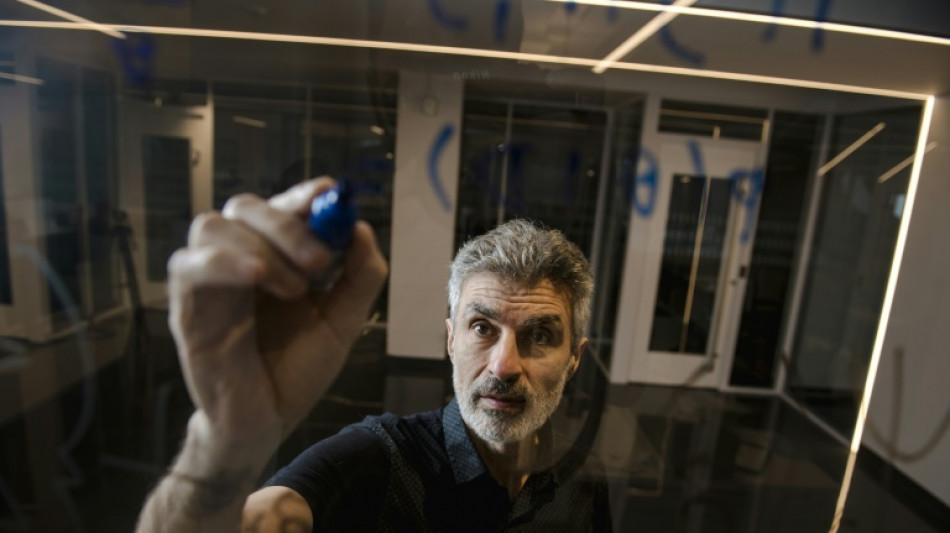
Montreal research hub spearheads global AI ethics debate / Photo: ANDREJ IVANOV - AFP

 De Zerbi apologises to fans after Spurs' stalemate extends goal drought

 Lowry takes four-shot lead as Trump jets in for Irish Open

 Harrison, Skupski win US Open men's doubles title

 Verstappen fears overtaking will be 'tough' at Spanish GP
 Argentina revives plan for South Atlantic naval base amid Falklands tensions

 Yemen government forces say hit Houthis in Red Sea city

 Dismal Spurs stay goalless after Everton stalemate

 Fire at nursing home in Chile kills 16

 Frustrated Hamilton urges Ferrari to 'work harder'

 Zelensky ready to meet Putin at Miami G20 but Kremlin refuses
 Anthropic boss calls for AI slowdown, Altman and Musk agree

 England back on track after 'chaos', says Root

 Shelton chases history in US Open title tilt with top seed Zverev

 Norris 'masterpiece' snatches Spanish GP pole from Antonelli

 Mas on brink of Vuelta triumph as Landa claims stage 20

 No Kerr clash as Ingebrigtsen pulls out of Ultimate 1,500m

 Anthropic boss calls for slowing pace of AI development

 BRICS nations call for 'maximum restraint' in Middle East war
 England v Pakistan Test series: Three talking points

 Marquez snatches San Marino MotoGP sprint ahead of Bezzecchi
 Philippine ferry fire death toll climbs to 76 as identification process begins
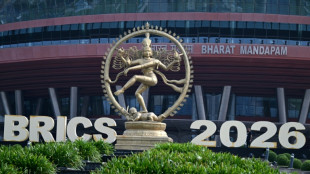 BRICS nations urge 'maximum restraint' in Middle East war

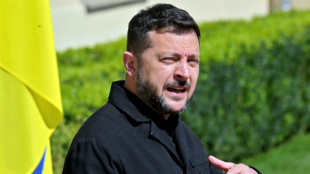 Zelensky open to meeting Putin at G20 in Miami

 England survive scare to seal 3-0 sweep against Pakistan

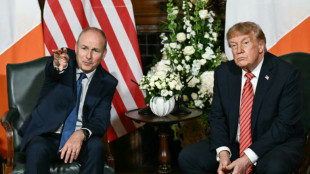 Trump says Irish unification would be 'fantastic'

Rapid developments in artificial intelligence -- and recent turmoil at industry powerhouse OpenAI -- have brought fresh attention to a key hub of ethics research related to the technology in Montreal, led by Canadian "godfather of AI" Yoshua Bengio.
Bengio -- who in 2018 shared with Geoffrey Hinton and Yann LeCun the Turing Award for their work on deep learning -- says he is worried about the technology leapfrogging human intelligence and capabilities in the not-too-distant future.
Speaking to AFP at his home in Montreal, the professor warned that AI developments are moving at breakneck speed and risked "creating a new species capable of making decisions that harm or even endanger humans."
OpenAI's recent dismissal and then rehiring a few days later of chief executive Sam Altman -- who has been accused of downplaying risks in his push to advance its ChatGPT bot -- illustrates some of the turmoil in the startup sector and fierce competition in the race to commercialize generative AI.
For some time, Bengio has been warning about companies moving too fast without guardrails, "potentially at the public's expense."
It is essential, he said, to have "rules that'll be followed by all companies."
At a world-first AI summit in Britain in early November, Bengio was tasked with leading a team producing an inaugural report on AI safety.
The aim is to set priorities to inform future work on the security of the cutting-edge technology.
- Society and AI -
The renowned AI academic has brought together a "critical mass of AI researchers" (1,000+) through his Mila research institute, located in a former working-class neighborhood of Montreal.
His neighbors include AI research facilities of American tech giants Microsoft, Meta, IBM and Google.
"This concentration of experts in artificial intelligence, which is greater than anywhere else in the world," is what attracted Google, says Hugo Larochelle, the hoodie-wearing scientific director of the Silicon Valley giant's AI subsidiary Deepmind.
Early on, these researchers began thinking about the future of AI, and consultations with the public and researchers from all disciplines led in 2018 to a global AI charter called the Montreal Declaration for a Responsible Development of Artificial Intelligence.
"We knew early on that the scientific community needed to think about the integration of AI into society," explained Guillaume Macaux, vice-president of OBVIA, an international observatory studying the social impacts of AI.
Its 220 researchers advise government policies and raise public awareness of the possible positive effects and negative impacts of this cutting-edge technology.
- Art 'demystifying AI' -
Artists too are playing a part in "demystifying AI," says Sandra Rodriguez, who splits her time making art in Montreal and teaching digital media at the prestigious Massachusetts Institute of Technology (MIT) in the United States.
She showed off to AFP her latest art installation.
Entering a breathtaking futuristic world via a virtual reality (VR) headset, the public is able to converse with a bot inspired by American linguist Noam Chomsky.
Voice and text answers to queries appear simultaneously. With the touch of a finger, lists of alternative responses considered by the AI with their associated percentage gradient pop up.
"You quickly realize that it's actually just an algorithm," said Rodriguez.
"Montreal is a fantastic playground" for exploring the potential and limits of artificial intelligence, as well as "debating (related) ethical and societal issues," she told AFP.
According to Rodriguez, art becomes "necessary more than ever" to invite "a wider public to ask questions about the issues of artificial intelligence which will affect them tomorrow."
S.Jackson--AT

