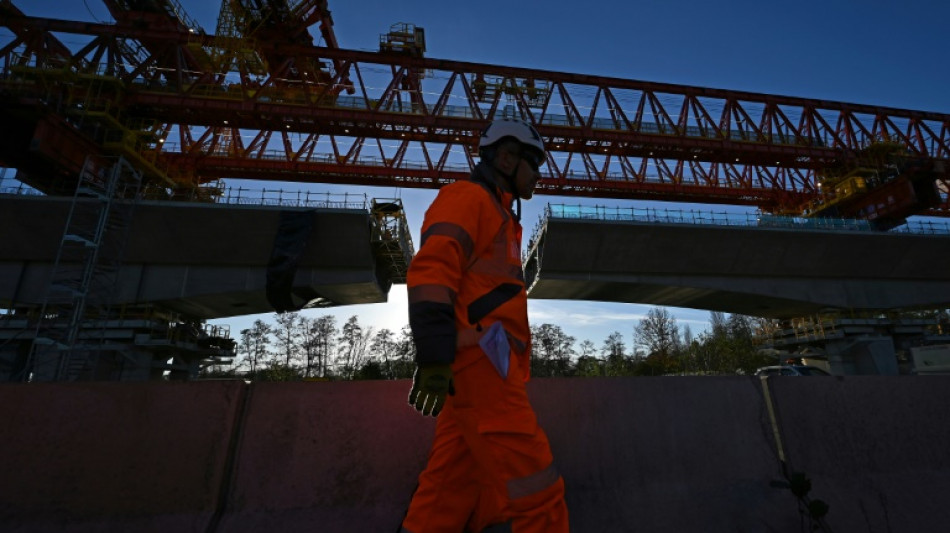
UK's HS2: trying to bridge the gap between cost and ambition / Photo: Justin TALLIS - AFP

 Arteta blasts 'unacceptable' Sunderland penalty despite Arsenal win

 Mbappe at the double as Real Madrid sink Rayo

 Arsenal extend perfect Premier League start as Chelsea, Liverpool held

 US survive Spain scare to book World Cup final clash with France

 Celine Dion makes long-awaited return to stage in Paris
 Werro crowned Ultimate queen, US sweep 100m races

 Venezuelans outside Caracas say capital not sharing blackout burden
 Danish WWII drama wins top prize at Venice festival
 Chelsea boss Alonso yearns for 'boring game' after Hull make their point

 Werro outguns Hodgkinson to win women's 800m at Ultimate

 Moreira leads AC Milan fightback in Lazio draw

 Chelsea boss Alonso for yearns for 'boring game' after Hull make their point
 'Tired' Liverpool must adapt to schedule, says Iraola

 Stunning US fightback sets up Solheim Cup singles showdown

 Monaco's perfect Ligue 1 start ends with Strasbourg draw

 Ukraine's economy hobbled by Russian strikes

 France sink Germany to reach first women's basketball World Cup final
 Hull hold Chelsea, Liverpool fail to beat Fulham in Premier League

 Nmecha and Silva keep Dortmund perfect in Bundesliga

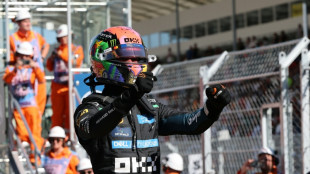 Norris snatches thrilling Spanish GP pole from Antonelli

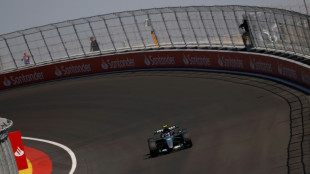 'Great to have a race at home': Fans celebrate F1's Madrid return
 French IT giant Capgemini sells subsidiary after row over ICE links

 Thousands rally in Kosovo ahead of ex-leader's war crimes verdict

 Zelensky ready to meet Putin at G20 in Miami

 Gaza film, 'irreverent' Malkovich drama vie for Venice top prize
The unfinished Colne Valley Viaduct traces a gentle curve over several lakes northwest of London, a picturesque symbol that belies the ugly debate over the ambitious but expensive HS2 train line.
The imposing viaduct is the most complex and eye-catching section of the controversial new high-speed line.
"The architect wanted the viaduct to resemble a pebble ricocheting off the water," Daniel Altier, project director for French construction firm Bouygues Travaux Publics, told AFP.
"This presented us with major technical challenges, particularly in the construction of the piers", which lift the bridge above the lakes, he added.
The French construction giant is leading a consortium of companies building the 2.1-mile (3.4-kilometre) structure, which will be the UK's longest railway bridge.
It is also leading construction of a 16-kilometre tunnel, which will pass beneath the Chiltern Hills, a designated Area of Outstanding Natural Beauty near Oxford, southern England.
Above the emerging viaduct, a gigantic red launching beam, which resembles a horizontal crane, places pre-fabricated concrete bridge sections in position one by one.
Over 600 of the 1,000 deck segments are now in place.
"A great deal of effort went into minimising noise and ensuring that the viaduct was completely integrated with the water," said Altier.
"Inevitably, compared with a much more basic viaduct, this increases the cost per kilometre."
The French group called it "the most advanced section of the HS2 project", with a scale that "defies imagination".
HS2, the UK's second high-speed line after that to the Channel Tunnel, is a totemic project in a country that lags behind its European neighbours.
The line aims to speed travel between London and some of England's major cities in central England.
But the government recently revised down its lofty ambitions, taking into account concerns of local people and the environment, which has meant more tunnels and more cost.
- Routes cut -
"Here we do not ride roughshod over the environment, over planning law, over local authorities and local people," Jon Thompson, chairman of the state-owned HS2 company, said earlier this year.
But that comes at a cost, driving up the price of the hotly contested project.
Combined, they have made HS2 one of the world's most expensive rail projects per kilometre, according to economic growth association Britain Remade, which compared infrastructure projects in 14 countries.
As a result, Downing Street recently made two cuts to the route to reduce costs, following heated debate about the costs and benefits of the project.
The project will now terminate in the city of Birmingham, central England, far from the northern hubs of Manchester and Leeds originally envisaged.
Even after amputation, and not accounting for high inflation since 2019, the line will still cost £45-54 billion ($57-68 billion) according to the latest government estimates.
The original 2013 estimate for the entire line was £37.5 billion.
The Bouygues-built tunnel and viaduct package has also seen its costs rise, from £1.2 billion at the outset to around £2 billion today.
"It's very beautiful. In the long run the railway will probably be better for it," Ben Hopkinson, researcher at Britain Remade, told AFP.
But to take on such a complex project "when we haven't really had the experience with building high speed rail for decades" is "a little bit ambitious," he said.
Completion of the Colne Valley Viaduct and Chiltern Tunnel section is scheduled for November 2025.
But they will not carry trains until the entire line is completed, which is scheduled to be between 2029 and 2033, according to latest estimates.
Th.Gonzalez--AT

